Maps and where we live
Students start the year learning to read maps and globes. They locate cities, states, and countries, and notice what makes a place feel different from the one next door.
This is the year students start to see how their own community fits into a bigger story. Students learn what a citizen does, how leaders are chosen, and why rules matter at home, in town, and in the country. They read maps, study early civilizations, and figure out why people trade and make choices about money. By spring, students can name a few founding ideas of the United States and explain a simple choice about saving or spending.
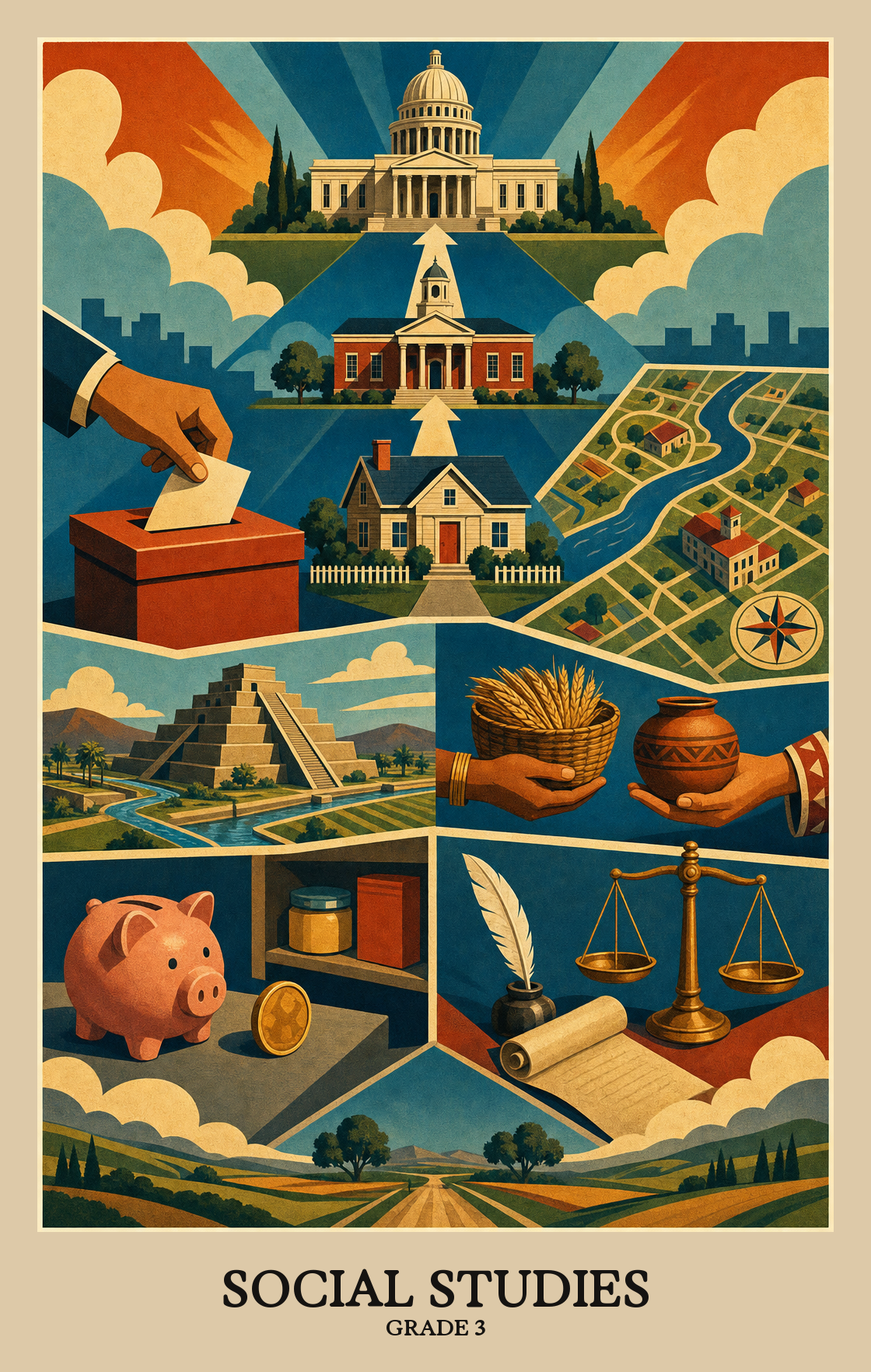
Students start the year learning to read maps and globes. They locate cities, states, and countries, and notice what makes a place feel different from the one next door.
Students learn how the United States began and why the founders wrote documents like the Declaration of Independence and the Constitution. They meet the big ideas behind American government.
Students look at what citizens do and how local, state, and federal government fit together. They talk about rights, responsibilities, voting, and ways people speak up in their community.
Students travel back to ancient civilizations and follow the world through the Middle Ages, the Renaissance, and the age of exploration. They see how trade and travel carried ideas from one place to another.
Students learn how families and businesses make decisions when they cannot have everything they want. They practice saving, spending, and budgeting with money they understand.
Students learn why the Constitution and other founding documents matter, what rules they set up for the country, and how those rules still shape the way the U.S. government works today.
Students learn about key turning points in American history and explain why those events still matter. This standard covers the big moments and time periods third graders are expected to know.
Students look at how American life has stayed the same and how it has changed over time. They study the people and groups who shaped those changes.
| Standard | Definition | Code |
|---|---|---|
| American Founding | Students learn why the Constitution and other founding documents matter, what rules they set up for the country, and how those rules still shape the way the U.S. government works today. | FL-SS.AH.3.1 |
| American Eras | Students learn about key turning points in American history and explain why those events still matter. This standard covers the big moments and time periods third graders are expected to know. | FL-SS.AH.3.2 |
| Continuity and Change | Students look at how American life has stayed the same and how it has changed over time. They study the people and groups who shaped those changes. | FL-SS.AH.3.3 |
Ancient civilizations like Egypt, Greece, and Rome built governments, traded goods, and created art and ideas that still shape the world today. Students explore how those early societies grew and what they left behind.
Students learn to place major chapters of world history in order, from the Middle Ages and Renaissance through the age of exploration and into modern times.
Trade, war, movement, and borrowed ideas all changed how ancient civilizations grew. Students study how contact between peoples, whether peaceful or violent, shaped cultures over time.
| Standard | Definition | Code |
|---|---|---|
| Ancient and Classical Civilizations | Ancient civilizations like Egypt, Greece, and Rome built governments, traded goods, and created art and ideas that still shape the world today. Students explore how those early societies grew and what they left behind. | FL-SS.WH.3.1 |
| World Eras | Students learn to place major chapters of world history in order, from the Middle Ages and Renaissance through the age of exploration and into modern times. | FL-SS.WH.3.2 |
| Global Interactions | Trade, war, movement, and borrowed ideas all changed how ancient civilizations grew. Students study how contact between peoples, whether peaceful or violent, shaped cultures over time. | FL-SS.WH.3.3 |
Students read maps and globes to find where places are and compare how big different regions are relative to each other.
Places have physical features like rivers and hills, and human features like roads and buildings. Students learn how both kinds of features can change over time.
Students learn why people move to new places, how communities grow and change over time, and how the culture of a group shapes what a neighborhood or region looks like.
| Standard | Definition | Code |
|---|---|---|
| The World in Spatial Terms | Students read maps and globes to find where places are and compare how big different regions are relative to each other. | FL-SS.GEO.3.1 |
| Places and Regions | Places have physical features like rivers and hills, and human features like roads and buildings. Students learn how both kinds of features can change over time. | FL-SS.GEO.3.2 |
| Human Systems | Students learn why people move to new places, how communities grow and change over time, and how the culture of a group shapes what a neighborhood or region looks like. | FL-SS.GEO.3.3 |
Scarcity means there is never enough of everything, so people have to choose. Students learn why individuals, families, and businesses weigh their options and give something up to get what they need most.
Markets are places where buyers and sellers agree on prices. When more people want something, the price usually rises. When sellers compete for customers, prices tend to fall. This is how a free-market economy decides who gets what.
Students practice making decisions about money: how much to save, how much to spend, and how to plan ahead so there's enough for what matters. Credit means borrowing money now and paying it back later.
| Standard | Definition | Code |
|---|---|---|
| Economic Decision Making | Scarcity means there is never enough of everything, so people have to choose. Students learn why individuals, families, and businesses weigh their options and give something up to get what they need most. | FL-SS.ECON.3.1 |
| Markets and the Economy | Markets are places where buyers and sellers agree on prices. When more people want something, the price usually rises. When sellers compete for customers, prices tend to fall. This is how a free-market economy decides who gets what. | FL-SS.ECON.3.2 |
| Personal Financial Literacy | Students practice making decisions about money: how much to save, how much to spend, and how to plan ahead so there's enough for what matters. Credit means borrowing money now and paying it back later. | FL-SS.ECON.3.3 |
Students learn why the U.S. was founded the way it was and what the Constitution and other founding documents actually say. The focus is on the basic rules and ideas that American government is built on.
Citizens have both rights (protections like free speech) and responsibilities (like following laws and voting). Students learn what it means to take part in community life as a citizen.
Students learn how the federal government in Washington, the state government in their capital, and the town or county government nearby each handle different jobs, and why those three levels work together rather than separately.
Citizens shape their community in more ways than just voting. Students learn how people run for office, speak up for a cause, and volunteer to improve life in their neighborhood or school.
| Standard | Definition | Code |
|---|---|---|
| Foundations of Government | Students learn why the U.S. was founded the way it was and what the Constitution and other founding documents actually say. The focus is on the basic rules and ideas that American government is built on. | FL-SS.CIV.3.1 |
| Roles, Rights, and Responsibilities | Citizens have both rights (protections like free speech) and responsibilities (like following laws and voting). Students learn what it means to take part in community life as a citizen. | FL-SS.CIV.3.2 |
| Government Structures | Students learn how the federal government in Washington, the state government in their capital, and the town or county government nearby each handle different jobs, and why those three levels work together rather than separately. | FL-SS.CIV.3.3 |
| Civic Engagement | Citizens shape their community in more ways than just voting. Students learn how people run for office, speak up for a cause, and volunteer to improve life in their neighborhood or school. | FL-SS.CIV.3.4 |
Federally administered sample-based assessment in reading, mathematics, science, and writing. NAEP results inform state-by-state comparisons rather than individual student or school accountability.
Students learn a little of everything: early American history, ancient civilizations, map skills, money basics, and how government works. The goal is to give students a foundation in each area before they go deeper in later grades.
Pull up a map when planning a trip or watching the news and ask students to find the city, state, and country. A globe or a placemat map works too. Five minutes a few times a week builds real comfort with where places are.
Most teachers anchor the year in geography and civics first, since those tools and vocabulary show up in every other unit. History units tend to land well in the middle and end of the year once students can place events on a map and talk about rules and leaders.
Students should understand that people cannot buy everything they want, so they make choices. They should be able to talk about saving, spending, and the basic idea of earning. Letting students handle real coins and bills at the store helps a lot.
Economic vocabulary like scarcity, trade-offs, and supply tends to slip without repeated use. The branches of government also need spiraling. Build short review moments into other units rather than saving everything for one test.
Talk through household rules and why they exist, and let students help make a small family decision by voting or listing pros and cons. Watching a local news story together and asking what the mayor or governor does makes government feel real.
Students should be able to name a few key figures and events, place them roughly in order, and explain why they mattered. Memorizing dates is less important than telling the story in their own words.
By spring, students should read a simple map, explain the basic job of each branch of government, describe a trade-off, and tell a short story from American or world history with cause and effect. If those four hold up, they are ready.
Tie it to something real: a family trip, a holiday, a coin in a pocket, or a story about an ancestor. Short documentaries and library picture books about ancient Egypt, Rome, or American history often spark more interest than a textbook page.