Thinking like a scientist
Students start the year by asking questions they can actually test. They run simple experiments, look at what happened, and explain why, instead of just guessing.
This is the year science starts to feel like real investigation. Students ask questions they can test, run simple experiments, and use what they observe to explain how things work. They study the sky and seasons, how plants and animals live and grow together, and what matter and motion actually are. By spring, students can plan a simple experiment, record what happens, and explain the results in their own words.
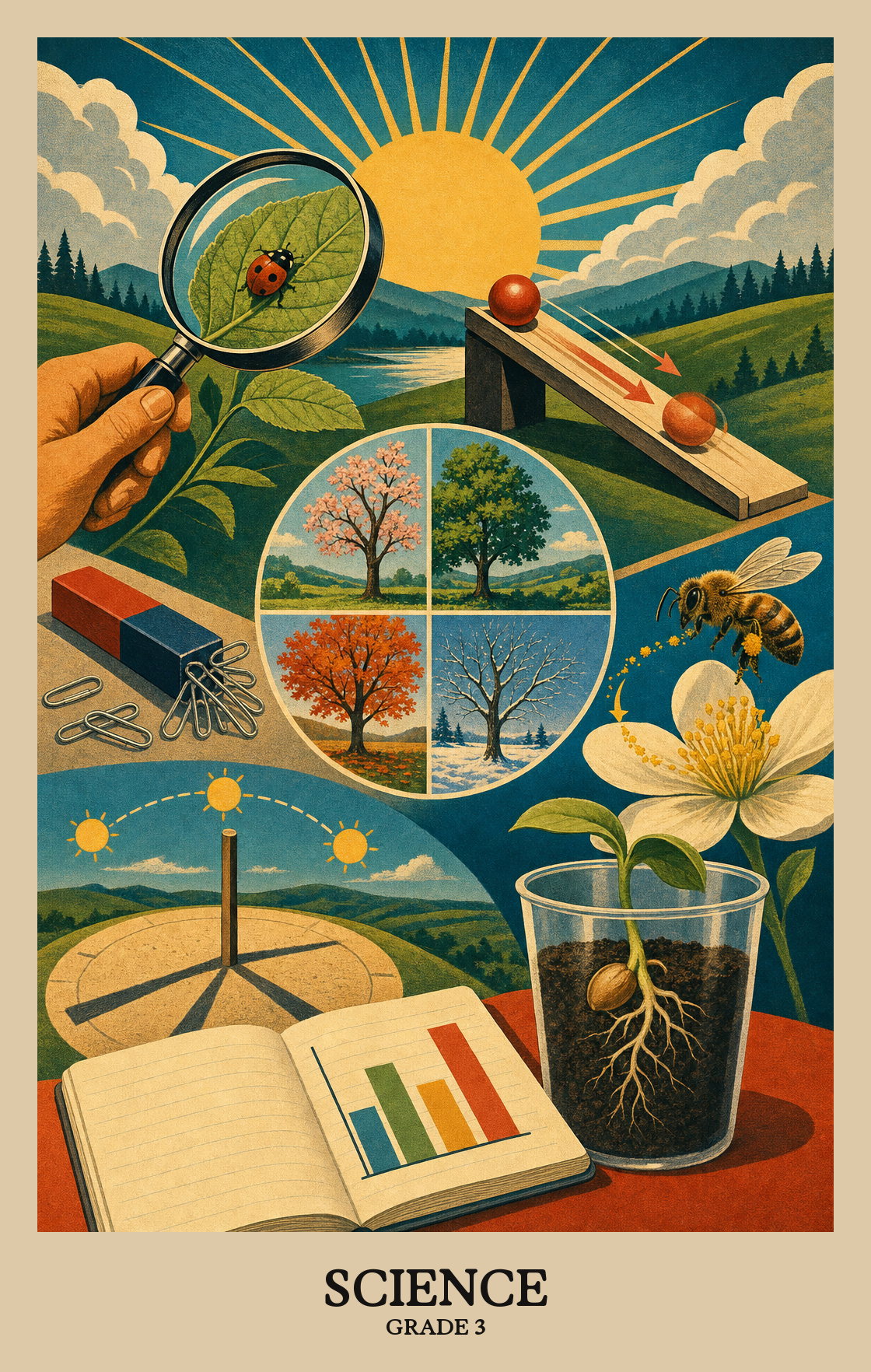
Students start the year by asking questions they can actually test. They run simple experiments, look at what happened, and explain why, instead of just guessing.
Students explore what things are made of and how they move. They push and pull objects, watch ice melt, and notice how heat, light, and sound travel from one place to another.
Students look at the ground under their feet and the sky above them. They track weather, talk about why day turns to night, and notice how the seasons change through the year.
Students study plants, animals, and the places they live. They learn how living things grow, have babies, and depend on each other for food, shelter, and survival.
Students ask a question they can test with an experiment, then collect and examine results to figure out what the evidence shows.
Scientists update their ideas when new evidence comes in. Students learn how scientists test, question, and check each other's work to make sure conclusions hold up.
A hypothesis is a testable guess. A theory explains why something happens, and a law describes what always happens. Students learn to tell these apart and use each one to explain what they observe in nature.
| Standard | Definition | Code |
|---|---|---|
| The Practice of Science | Students ask a question they can test with an experiment, then collect and examine results to figure out what the evidence shows. | FL-SCI.NATURE.3.1 |
| The Characteristics of Scientific Knowledge | Scientists update their ideas when new evidence comes in. Students learn how scientists test, question, and check each other's work to make sure conclusions hold up. | FL-SCI.NATURE.3.2 |
| The Role of Theories, Laws, and Models | A hypothesis is a testable guess. A theory explains why something happens, and a law describes what always happens. Students learn to tell these apart and use each one to explain what they observe in nature. | FL-SCI.NATURE.3.3 |
Students learn why we have day, night, and seasons by studying how Earth moves around the Sun and spins on its axis. They recognize patterns in sunlight and temperature that repeat throughout the year.
Students learn what makes up the ground beneath their feet, the water around the planet, and the air above it. They explore how these three layers of Earth connect and change over time.
Students learn why weather follows patterns and why some places are hot, rainy, or cold year after year. They look at what shapes a region's climate, like its distance from the equator or the ocean nearby.
| Standard | Definition | Code |
|---|---|---|
| Earth in Space and Time | Students learn why we have day, night, and seasons by studying how Earth moves around the Sun and spins on its axis. They recognize patterns in sunlight and temperature that repeat throughout the year. | FL-SCI.ESS.3.1 |
| Earth's Structures | Students learn what makes up the ground beneath their feet, the water around the planet, and the air above it. They explore how these three layers of Earth connect and change over time. | FL-SCI.ESS.3.2 |
| Weather and Climate | Students learn why weather follows patterns and why some places are hot, rainy, or cold year after year. They look at what shapes a region's climate, like its distance from the equator or the ocean nearby. | FL-SCI.ESS.3.3 |
Living things are built from tiny cells, the way a wall is built from bricks. Students learn how those cells join together to form tissues, organs, and finally a whole living body.
Students learn how living things make offspring, grow from young to adult, and pass traits like color or size to the next generation.
Students learn why living things look and behave differently from one another, and how plants and animals have slowly changed over long stretches of time to survive in their environments.
Plants, animals, and other living things depend on each other to survive. Students learn how food, water, and nutrients move through an ecosystem, cycling from one living thing to the next.
| Standard | Definition | Code |
|---|---|---|
| Organization and Development | Living things are built from tiny cells, the way a wall is built from bricks. Students learn how those cells join together to form tissues, organs, and finally a whole living body. | FL-SCI.LS.3.1 |
| Heredity and Reproduction | Students learn how living things make offspring, grow from young to adult, and pass traits like color or size to the next generation. | FL-SCI.LS.3.2 |
| Diversity and Evolution | Students learn why living things look and behave differently from one another, and how plants and animals have slowly changed over long stretches of time to survive in their environments. | FL-SCI.LS.3.3 |
| Interdependence | Plants, animals, and other living things depend on each other to survive. Students learn how food, water, and nutrients move through an ecosystem, cycling from one living thing to the next. | FL-SCI.LS.3.4 |
Students sort and describe everyday materials, like wood, water, and metal, by their physical properties. They also observe what happens when matter changes form, such as ice melting or clay being shaped.
Sound, light, and heat are all forms of energy. Students learn how energy moves from one place to another and why the total amount of energy in a system stays the same even when it changes form.
Students learn how pushes and pulls move objects, and why some things speed up, slow down, or change direction. They explore how the size of a force affects how far or fast something moves.
| Standard | Definition | Code |
|---|---|---|
| Properties of Matter | Students sort and describe everyday materials, like wood, water, and metal, by their physical properties. They also observe what happens when matter changes form, such as ice melting or clay being shaped. | FL-SCI.PS.3.1 |
| Forms of Energy | Sound, light, and heat are all forms of energy. Students learn how energy moves from one place to another and why the total amount of energy in a system stays the same even when it changes form. | FL-SCI.PS.3.2 |
| Forces and Motion | Students learn how pushes and pulls move objects, and why some things speed up, slow down, or change direction. They explore how the size of a force affects how far or fast something moves. | FL-SCI.PS.3.3 |
Federally administered sample-based assessment in reading, mathematics, science, and writing. NAEP results inform state-by-state comparisons rather than individual student or school accountability.
Students ask questions they can actually test, plan simple investigations, and explain what they found using evidence. They study weather and the sky, plants and animals, and how things move and change. The focus is on doing science, not just reading about it.
Talk through everyday questions like why puddles dry up, why the moon looks different each night, or what plants need to grow. Ask students what they think will happen and why, then check together. Five minutes of wondering out loud goes a long way.
Most students who say this mean they hate reading about science. Try doing something instead: mix baking soda and vinegar, plant a bean in a cup, or track the weather for a week. Curiosity usually comes back once their hands are busy.
A common path is nature of science first, then physical science, then life science, then earth and space, with investigation skills woven through every unit. Start with short, hands-on labs so students learn to ask testable questions before tackling bigger content.
The hardest ideas are usually the abstract ones: energy transfer, the difference between weather and climate, and how matter changes without disappearing. Plan extra hands-on time for these, and expect to revisit them more than once.
Some words matter, like evidence, hypothesis, matter, and energy. But understanding the idea is more important than reciting a definition. If students can explain it in their own words and give an example, they know it.
A good investigation has a question students can actually test, a fair way to test it, and a result they can explain with evidence. Keep variables simple, like one cup in sun and one in shade. The thinking matters more than the materials.
By spring, students should be able to ask a testable question, plan a simple investigation, and explain results using what they observed. They should also be able to talk about weather patterns, living things and their needs, and how forces make things move.