Moving with purpose
Students start the year exploring how their bodies move through space, using different levels, speeds, and shapes. They learn the basic vocabulary dancers use to talk about movement.
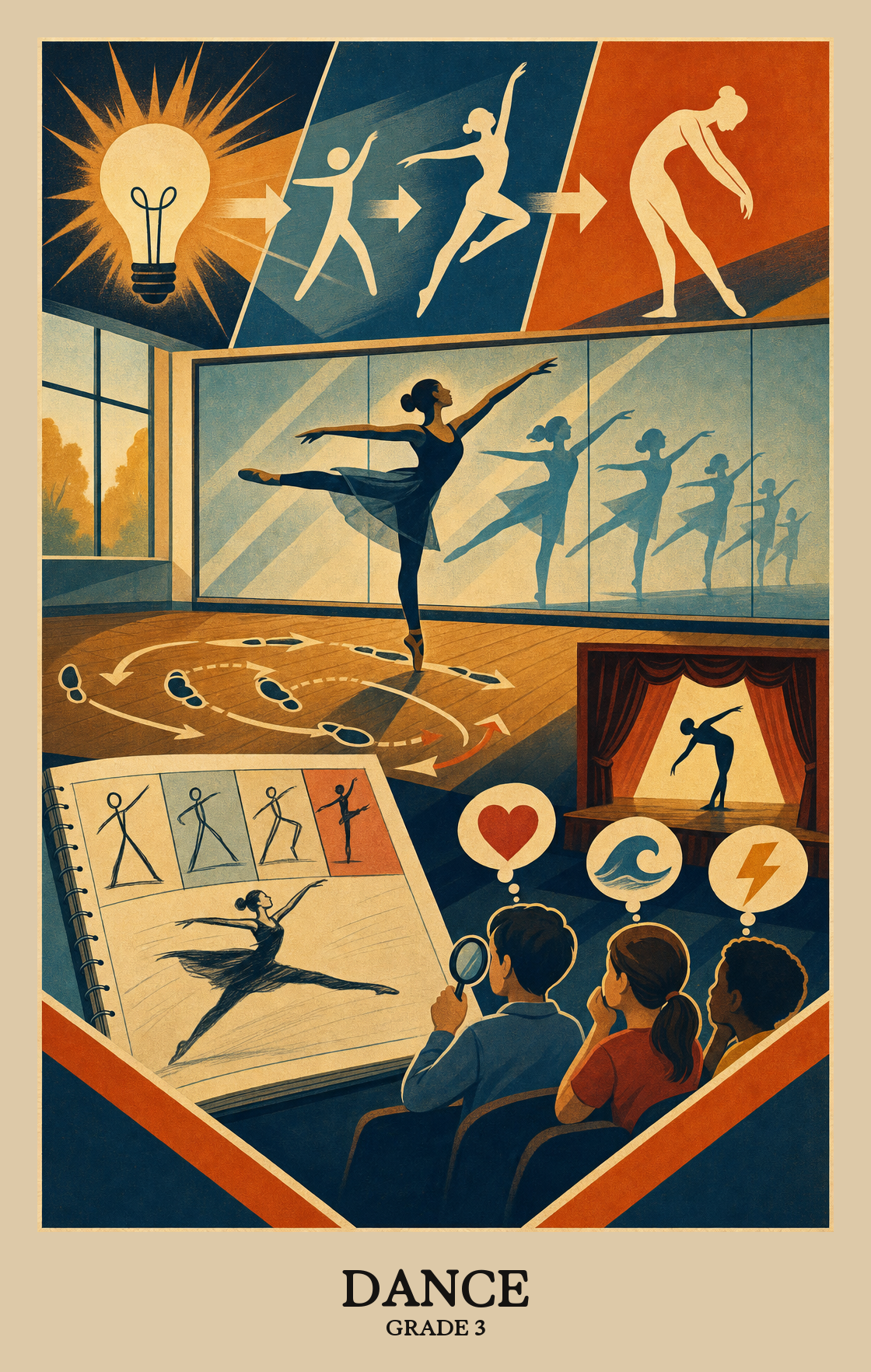
This is the year dance becomes intentional. Students start with an idea, shape it into movement, and practice it until a short piece is ready to share. They learn to watch dances closely and talk about what the choreographer was trying to say. By spring, students can build a short dance with a clear beginning and ending and explain the idea behind it.
Students start the year exploring how their bodies move through space, using different levels, speeds, and shapes. They learn the basic vocabulary dancers use to talk about movement.
Students turn ideas, stories, and personal experiences into short dances of their own. They practice picking movements on purpose instead of just moving randomly.
Students take a rough dance and make it better. They rehearse, fix the parts that feel unclear, and learn techniques that help a dance read to an audience.
Students share dances in front of classmates and try to communicate a clear idea or feeling through their movement. They learn what it takes to be ready to perform.
Students watch dances, including ones from other cultures and time periods, and talk about what they notice. They use simple criteria to say what works and why.
Students connect something from their own life to a dance they make or study, explaining why that personal link changes how they understand the movement.
Students look at a dance and think about where it comes from: the culture, the time period, or the community that shaped it. That context helps them understand why the dance looks and feels the way it does.
| Standard | Definition | Code |
|---|---|---|
| Synthesize and relate knowledge and personal experiences to make art | Students connect something from their own life to a dance they make or study, explaining why that personal link changes how they understand the movement. | DA:Cn10.3 |
| Relate artistic ideas and works with societal, cultural | Students look at a dance and think about where it comes from: the culture, the time period, or the community that shaped it. That context helps them understand why the dance looks and feels the way it does. | DA:Cn11.3 |
Students brainstorm movement ideas and start shaping them into a short dance. They explore different ways their body can move before deciding what to keep.
Students take a dance idea and shape it into a short sequence, choosing which movements to keep, change, or put in order.
Students revisit a dance they have been building, make changes to improve it, and practice until it feels finished and ready to share.
| Standard | Definition | Code |
|---|---|---|
| Generate and conceptualize artistic ideas and work | Students brainstorm movement ideas and start shaping them into a short dance. They explore different ways their body can move before deciding what to keep. | DA:Cr1.3 |
| Organize and develop artistic ideas and work | Students take a dance idea and shape it into a short sequence, choosing which movements to keep, change, or put in order. | DA:Cr2.3 |
| Refine and complete artistic work | Students revisit a dance they have been building, make changes to improve it, and practice until it feels finished and ready to share. | DA:Cr3.3 |
Students choose which dances or movements to perform and explain why those choices fit the moment. They start learning to think like a performer, not just a mover.
Students practice a dance sequence, then improve it before performing for an audience. The focus is on clean movement and making deliberate choices about how the dance looks and feels.
Students perform a dance for an audience with a clear purpose, using movement choices to express an idea or feeling rather than just going through the steps.
| Standard | Definition | Code |
|---|---|---|
| Analyze, interpret, and select artistic work for presentation | Students choose which dances or movements to perform and explain why those choices fit the moment. They start learning to think like a performer, not just a mover. | DA:Pr4.3 |
| Develop and refine artistic techniques and work for presentation | Students practice a dance sequence, then improve it before performing for an audience. The focus is on clean movement and making deliberate choices about how the dance looks and feels. | DA:Pr5.3 |
| Convey meaning through the presentation of artistic work | Students perform a dance for an audience with a clear purpose, using movement choices to express an idea or feeling rather than just going through the steps. | DA:Pr6.3 |
Students watch a dance and describe what they notice, such as how the dancer moves fast or slow, uses big or small movements, or changes direction. They start to explain why those choices matter.
Students describe what a dance is trying to say and explain why specific movements or sequences give them that impression.
Students look at a dance performance and explain what makes it work well or fall short, using specific reasons rather than just saying they liked it or didn't.
| Standard | Definition | Code |
|---|---|---|
| Perceive and analyze artistic work | Students watch a dance and describe what they notice, such as how the dancer moves fast or slow, uses big or small movements, or changes direction. They start to explain why those choices matter. | DA:Re7.3 |
| Interpret intent and meaning in artistic work | Students describe what a dance is trying to say and explain why specific movements or sequences give them that impression. | DA:Re8.3 |
| Apply criteria to evaluate artistic work | Students look at a dance performance and explain what makes it work well or fall short, using specific reasons rather than just saying they liked it or didn't. | DA:Re9.3 |
Students make up short dances on purpose, learn steps from a teacher, and perform for others. They also watch dance and talk about what it makes them feel or think. The focus is on using the body to tell an idea, not on being a trained dancer.
Put on music and ask what story the song could tell, then move to it together for a few minutes. Ask what shape the body is making, whether it is fast or slow, and high or low. Five minutes of moving and talking goes a long way.
Dance at this age is about making and sharing ideas, not about looking like a dancer on TV. Praise specific choices, like a strong freeze or a slow turn, instead of saying it looked pretty. That keeps the focus on thinking, not performing.
Start with body awareness and the basics of space, time, and energy, then move into making short phrases. By midyear students can string movements together with a clear beginning and end. Save group pieces and audience performance for the second half once vocabulary is solid.
The hardest part is shaping a dance with intent rather than moving randomly to music. Students also struggle to give feedback that goes past liked it or did not like it. Plan extra time for revising a phrase and for using dance words when talking about a peer's work.
Students should see dance from different places and times and notice what is similar and different. Keep it concrete, such as a folk dance from one country next to a dance from another. The goal is curiosity and respect, not memorizing names and dates.
Sharing work is part of the year, but it can be small, like dancing for one other class or a short video sent home. Practice at home by asking for a ten-second dance about a feeling or a weather word. Low stakes builds confidence for the bigger share.
By spring students should be able to plan a short dance with a partner, perform it with control, and say what it was about. They should also be able to watch a classmate's dance and point to one thing that worked and one thing to try. That is the bar for moving on.