Me, my family, and school
Students start the year learning what it means to be part of a group. They talk about their family, their classroom, and the rules that help everyone get along.
This is the year the world outside home starts to make sense as a place with rules, jobs, and neighbors. Students learn what it means to be part of a class and a country, with leaders, flags, and simple rules everyone follows. They look at maps and globes, talk about where they live, and notice how families earn money and decide what to buy. By spring, students can name a few national symbols, point out their state on a map, and explain why people take turns and share.
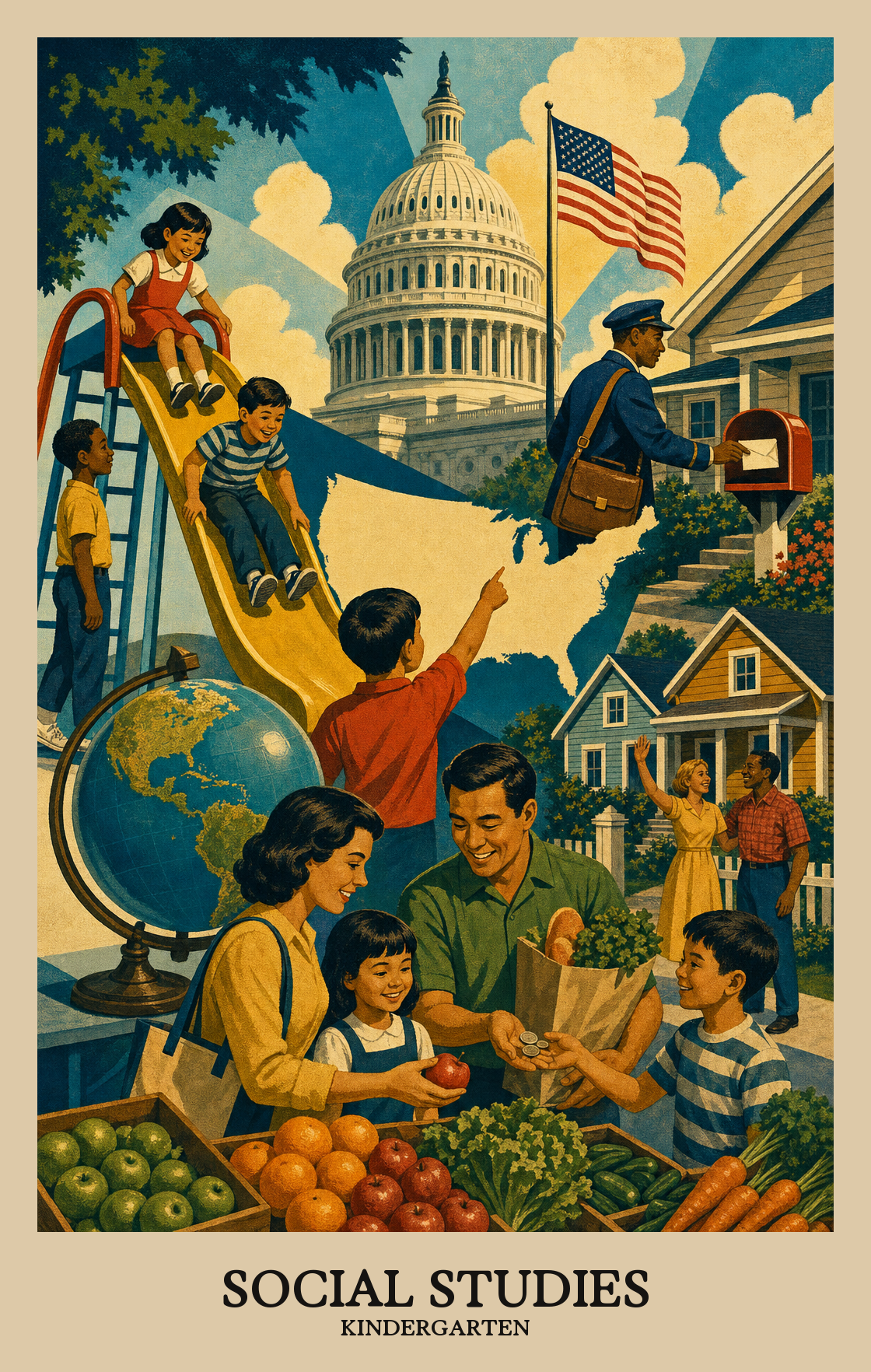
Students start the year learning what it means to be part of a group. They talk about their family, their classroom, and the rules that help everyone get along.
Students look at where they live and how to describe it. They use simple maps and globes to find their school, their state, and the country around them.
Students learn the songs, flags, and stories that connect people across the country. They hear about leaders from the past and the holidays that honor them.
Students compare life today with life in the past and in other parts of the world. They notice how clothes, homes, and tools change over time and place.
Students learn the difference between things they need and things they want. They talk about saving coins, taking turns, and the jobs people do to earn money.
Students wrap up the year thinking about how to help others at school and at home. They practice voting on simple choices and learn what leaders do for a community.
Students learn why the United States was created and what its earliest rules say. They look at documents like the Constitution to understand how the country's government is supposed to work.
Students learn about big moments in American history, like the Pilgrims landing or the first Fourth of July. They talk about why those events still matter today.
Students look at how life in America has stayed the same over time and how it has changed. They learn about real people and groups who helped shape those changes.
| Standard | Definition | Code |
|---|---|---|
| American Founding | Students learn why the United States was created and what its earliest rules say. They look at documents like the Constitution to understand how the country's government is supposed to work. | FL-SS.AH.K.1 |
| American Eras | Students learn about big moments in American history, like the Pilgrims landing or the first Fourth of July. They talk about why those events still matter today. | FL-SS.AH.K.2 |
| Continuity and Change | Students look at how life in America has stayed the same over time and how it has changed. They learn about real people and groups who helped shape those changes. | FL-SS.AH.K.3 |
Kindergartners look at some of the world's earliest communities, like ancient Egypt or Greece, and learn how those people lived, ruled themselves, and traded with others.
Kindergartners learn that history is divided into big chunks of time, each with its own way of living. This standard introduces a few of those chunks, like the Middle Ages and the Renaissance, so students can start to see how the world changed over time.
Students learn that people from different places have always traded goods, fought, moved to new lands, and shared ideas with each other. Those interactions changed how everyone lived.
| Standard | Definition | Code |
|---|---|---|
| Ancient and Classical Civilizations | Kindergartners look at some of the world's earliest communities, like ancient Egypt or Greece, and learn how those people lived, ruled themselves, and traded with others. | FL-SS.WH.K.1 |
| World Eras | Kindergartners learn that history is divided into big chunks of time, each with its own way of living. This standard introduces a few of those chunks, like the Middle Ages and the Renaissance, so students can start to see how the world changed over time. | FL-SS.WH.K.2 |
| Global Interactions | Students learn that people from different places have always traded goods, fought, moved to new lands, and shared ideas with each other. Those interactions changed how everyone lived. | FL-SS.WH.K.3 |
Students look at maps and globes to find where places are and compare how big or small different areas are.
Students learn that places have features like hills, water, and buildings, and that those features can change as people move in or build new things.
Students learn why people move to new places and how groups of people, once settled, shape what a neighborhood or town looks, sounds, and feels like.
| Standard | Definition | Code |
|---|---|---|
| The World in Spatial Terms | Students look at maps and globes to find where places are and compare how big or small different areas are. | FL-SS.GEO.K.1 |
| Places and Regions | Students learn that places have features like hills, water, and buildings, and that those features can change as people move in or build new things. | FL-SS.GEO.K.2 |
| Human Systems | Students learn why people move to new places and how groups of people, once settled, shape what a neighborhood or town looks, sounds, and feels like. | FL-SS.GEO.K.3 |
Scarcity means there is never enough of everything to go around. Students learn why people, families, and businesses have to choose what to spend money or time on, and what they give up when they make that choice.
Markets are places where people buy and sell things. When more people want something, the price usually goes up. When stores compete for customers, prices tend to come down.
Saving means setting money aside instead of spending it now. Students learn to think about wants versus needs, how to make simple money choices, and why keeping some money for later can matter.
| Standard | Definition | Code |
|---|---|---|
| Economic Decision Making | Scarcity means there is never enough of everything to go around. Students learn why people, families, and businesses have to choose what to spend money or time on, and what they give up when they make that choice. | FL-SS.ECON.K.1 |
| Markets and the Economy | Markets are places where people buy and sell things. When more people want something, the price usually goes up. When stores compete for customers, prices tend to come down. | FL-SS.ECON.K.2 |
| Personal Financial Literacy | Saving means setting money aside instead of spending it now. Students learn to think about wants versus needs, how to make simple money choices, and why keeping some money for later can matter. | FL-SS.ECON.K.3 |
Students learn why America has rules and who made them. They get a first look at documents like the Constitution and what it means to live in a country where everyone follows the same laws.
Students learn what it means to follow rules, help others, and take part in their community. They practice the basic habits of being a good citizen at school and at home.
Students learn that governments work at different levels: the town, the state, and the whole country. Each level handles different jobs, and they work together to make and follow rules.
Students learn how people take part in their community by voting, speaking up for what they believe in, and helping others. These are the basic habits of being a good citizen.
| Standard | Definition | Code |
|---|---|---|
| Foundations of Government | Students learn why America has rules and who made them. They get a first look at documents like the Constitution and what it means to live in a country where everyone follows the same laws. | FL-SS.CIV.K.1 |
| Roles, Rights, and Responsibilities | Students learn what it means to follow rules, help others, and take part in their community. They practice the basic habits of being a good citizen at school and at home. | FL-SS.CIV.K.2 |
| Government Structures | Students learn that governments work at different levels: the town, the state, and the whole country. Each level handles different jobs, and they work together to make and follow rules. | FL-SS.CIV.K.3 |
| Civic Engagement | Students learn how people take part in their community by voting, speaking up for what they believe in, and helping others. These are the basic habits of being a good citizen. | FL-SS.CIV.K.4 |
Federally administered sample-based assessment in reading, mathematics, science, and writing. NAEP results inform state-by-state comparisons rather than individual student or school accountability.
Students learn about the people and places in their own world first. That means family, school, neighborhood, and community helpers like firefighters and mail carriers. They also start using simple maps and learn a few American symbols, like the flag and the Pledge of Allegiance.
Talk about your family and where relatives live. Point out the flag, talk about rules at home, and let students help with small jobs like sorting coins or setting the table. A short walk around the block and a chat about what you see counts as geography at this age.
At this age it is mostly stories and pictures, not dates. Students hear about a few key people and holidays, like Washington, Lincoln, Thanksgiving, and the Fourth of July. Reading a picture book about one of these once a week is plenty.
Most teachers start with self, family, and classroom rules in the fall, move to community helpers and maps in the winter, and save American symbols, holidays, and basic economics for the spring. Pulling civics into daily routines, like classroom jobs and voting on a book, spreads the work out.
Keep it concrete. Students should know the difference between needs and wants, recognize coins, and understand that people work to earn money and trade it for things. A pretend store or a classroom job chart covers most of it.
Students should know that a map is a picture of a real place from above. They should point to land and water on a globe, follow a simple classroom or playground map, and use words like near, far, left, and right to describe location.
Rules versus laws and the idea of government tend to stay fuzzy. So does the difference between a need and a want once candy enters the conversation. Short, repeated examples tied to the classroom work better than one big lesson.
By June, students should name the country, state, and city they live in, recognize the flag and a few national holidays, follow classroom rules, and explain one job a community helper does. They should also sort items into needs and wants with a quick example.