Moving and exploring space
Students learn how their bodies move through space. They try high and low movements, fast and slow, and practice using their own space without bumping into others.
This is the year movement becomes a way to tell a story. Students explore how their bodies can stretch, jump, freeze, and travel through space with purpose. They make up short dances based on ideas they care about, then watch classmates and share what they noticed. By spring, students can perform a simple dance for the class and explain what it was about.
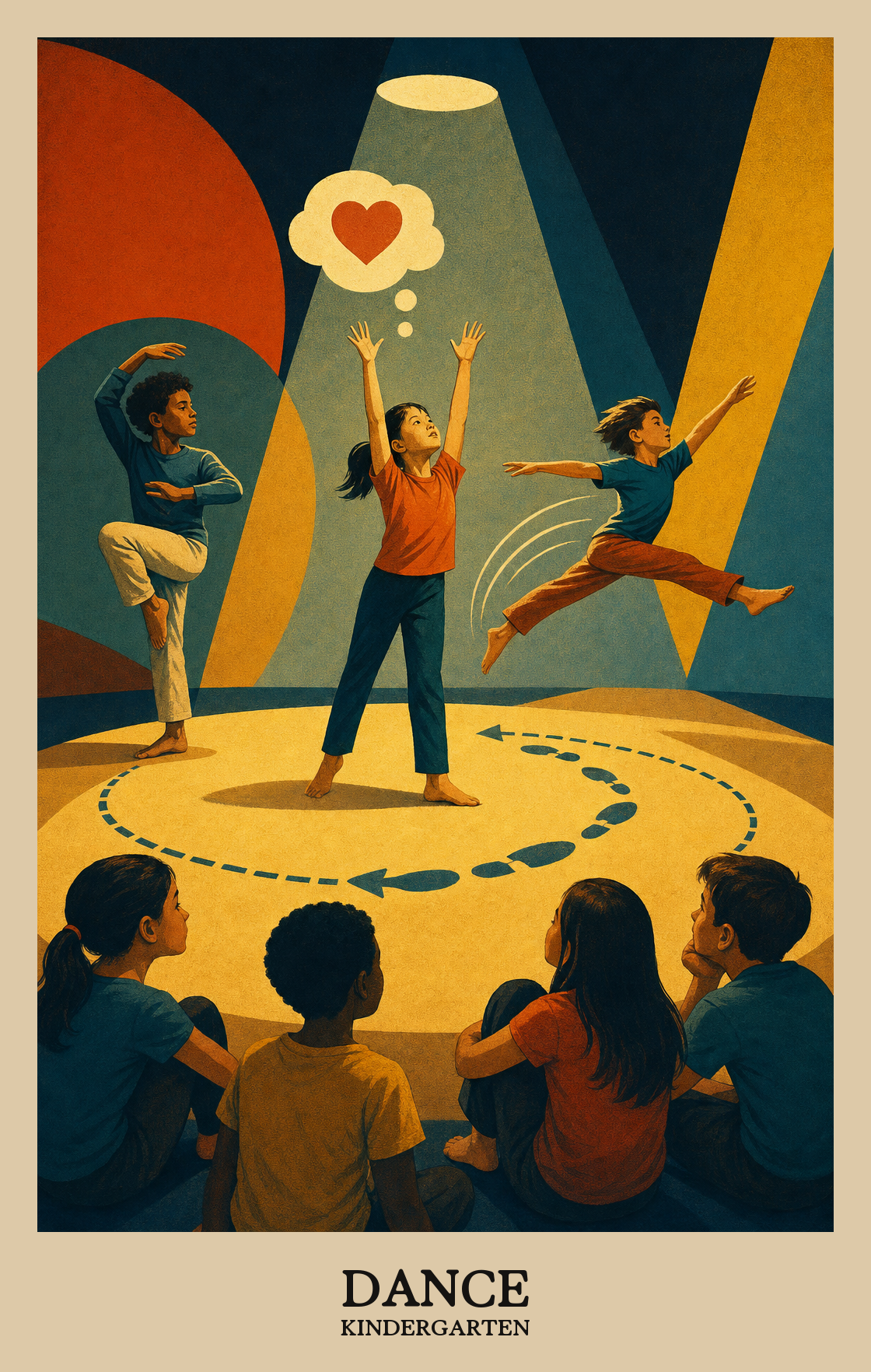
Students learn how their bodies move through space. They try high and low movements, fast and slow, and practice using their own space without bumping into others.
Students invent their own dance moves from ideas they pick, like animals, weather, or a favorite story. They string a few movements together into a short sequence.
Students take the moves they made up and clean them up for an audience. They practice a clear start, a middle, and an ending, and learn to show feeling through movement.
Students perform short dances for classmates and watch others dance. They talk about what they noticed, what the dance reminded them of, and what they liked.
Students connect something from their own life to a dance they make or watch. A memory, a feeling, or something they know helps shape the movement.
Students connect dances they see or perform to the world around them, noticing how a dance might tell a story about where people live, what they celebrate, or how life looked long ago.
| Standard | Definition | Code |
|---|---|---|
| Synthesize and relate knowledge and personal experiences to make art | Students connect something from their own life to a dance they make or watch. A memory, a feeling, or something they know helps shape the movement. | DA:Cn10.k |
| Relate artistic ideas and works with societal, cultural | Students connect dances they see or perform to the world around them, noticing how a dance might tell a story about where people live, what they celebrate, or how life looked long ago. | DA:Cn11.k |
Students come up with their own ideas for how to move their bodies and start turning those ideas into a dance.
Students arrange movements into a short sequence with a clear beginning and end, turning individual ideas into a simple dance.
Students revisit a dance they made and make small changes until it feels finished and ready to share.
| Standard | Definition | Code |
|---|---|---|
| Generate and conceptualize artistic ideas and work | Students come up with their own ideas for how to move their bodies and start turning those ideas into a dance. | DA:Cr1.k |
| Organize and develop artistic ideas and work | Students arrange movements into a short sequence with a clear beginning and end, turning individual ideas into a simple dance. | DA:Cr2.k |
| Refine and complete artistic work | Students revisit a dance they made and make small changes until it feels finished and ready to share. | DA:Cr3.k |
Students pick a dance or movement to share with others and practice showing it clearly.
Students practice a dance move, then try it again to make it cleaner and more controlled before showing it to others.
Students pick a dance they've practiced and perform it for others. The movement itself is how they share an idea or feeling.
| Standard | Definition | Code |
|---|---|---|
| Analyze, interpret, and select artistic work for presentation | Students pick a dance or movement to share with others and practice showing it clearly. | DA:Pr4.k |
| Develop and refine artistic techniques and work for presentation | Students practice a dance move, then try it again to make it cleaner and more controlled before showing it to others. | DA:Pr5.k |
| Convey meaning through the presentation of artistic work | Students pick a dance they've practiced and perform it for others. The movement itself is how they share an idea or feeling. | DA:Pr6.k |
Students watch a dance and talk about what they see, noticing how the body moves and what the movement makes them feel.
Students look at a dance someone else created and talk about what they think it means or how it makes them feel.
Students watch a dance and say what they noticed, like which movements felt strong or matched the music. They practice having a reason for what they think.
| Standard | Definition | Code |
|---|---|---|
| Perceive and analyze artistic work | Students watch a dance and talk about what they see, noticing how the body moves and what the movement makes them feel. | DA:Re7.k |
| Interpret intent and meaning in artistic work | Students look at a dance someone else created and talk about what they think it means or how it makes them feel. | DA:Re8.k |
| Apply criteria to evaluate artistic work | Students watch a dance and say what they noticed, like which movements felt strong or matched the music. They practice having a reason for what they think. | DA:Re9.k |
Students explore how their bodies move through space. They try different shapes, speeds, and levels, like high and low or fast and slow. They also make up short movement ideas based on stories, animals, or feelings, and watch each other dance.
Put on music and ask students to move like something specific, such as a falling leaf, a busy bee, or a sleepy bear. Five minutes is plenty. The goal is trying out movement ideas, not learning steps.
No. The focus is on movement basics and making up simple dances, not formal training. Students learn that dance is a way to show ideas and feelings with their bodies.
Start with body awareness and safe movement in shared space. Move into elements like shape, level, speed, and direction. Spend the second half on making short dances from prompts and sharing them with the class.
Students can move safely around others, copy and create simple movement patterns, and show a clear beginning, middle, and end in a short dance. They can also say one thing they noticed when a classmate performs.
Personal space and self-control during music. Many students also need repeated practice with stopping on a signal and holding a still shape. Build these into warm-ups all year, not just at the start.
Dance alongside them at home so it feels like play, not performance. Ask them to teach a short move to a stuffed animal or sibling. Small, low-pressure practice builds the confidence to join in at school.
Ask simple questions after watching a short clip or a classmate. What did the movement remind you of? Was it fast or slow, big or small? Naming what they see is the start of analyzing and responding to dance.