Letters, sounds, and print
Students learn how books work, from holding them right-side up to following words left to right. They name letters, match each to its sound, and start hearing the separate sounds inside spoken words.
This is the year letters start sounding like words. Students learn the names and sounds of every letter, then blend those sounds to read short, simple words like cat and sun. They also listen to stories read aloud and talk about what happened, who was in it, and what it meant. By spring, students can write their name, sound out simple words on their own, and retell a favorite story in order.
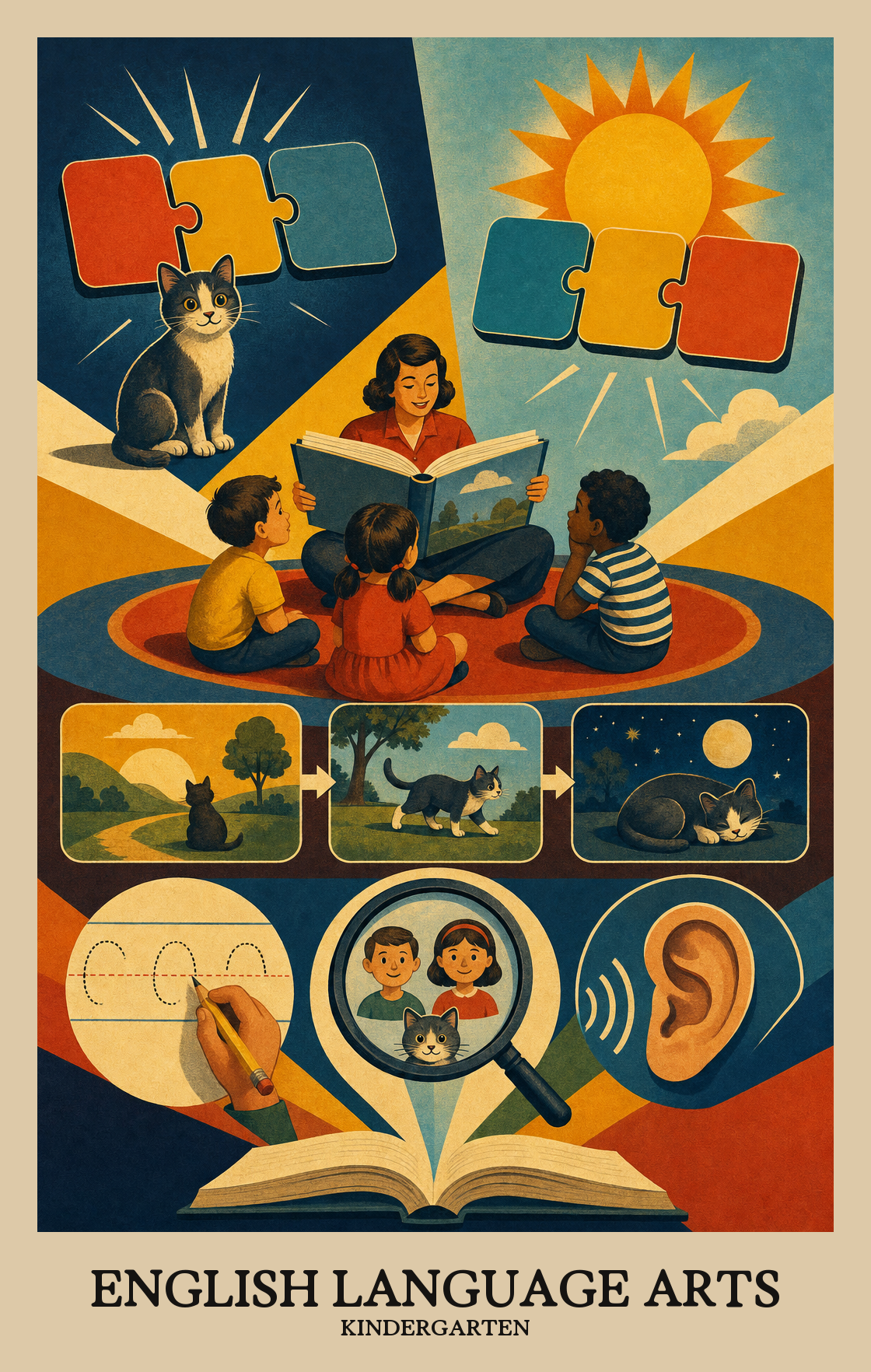
Students learn how books work, from holding them right-side up to following words left to right. They name letters, match each to its sound, and start hearing the separate sounds inside spoken words.
Students stretch and blend sounds to read short words like cat, sun, and pig. They also start writing letters and labeling pictures with the sounds they hear.
Students read simple books and listen to longer stories read aloud. They talk about the characters, what happens, and the lesson, and they answer questions using what they saw on the page.
Students explore books about real topics like animals, weather, and community helpers. They pick out the main idea, learn new words, and compare what two books say about the same thing.
Students write short pieces that tell a story, share facts, or give an opinion, using pictures and words together. They speak in full sentences when sharing their work and listen while classmates share theirs.
Students connect what they already know to what they read. They notice how ideas in one story or book link to ideas in another.
Students read simple books aloud smoothly and accurately, understanding what they read. At this level, that means short sentences and familiar words.
Reading a sentence or picture isn't enough on its own. Students use clues from the story to figure out something the author didn't say directly.
Students back up what they say about a story or book by pointing to something in the text or connecting it to something they already know.
Students write letters and words correctly and speak in clear, complete sentences. This includes using capital letters, spaces between words, and proper punctuation as they learn to put thoughts on paper and share ideas out loud.
Students listen to stories and discuss what it means to be honest, kind, and a good member of their community.
| Standard | Definition | Code |
|---|---|---|
| Think Critically | Students connect what they already know to what they read. They notice how ideas in one story or book link to ideas in another. | FL-ELA.EE.K.1 |
| Read Fluently | Students read simple books aloud smoothly and accurately, understanding what they read. At this level, that means short sentences and familiar words. | FL-ELA.EE.K.2 |
| Make Inferences | Reading a sentence or picture isn't enough on its own. Students use clues from the story to figure out something the author didn't say directly. | FL-ELA.EE.K.3 |
| Use Evidence | Students back up what they say about a story or book by pointing to something in the text or connecting it to something they already know. | FL-ELA.EE.K.4 |
| Communicate Effectively | Students write letters and words correctly and speak in clear, complete sentences. This includes using capital letters, spaces between words, and proper punctuation as they learn to put thoughts on paper and share ideas out loud. | FL-ELA.EE.K.5 |
| Engage with Civics and Character | Students listen to stories and discuss what it means to be honest, kind, and a good member of their community. | FL-ELA.EE.K.6 |
Students learn that print works in a specific order: left to right, top to bottom, one word at a time. They also recognize where a book starts, where sentences begin and end, and what spaces between words mean.
Students learn to hear individual sounds in spoken words, put sounds together to make a word, and break words apart into separate sounds.
Students use letter-sound rules to sound out and read words correctly. This is the decoding work that makes reading click.
Students read simple books aloud at a steady pace, saying each word correctly and using a natural tone, the way people talk in real life.
| Standard | Definition | Code |
|---|---|---|
| Print Concepts | Students learn that print works in a specific order: left to right, top to bottom, one word at a time. They also recognize where a book starts, where sentences begin and end, and what spaces between words mean. | FL-ELA.F.K.1 |
| Phonological Awareness | Students learn to hear individual sounds in spoken words, put sounds together to make a word, and break words apart into separate sounds. | FL-ELA.F.K.2 |
| Phonics and Word Analysis | Students use letter-sound rules to sound out and read words correctly. This is the decoding work that makes reading click. | FL-ELA.F.K.3 |
| Fluency | Students read simple books aloud at a steady pace, saying each word correctly and using a natural tone, the way people talk in real life. | FL-ELA.F.K.4 |
Students listen to stories and talk about what happens, who the characters are, and what lesson the story teaches. This is the start of understanding how stories work.
Students listen to stories and talk about why the author picked certain words. They notice how word choices make a story feel happy, scary, or funny.
Students find the big idea in a story or book and track how it grows from beginning to end. In kindergarten, this means noticing what a text is mostly about and putting it into their own words.
Students look at how a nonfiction book or article is put together and notice why the author arranged it that way. A table of contents, headings, or a simple list can all be clues to what the text is trying to teach.
Students listen to a nonfiction book or passage and decide whether the author's reasons make sense. They practice spotting when an argument holds up and when something doesn't add up.
Students look at two books on the same topic and talk about what is the same and what is different, whether that's the story's big idea, the way it's told, or what each book chooses to show.
| Standard | Definition | Code |
|---|---|---|
| Literary Elements | Students listen to stories and talk about what happens, who the characters are, and what lesson the story teaches. This is the start of understanding how stories work. | FL-ELA.R.K.1 |
| Author's Craft | Students listen to stories and talk about why the author picked certain words. They notice how word choices make a story feel happy, scary, or funny. | FL-ELA.R.K.2 |
| Central Ideas | Students find the big idea in a story or book and track how it grows from beginning to end. In kindergarten, this means noticing what a text is mostly about and putting it into their own words. | FL-ELA.R.K.3 |
| Informational Text Structure | Students look at how a nonfiction book or article is put together and notice why the author arranged it that way. A table of contents, headings, or a simple list can all be clues to what the text is trying to teach. | FL-ELA.R.K.4 |
| Argument and Reasoning | Students listen to a nonfiction book or passage and decide whether the author's reasons make sense. They practice spotting when an argument holds up and when something doesn't add up. | FL-ELA.R.K.5 |
| Compare Texts | Students look at two books on the same topic and talk about what is the same and what is different, whether that's the story's big idea, the way it's told, or what each book chooses to show. | FL-ELA.R.K.6 |
Students practice listening and talking with classmates in a way that is clear and kind. This includes taking turns speaking and paying attention when others talk.
Students practice the basic rules of writing: starting sentences with a capital letter, adding a period at the end, and spelling common words correctly. The same care for clear language carries over when they speak.
Students practice writing three kinds of pieces: stories, explanations, and opinion writing. Each piece has a clear idea, a beginning-to-end shape, and a consistent voice.
Students pick a simple topic, find a few reliable sources, and use what they learn to write sentences that show where the information came from.
Students work with classmates to plan a simple presentation, then use pictures, words, or drawings to share an idea with the group.
| Standard | Definition | Code |
|---|---|---|
| Communicating with Others | Students practice listening and talking with classmates in a way that is clear and kind. This includes taking turns speaking and paying attention when others talk. | FL-ELA.C.K.1 |
| Following Conventions | Students practice the basic rules of writing: starting sentences with a capital letter, adding a period at the end, and spelling common words correctly. The same care for clear language carries over when they speak. | FL-ELA.C.K.2 |
| Writing | Students practice writing three kinds of pieces: stories, explanations, and opinion writing. Each piece has a clear idea, a beginning-to-end shape, and a consistent voice. | FL-ELA.C.K.3 |
| Researching | Students pick a simple topic, find a few reliable sources, and use what they learn to write sentences that show where the information came from. | FL-ELA.C.K.4 |
| Creating and Collaborating | Students work with classmates to plan a simple presentation, then use pictures, words, or drawings to share an idea with the group. | FL-ELA.C.K.5 |
Students learn the kinds of words that show up in school lessons and books, then use those words when they talk and write.
Students figure out what an unfamiliar word means by looking at the words around it or by checking a picture dictionary. This is the beginning of the habit readers use for the rest of their lives.
Students learn that many English words have roots in older languages, which is why some words look or sound alike. Recognizing those patterns helps students figure out the meaning of unfamiliar words.
| Standard | Definition | Code |
|---|---|---|
| Acquiring Vocabulary | Students learn the kinds of words that show up in school lessons and books, then use those words when they talk and write. | FL-ELA.V.K.1 |
| Word Relationships | Students figure out what an unfamiliar word means by looking at the words around it or by checking a picture dictionary. This is the beginning of the habit readers use for the rest of their lives. | FL-ELA.V.K.2 |
| Word Origins | Students learn that many English words have roots in older languages, which is why some words look or sound alike. Recognizing those patterns helps students figure out the meaning of unfamiliar words. | FL-ELA.V.K.3 |
Florida Assessment of Student Thinking ELA Reading is given three times per year (PM1 fall, PM2 winter, PM3 spring) in grades 3 through 5. PM3 is the summative test of record used for accountability.
Students should know the letters and the sounds they make, blend simple sounds into short words like cat or sun, and read a few sight words such as the and is. They should also listen to a story and talk about what happened and who was in it.
Read a picture book aloud most nights and pause to ask what is happening and what might happen next. Point at the words as you read so students see that print moves left to right. Play sound games in the car, like clapping the sounds in dog or rhyming hat and bat.
At this age, mixing up letters that look alike is normal. Keep practicing with magnetic letters, sand trays, or writing letters in the air. If the same letters are still flipped after lots of practice through first grade, mention it to the teacher.
Yes. Early writing often looks like strings of letters that match the sounds students hear, such as KT for cat. That is real progress. Ask what the writing says and write the adult version underneath so they can compare.
Start with letter names and the most common sound for each letter, then move into blending two and three sounds into short words. Build in daily phonemic awareness without letters, since hearing sounds is what unlocks decoding. Save trickier patterns like silent e and digraphs for the back half of the year.
Segmenting sounds in a spoken word is the skill that holds the most students back. Many can say the word but cannot pull it apart into separate sounds. Short, frequent practice with two and three sound words works better than one long lesson a week.
Aim for a short writing task most days, even if it is one sentence with a drawing. Mix story writing, how-to writing, and opinion writing across the year so students practice all three. Quality of thinking matters more than length at this age.
A lot of early reading work happens through talk. Students retell stories, answer questions about a read-aloud, and take turns sharing ideas in small groups. Strong speaking and listening habits now make reading comprehension easier later.
A student is ready when they know all the letter sounds, can blend short words on their own, recognize common sight words, and can retell a simple story with a beginning, middle, and end. Writing a sentence that another person can read is another strong sign.