Counting and number sense
Students learn to count objects, match numbers to amounts, and write numbers from zero to twenty. They start comparing groups to see which has more and which has less.
This is the year numbers start to make sense. Students learn to count, name how many are in a small group, and put numbers in order. They begin adding and taking away with small amounts, sort objects by size or shape, and talk about coins and time. By spring, they can count a pile of up to 20 objects and tell you which group has more.
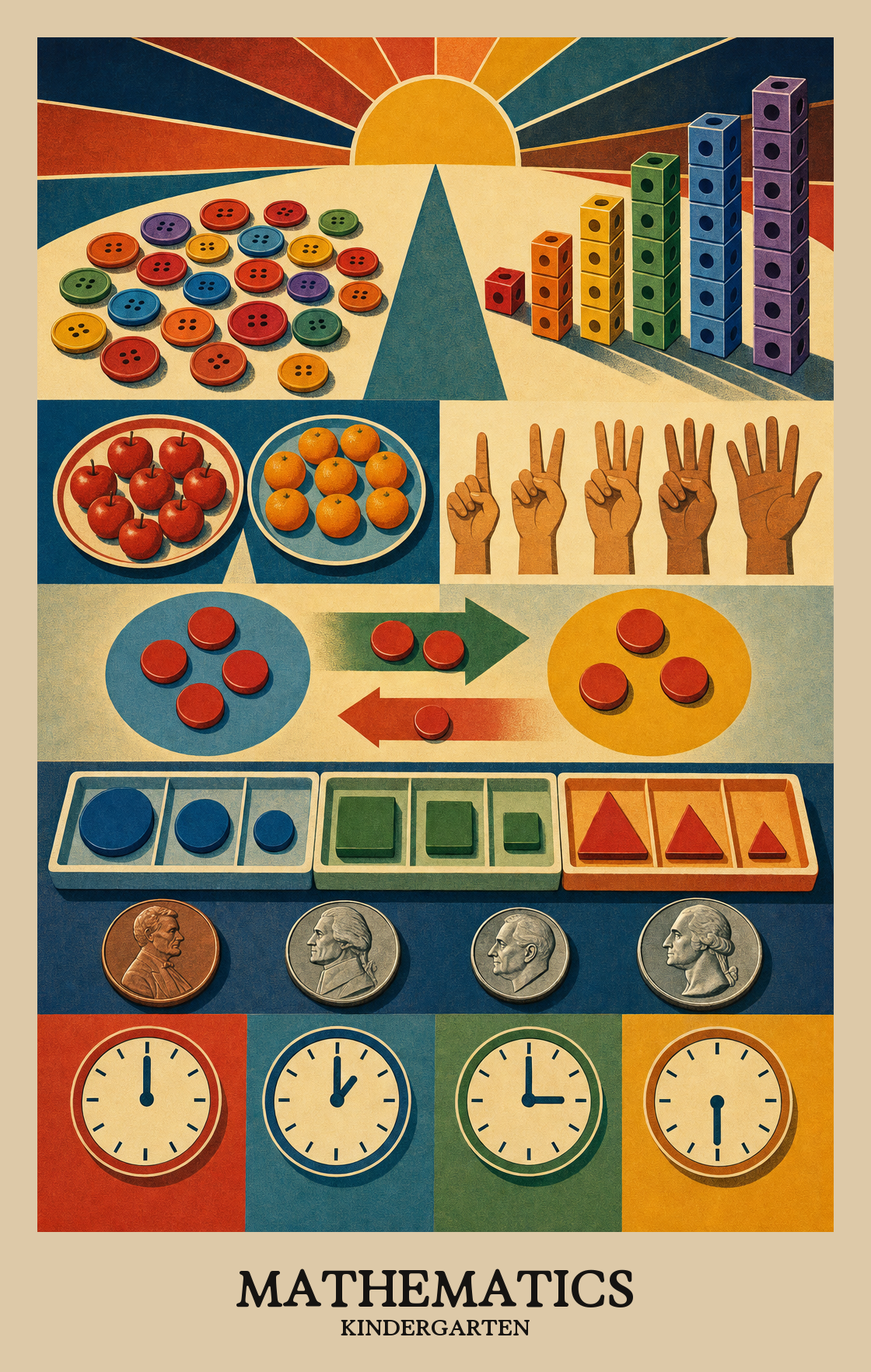
Students learn to count objects, match numbers to amounts, and write numbers from zero to twenty. They start comparing groups to see which has more and which has less.
Students put small groups together and take some away to find how many are left. They use fingers, blocks, and drawings to act out everyday situations like sharing snacks.
Students name and describe circles, squares, triangles, cubes, and spheres. They sort objects by size, color, or shape and notice these shapes in things around them.
Students compare lengths and weights using words like longer, shorter, and heavier. They begin to recognize coins and talk about saving and spending in simple ways.
Students spot and extend patterns, like red-blue-red-blue, and use math words to explain their thinking. They build simple picture graphs to show how many of each thing they have.
Students keep trying when a math problem feels hard. They look for more than one way to solve it and don't stop at the first answer they find.
Students use drawings, objects, or numbers to show something from everyday life, like counting chairs at a table or measuring with blocks. Math becomes a tool for making sense of the world around them.
Students solve simple math problems using the quickest method that makes sense to them, not just the first one they think of. The goal is accuracy and speed together.
Students talk through math problems with classmates, asking questions when something is confusing and answering questions to help others understand.
Students look for patterns and shortcuts to solve math problems, like noticing that adding zero never changes a number. Spotting structure helps students work faster and check whether an answer makes sense.
Students check whether an answer makes sense for the problem at hand. In math, that might mean asking if a counted total seems too high or too low before deciding it's right.
Students use math to figure out everyday problems, like sharing snacks, counting objects around the room, or deciding how many are left. Math class connects to real decisions students make outside school too.
| Standard | Definition | Code |
|---|---|---|
| Mathematical Thinking | Students keep trying when a math problem feels hard. They look for more than one way to solve it and don't stop at the first answer they find. | FL-MATH.MTR.K.1 |
| Modeling Real-World Situations | Students use drawings, objects, or numbers to show something from everyday life, like counting chairs at a table or measuring with blocks. Math becomes a tool for making sense of the world around them. | FL-MATH.MTR.K.2 |
| Complete Tasks with Fluency | Students solve simple math problems using the quickest method that makes sense to them, not just the first one they think of. The goal is accuracy and speed together. | FL-MATH.MTR.K.3 |
| Engage in Discourse | Students talk through math problems with classmates, asking questions when something is confusing and answering questions to help others understand. | FL-MATH.MTR.K.4 |
| Use Patterns and Structure | Students look for patterns and shortcuts to solve math problems, like noticing that adding zero never changes a number. Spotting structure helps students work faster and check whether an answer makes sense. | FL-MATH.MTR.K.5 |
| Assess Reasonableness | Students check whether an answer makes sense for the problem at hand. In math, that might mean asking if a counted total seems too high or too low before deciding it's right. | FL-MATH.MTR.K.6 |
| Apply Mathematics in Real-World Contexts | Students use math to figure out everyday problems, like sharing snacks, counting objects around the room, or deciding how many are left. Math class connects to real decisions students make outside school too. | FL-MATH.MTR.K.7 |
Kindergartners count, compare, and work with whole numbers. This standard covers the number skills students build all year, from counting objects to understanding what numbers mean.
Students spot simple patterns, like a shape that repeats or a number that grows, and explain what comes next. This is the early thinking behind algebra.
Students practice measuring and comparing everyday things like pencils, blocks, and coins. They start to tell time on a clock and figure out simple problems using length, weight, and money.
Students sort and describe shapes like circles, squares, and cubes by looking at their sides and corners. They also compare sizes by measuring with simple tools.
Sorting and counting things, then showing what they found in a simple picture graph or chart. Students practice reading those charts to answer basic questions like "which group has more?"
Students learn that money choices matter, even small ones. They practice deciding when to save coins for later and when to spend them now.
| Standard | Definition | Code |
|---|---|---|
| Number Sense and Operations | Kindergartners count, compare, and work with whole numbers. This standard covers the number skills students build all year, from counting objects to understanding what numbers mean. | FL-MATH.K8.K.1 |
| Algebraic Reasoning | Students spot simple patterns, like a shape that repeats or a number that grows, and explain what comes next. This is the early thinking behind algebra. | FL-MATH.K8.K.2 |
| Measurement | Students practice measuring and comparing everyday things like pencils, blocks, and coins. They start to tell time on a clock and figure out simple problems using length, weight, and money. | FL-MATH.K8.K.3 |
| Geometric Reasoning | Students sort and describe shapes like circles, squares, and cubes by looking at their sides and corners. They also compare sizes by measuring with simple tools. | FL-MATH.K8.K.4 |
| Data Analysis and Probability | Sorting and counting things, then showing what they found in a simple picture graph or chart. Students practice reading those charts to answer basic questions like "which group has more?" | FL-MATH.K8.K.5 |
| Financial Literacy | Students learn that money choices matter, even small ones. They practice deciding when to save coins for later and when to spend them now. | FL-MATH.K8.K.6 |
FAST Mathematics for grades 3 through 5, given three times per year with PM3 as the summative result for accountability.
By spring, students should count to 100, write numbers to 20, and add and subtract small amounts up to 10. They should also name basic shapes, sort objects, and compare which group has more or less.
Count real things together. Count the steps to the car, the grapes on a plate, or the buttons on a shirt. Ask questions like how many are there and how many will be left if we eat two.
Start with counting and one-to-one matching in the fall, then build to writing numbers and comparing groups by winter. Save adding and subtracting within 10 for the second half of the year, once counting is solid.
Keep practicing in short bursts with real objects. Count coins, crackers, or steps up the stairs. Most students need many tries before the teen numbers stick, and the jump from 29 to 30 is often the hardest part.
Writing teen numbers, comparing groups that look different in size, and the idea that the last number counted tells the total. Plan to revisit these every few weeks instead of teaching them once and moving on.
Not yet. Students should be able to figure out small sums and differences within 10 using fingers, drawings, or objects. Quick recall comes in first grade once the meaning of adding and taking away is solid.
Point out circles, squares, triangles, and rectangles on signs, food, and toys. Compare which shoe is longer, which cup is heavier, or which snack has more pieces. A few minutes a day is enough.
A ready student counts to 100, recognizes and writes numbers to 20, and solves small story problems with objects or drawings. They can also name common shapes and explain which group is bigger and why.