Looking closely like a scientist
Students start the year noticing things around them and asking questions. They learn to watch carefully, describe what they see, and share what they wonder about.
This is the year science becomes a habit of asking questions and looking closely. Students notice patterns in the weather, the sky, and the seasons, and they sort plants and animals by what they need to live. They also explore how everyday things move, push, pull, and change. By spring, students can ask a simple question about something they see outside and describe what they observed.
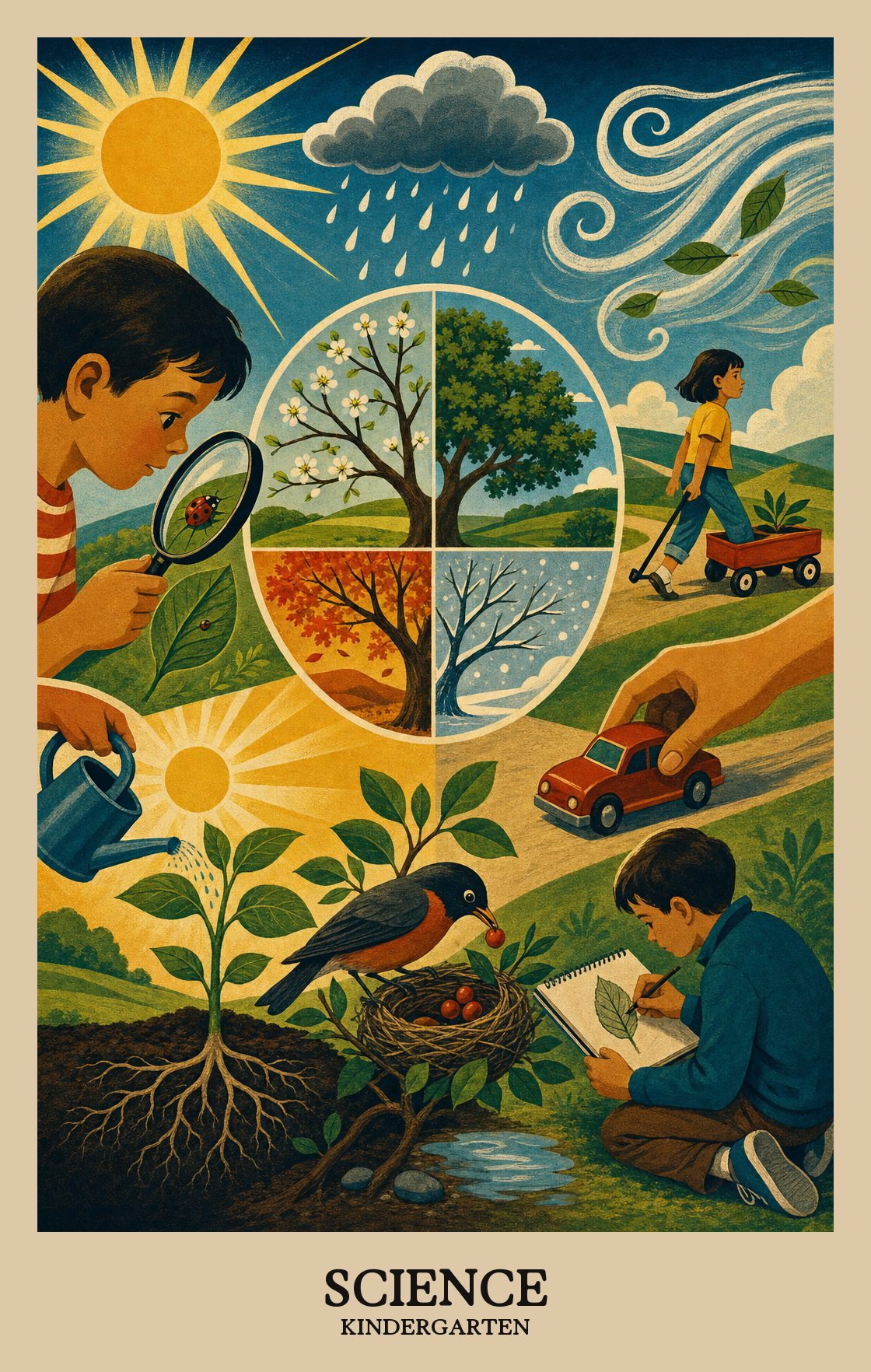
Students start the year noticing things around them and asking questions. They learn to watch carefully, describe what they see, and share what they wonder about.
Students track the weather day by day and notice the sun, moon, and changing seasons. They start to see patterns, like cooler mornings or rainy afternoons.
Students look at plants, animals, and people and sort them by what they need to live. They notice how a fish, a tree, and a squirrel each fit where they live.
Students explore what things are made of and how they feel, then test how pushes and pulls make objects move, stop, or change direction.
Students pull the year together by running small investigations of their own. They ask a question, try something out, and talk about what the evidence shows.
Students ask simple questions about the world around them, then try to find answers by looking closely, testing ideas, and talking about what they noticed.
Scientists test ideas, compare findings, and change their thinking when new evidence shows they were wrong. Students learn that science is a process of checking and improving, not a set of facts to memorize.
Kindergartners sort big science ideas into groups: a guess before a test, a rule that always holds, or a drawing that explains how something works. They use those tools to figure out why the world around them acts the way it does.
| Standard | Definition | Code |
|---|---|---|
| The Practice of Science | Students ask simple questions about the world around them, then try to find answers by looking closely, testing ideas, and talking about what they noticed. | FL-SCI.NATURE.K.1 |
| The Characteristics of Scientific Knowledge | Scientists test ideas, compare findings, and change their thinking when new evidence shows they were wrong. Students learn that science is a process of checking and improving, not a set of facts to memorize. | FL-SCI.NATURE.K.2 |
| The Role of Theories, Laws, and Models | Kindergartners sort big science ideas into groups: a guess before a test, a rule that always holds, or a drawing that explains how something works. They use those tools to figure out why the world around them acts the way it does. | FL-SCI.NATURE.K.3 |
Students notice that day turns to night and back again, and that weather and daylight change through the seasons. They begin to see these as repeating patterns, not random events.
Students learn that Earth is made of different layers and coverings: solid ground underfoot, water in oceans and lakes, and the air all around us. They begin to notice how these parts of Earth work together.
Students notice how weather changes day to day and how seasons follow a predictable pattern each year. They learn what shapes those patterns, like the sun's warmth and where water goes after it rains.
| Standard | Definition | Code |
|---|---|---|
| Earth in Space and Time | Students notice that day turns to night and back again, and that weather and daylight change through the seasons. They begin to see these as repeating patterns, not random events. | FL-SCI.ESS.K.1 |
| Earth's Structures | Students learn that Earth is made of different layers and coverings: solid ground underfoot, water in oceans and lakes, and the air all around us. They begin to notice how these parts of Earth work together. | FL-SCI.ESS.K.2 |
| Weather and Climate | Students notice how weather changes day to day and how seasons follow a predictable pattern each year. They learn what shapes those patterns, like the sun's warmth and where water goes after it rains. | FL-SCI.ESS.K.3 |
Living things are made of tiny building blocks called cells. Students learn how those cells work together to build leaves, skin, muscles, and eventually whole plants or animals.
Students learn that baby animals and plants look like their parents because living things pass traits from one generation to the next. A puppy grows into a dog, not a cat, because of information it inherited at birth.
Students sort and describe living things by how they look and where they live. This is the first step toward understanding why different plants and animals exist in different places.
Students learn that plants, animals, and other living things depend on each other to survive. A flower needs sunlight and water; a bee needs the flower. Living things are connected, and what one needs, another often provides.
| Standard | Definition | Code |
|---|---|---|
| Organization and Development | Living things are made of tiny building blocks called cells. Students learn how those cells work together to build leaves, skin, muscles, and eventually whole plants or animals. | FL-SCI.LS.K.1 |
| Heredity and Reproduction | Students learn that baby animals and plants look like their parents because living things pass traits from one generation to the next. A puppy grows into a dog, not a cat, because of information it inherited at birth. | FL-SCI.LS.K.2 |
| Diversity and Evolution | Students sort and describe living things by how they look and where they live. This is the first step toward understanding why different plants and animals exist in different places. | FL-SCI.LS.K.3 |
| Interdependence | Students learn that plants, animals, and other living things depend on each other to survive. A flower needs sunlight and water; a bee needs the flower. Living things are connected, and what one needs, another often provides. | FL-SCI.LS.K.4 |
Students sort everyday objects by what they can observe: color, shape, size, and texture. They learn that matter can change when you heat it, cool it, or mix it with something else.
Sound, light, and heat are forms of energy. Students learn to notice where energy comes from and where it goes, like how the sun warms the ground or how a drum makes noise when struck.
Students learn that pushes and pulls make things move, stop, or change direction. They explore how a harder push moves something farther than a gentle one.
| Standard | Definition | Code |
|---|---|---|
| Properties of Matter | Students sort everyday objects by what they can observe: color, shape, size, and texture. They learn that matter can change when you heat it, cool it, or mix it with something else. | FL-SCI.PS.K.1 |
| Forms of Energy | Sound, light, and heat are forms of energy. Students learn to notice where energy comes from and where it goes, like how the sun warms the ground or how a drum makes noise when struck. | FL-SCI.PS.K.2 |
| Forces and Motion | Students learn that pushes and pulls make things move, stop, or change direction. They explore how a harder push moves something farther than a gentle one. | FL-SCI.PS.K.3 |
Federally administered sample-based assessment in reading, mathematics, science, and writing. NAEP results inform state-by-state comparisons rather than individual student or school accountability.
Students notice things, ask questions, and try simple investigations. They watch the weather, sort rocks and leaves, see what sinks or floats, and talk about what they saw. Most of the year is hands-on observing and describing, not reading from a textbook.
Go outside and talk about what students see. Watch the moon for a week, listen for birds, or push toy cars down a ramp to see which goes farther. Ask questions like what do you notice, what changed, and why do you think that happened.
No. Kindergarten science is about looking closely and describing what students find, not memorizing terms. Knowing the names of a few animals, weather words like sunny and windy, and body parts is plenty.
Students should ask a question about something they observed, try a simple test, and describe what happened in their own words. They should also describe daily weather, sort living and non-living things, and talk about how objects move when pushed or pulled.
Start with observation routines and weather, since those run all year. Move into living things in the fall and winter, then physical science with motion and matter in the spring. Earth and space patterns like day and night can sit alongside weather work.
Asking a testable question and separating what students saw from what they guessed are the hardest parts. Many also confuse living and non-living when something moves, like fire or water. Build in short practice with sorting and with describing only what was observed.
Most of it should be hands-on. Plan for short investigations two or three times a week, with read-alouds and picture books used to introduce vocabulary or extend what students already explored. Save worksheets for quick checks, not the main lesson.
Students should be curious, willing to guess, and able to describe what they noticed in a few sentences. If a child can watch something happen, say what changed, and ask a follow-up question, they are ready.