Our classroom and community
Students start the year learning what it means to belong to a group. They talk about classroom rules, fairness, and the jobs people do at school and at home.
This is the year students step outside their own family and start to see how a community works. Students learn what rules are for, why people vote, and how a map shows where they live. They hear stories about people who helped build the country and meet kids from long ago and far away. By spring, they can name a few national symbols, point to land and water on a map, and explain why people trade what they have for what they need.
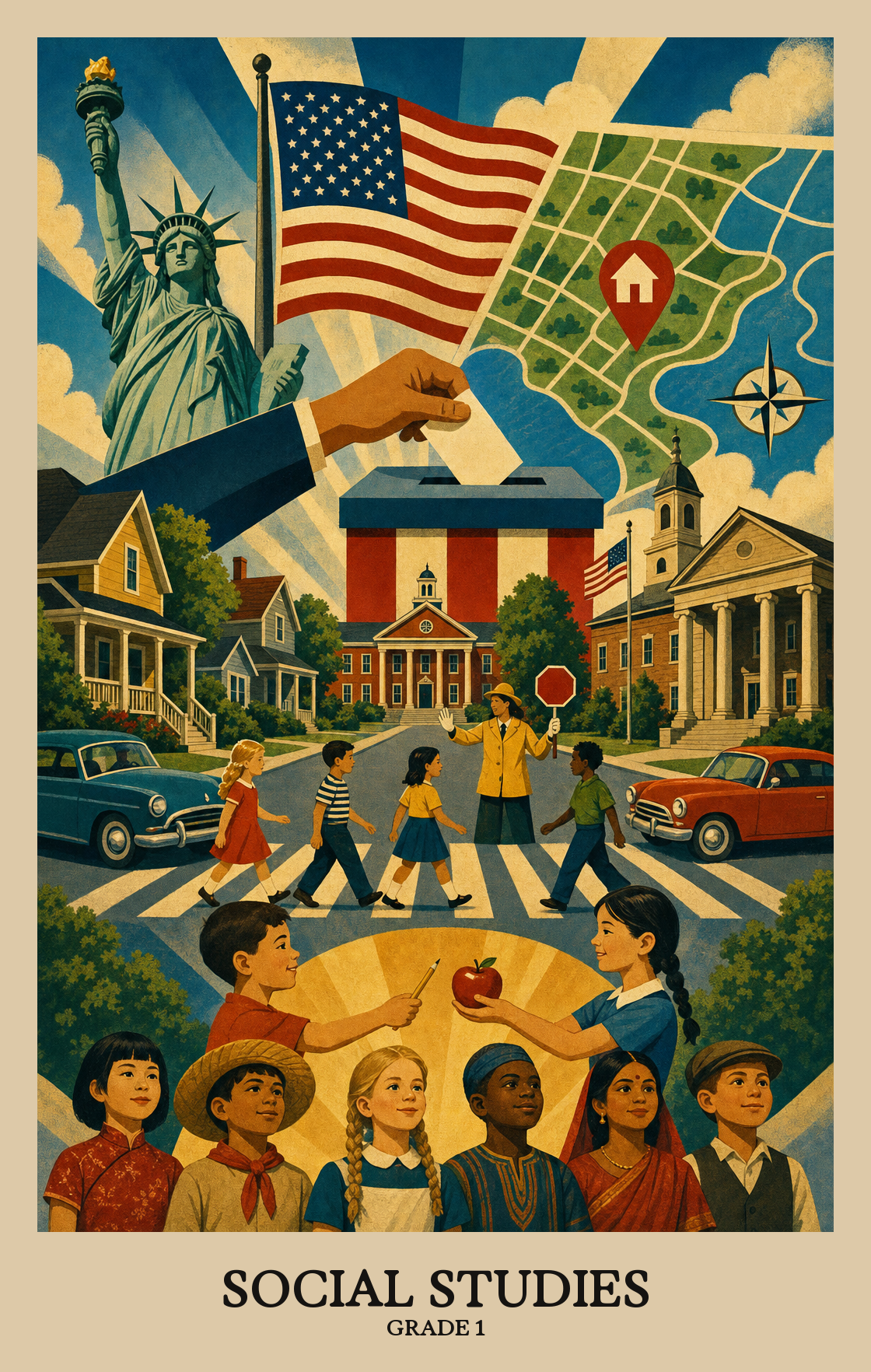
Students start the year learning what it means to belong to a group. They talk about classroom rules, fairness, and the jobs people do at school and at home.
Students use simple maps and a globe to find their town, their state, and the oceans around them. They learn that a map is a picture of a real place from above.
Students hear stories about people who helped shape the country and other places long ago. They start to see how life today is different from life a long time ago.
Students learn the difference between things people need and things people want. They talk about how families make choices when they cannot have everything, and how saving works.
Students learn about leaders, voting, and the symbols of the country like the flag. They practice ways to be a good citizen at school and in their neighborhood.
Students learn why the U.S. was founded, what documents like the Constitution set up, and how those rules still shape the way the country is governed today.
Students learn about key moments in American history, like the first Thanksgiving or the American Revolution, and talk about why those events still matter today.
Students look at how life in America has stayed the same and how it has changed over time. They learn how individual people and groups helped shape those changes.
| Standard | Definition | Code |
|---|---|---|
| American Founding | Students learn why the U.S. was founded, what documents like the Constitution set up, and how those rules still shape the way the country is governed today. | FL-SS.AH.1.1 |
| American Eras | Students learn about key moments in American history, like the first Thanksgiving or the American Revolution, and talk about why those events still matter today. | FL-SS.AH.1.2 |
| Continuity and Change | Students look at how life in America has stayed the same and how it has changed over time. They learn how individual people and groups helped shape those changes. | FL-SS.AH.1.3 |
First graders look at how early civilizations like ancient Egypt or Greece got started, how people organized their communities, and what those societies gave us, from written language to early laws to trade.
Students learn the order of major periods in human history, from the Middle Ages and Renaissance through the age of exploration and into modern times.
Trade, war, movement, and shared ideas connect people across the world. Students look at how ancient civilizations shaped each other by doing business, fighting, moving to new places, and borrowing one another's inventions and beliefs.
| Standard | Definition | Code |
|---|---|---|
| Ancient and Classical Civilizations | First graders look at how early civilizations like ancient Egypt or Greece got started, how people organized their communities, and what those societies gave us, from written language to early laws to trade. | FL-SS.WH.1.1 |
| World Eras | Students learn the order of major periods in human history, from the Middle Ages and Renaissance through the age of exploration and into modern times. | FL-SS.WH.1.2 |
| Global Interactions | Trade, war, movement, and shared ideas connect people across the world. Students look at how ancient civilizations shaped each other by doing business, fighting, moving to new places, and borrowing one another's inventions and beliefs. | FL-SS.WH.1.3 |
Students read maps and globes to find where places are and compare how big or small different areas are.
Students learn that places have features like hills, water, roads, and buildings, and that those features can change as people move in, build, or leave.
Students look at why people move to new places and how a community's traditions, languages, and ways of life change a neighborhood over time.
| Standard | Definition | Code |
|---|---|---|
| The World in Spatial Terms | Students read maps and globes to find where places are and compare how big or small different areas are. | FL-SS.GEO.1.1 |
| Places and Regions | Students learn that places have features like hills, water, roads, and buildings, and that those features can change as people move in, build, or leave. | FL-SS.GEO.1.2 |
| Human Systems | Students look at why people move to new places and how a community's traditions, languages, and ways of life change a neighborhood over time. | FL-SS.GEO.1.3 |
Scarcity means people can't have everything they want, so they have to choose. Students learn why individuals, families, and businesses weigh options and give something up to get something else.
Markets are places where buyers and sellers agree on a price for goods. When more stores sell the same thing, prices tend to drop. Students learn how this back-and-forth shapes what gets made and who gets it.
Students learn why saving some money, spending wisely, and planning ahead matters in everyday life. They practice thinking through simple choices like whether to buy something now or set money aside for later.
| Standard | Definition | Code |
|---|---|---|
| Economic Decision Making | Scarcity means people can't have everything they want, so they have to choose. Students learn why individuals, families, and businesses weigh options and give something up to get something else. | FL-SS.ECON.1.1 |
| Markets and the Economy | Markets are places where buyers and sellers agree on a price for goods. When more stores sell the same thing, prices tend to drop. Students learn how this back-and-forth shapes what gets made and who gets it. | FL-SS.ECON.1.2 |
| Personal Financial Literacy | Students learn why saving some money, spending wisely, and planning ahead matters in everyday life. They practice thinking through simple choices like whether to buy something now or set money aside for later. | FL-SS.ECON.1.3 |
Students learn why the U.S. has written rules for the whole country. They look at documents like the Constitution and what ideas, such as fairness and equal rights, those rules are built on.
Students learn what it means to be a good citizen: what rights they have and what responsibilities come with those rights. They also look at how people participate in their community and government.
Students learn that there are different layers of government, from town leaders to state officials to the president, and that each layer handles different rules and decisions that affect daily life.
Citizens take part in their community by voting, speaking up for causes they care about, and helping others. Students learn the basic ways people have a say in how their town or country is run.
| Standard | Definition | Code |
|---|---|---|
| Foundations of Government | Students learn why the U.S. has written rules for the whole country. They look at documents like the Constitution and what ideas, such as fairness and equal rights, those rules are built on. | FL-SS.CIV.1.1 |
| Roles, Rights, and Responsibilities | Students learn what it means to be a good citizen: what rights they have and what responsibilities come with those rights. They also look at how people participate in their community and government. | FL-SS.CIV.1.2 |
| Government Structures | Students learn that there are different layers of government, from town leaders to state officials to the president, and that each layer handles different rules and decisions that affect daily life. | FL-SS.CIV.1.3 |
| Civic Engagement | Citizens take part in their community by voting, speaking up for causes they care about, and helping others. Students learn the basic ways people have a say in how their town or country is run. | FL-SS.CIV.1.4 |
Federally administered sample-based assessment in reading, mathematics, science, and writing. NAEP results inform state-by-state comparisons rather than individual student or school accountability.
Students learn about families, neighborhoods, and how their community works. They start to read simple maps, talk about rules and leaders, and hear stories about people from long ago. Most of the year stays close to what students already know before stretching out to the wider world.
Talk about real life. Point out coins when paying, name the street and city when driving, and ask why a rule exists at home. Reading a picture book about a historical person or another country once a week also goes a long way.
Not really. At this age, students should recognize a few key people and holidays and know roughly what they stand for, like why we have a Fourth of July. Understanding the story matters more than reciting the date.
A common path starts close to home with self, family, and school, then moves out to the neighborhood and community, then to the country and wider world. Map skills and basic economics can be folded into each unit rather than taught as separate blocks.
Students should use a simple map key, point out land and water, and describe where something is using words like near, far, left, and right. A globe should be familiar enough that students can find the oceans and the continent they live on.
Keep it concrete. Voting on a class book, following classroom rules, and meeting a local helper like a firefighter or mayor teach the same ideas as formal civics lessons. Students can then name a few jobs leaders do and why rules help everyone.
It means choices. Students learn that money is limited, that wants and needs are different, and that saving a coin today means buying something later. A piggy bank or a small allowance conversation at home reinforces this better than a worksheet.
Map directions, the difference between needs and wants, and the idea that people long ago lived without the things we use today. Short, repeated exposure across the year works better than one long unit on each.
By the end of the year, students should describe their community, read a simple map, name a few national symbols and holidays, and explain why people trade or save. Telling a short story about a historical figure in their own words is another strong sign.