Listening and joining in
Students start the year by listening closely to songs and matching what they hear with their voices, hands, and feet. They learn to notice when music is fast or slow, loud or soft.
This is the year music shifts from joining in to making real choices. Students start inventing their own short rhythms and melodies, then practice them so they sound the way they want. Singing and playing become a small performance, with attention to how loud, fast, or steady a piece should feel. By spring, students can perform a short song for the class and say what the music made them think of.
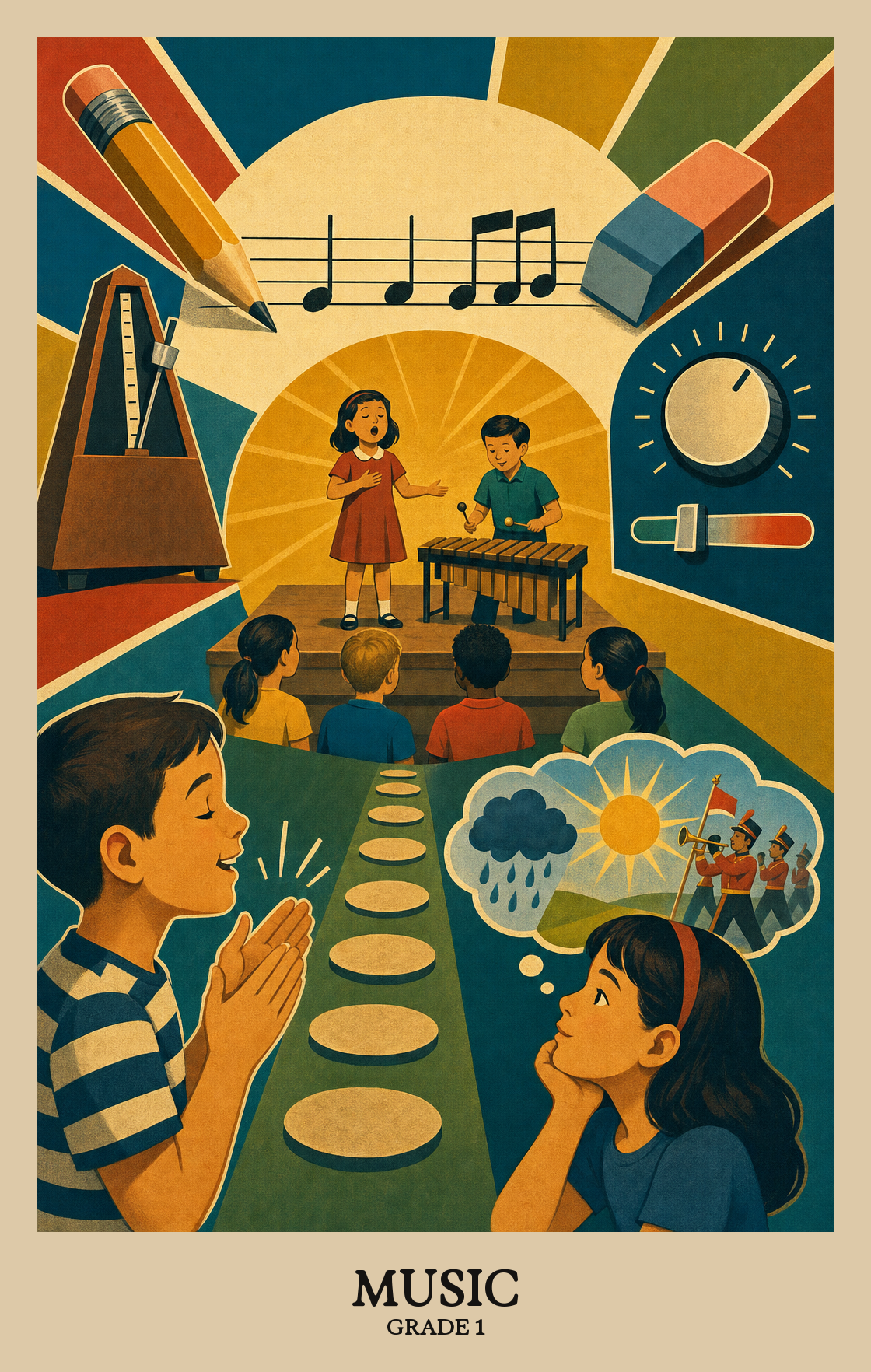
Students start the year by listening closely to songs and matching what they hear with their voices, hands, and feet. They learn to notice when music is fast or slow, loud or soft.
Students invent short patterns of sound, like clapping a rhythm or humming a tune. They try out ideas, pick the ones they like best, and shape them into something they can share.
Students rehearse songs and rhythm pieces with the class. They learn to start and stop together, use a singing voice, and play simple instruments in time with the group.
Students perform for others and talk about what songs make them think or feel. They connect music to stories from home, holidays, and other subjects, and give kind feedback to classmates.
Students connect what they already know and what they've experienced to the music they make and explore in class.
Students connect a song or piece of music to the time, place, or people it came from. Knowing that context helps them understand why the music sounds the way it does.
| Standard | Definition | Code |
|---|---|---|
| Synthesize and relate knowledge and personal experiences to make art | Students connect what they already know and what they've experienced to the music they make and explore in class. | MU:Cn10.1 |
| Relate artistic ideas and works with societal, cultural | Students connect a song or piece of music to the time, place, or people it came from. Knowing that context helps them understand why the music sounds the way it does. | MU:Cn11.1 |
Students come up with their own musical ideas, like inventing a simple melody, making up a rhythm, or deciding how a song should sound.
Students take their musical ideas and shape them into a short song or pattern. They try different rhythms or melodies until the piece feels finished.
Students listen back to a short song or rhythm they made, then change something to make it sound better before sharing it with the class.
| Standard | Definition | Code |
|---|---|---|
| Generate and conceptualize artistic ideas and work | Students come up with their own musical ideas, like inventing a simple melody, making up a rhythm, or deciding how a song should sound. | MU:Cr1.1 |
| Organize and develop artistic ideas and work | Students take their musical ideas and shape them into a short song or pattern. They try different rhythms or melodies until the piece feels finished. | MU:Cr2.1 |
| Refine and complete artistic work | Students listen back to a short song or rhythm they made, then change something to make it sound better before sharing it with the class. | MU:Cr3.1 |
Students choose a song or piece of music to perform and explain why they picked it. They think about what the music means and how they want to share it with an audience.
Students practice a song or rhythm until it sounds better than the first try. The goal is to perform it clearly enough for others to follow along.
Students perform a song or rhythm for an audience and make choices, like how loud or soft to play, that give the music a feeling or meaning.
| Standard | Definition | Code |
|---|---|---|
| Analyze, interpret, and select artistic work for presentation | Students choose a song or piece of music to perform and explain why they picked it. They think about what the music means and how they want to share it with an audience. | MU:Pr4.1 |
| Develop and refine artistic techniques and work for presentation | Students practice a song or rhythm until it sounds better than the first try. The goal is to perform it clearly enough for others to follow along. | MU:Pr5.1 |
| Convey meaning through the presentation of artistic work | Students perform a song or rhythm for an audience and make choices, like how loud or soft to play, that give the music a feeling or meaning. | MU:Pr6.1 |
Students listen to a short piece of music and describe what they notice, such as whether it is fast or slow, loud or soft, or happy or sad.
Students listen to a short piece of music and explain what feeling or story they think it tells, using what they hear in the rhythm, melody, or tempo as their reason.
Students listen to a piece of music and decide what they think of it, using simple questions like "Does it feel fast or slow?" or "Does it match the words?" They explain why they like or don't like what they hear.
| Standard | Definition | Code |
|---|---|---|
| Perceive and analyze artistic work | Students listen to a short piece of music and describe what they notice, such as whether it is fast or slow, loud or soft, or happy or sad. | MU:Re7.1 |
| Interpret intent and meaning in artistic work | Students listen to a short piece of music and explain what feeling or story they think it tells, using what they hear in the rhythm, melody, or tempo as their reason. | MU:Re8.1 |
| Apply criteria to evaluate artistic work | Students listen to a piece of music and decide what they think of it, using simple questions like "Does it feel fast or slow?" or "Does it match the words?" They explain why they like or don't like what they hear. | MU:Re9.1 |
Students sing simple songs, clap steady beats, play rhythms on drums or shakers, and start to notice high and low sounds. They also listen to short pieces of music and talk about how the music makes them feel.
Sing together in the car, clap the beat to favorite songs, and ask what the music sounds like. Slow or fast? Loud or soft? Happy or sad? Five minutes of this a few times a week builds the same listening skills used in class.
No. First graders are not expected to read traditional notes. They learn rhythm by clapping and patting, and melody by singing. Reading music comes later, after the ear is trained.
Most teachers start with steady beat and simple singing, add basic rhythm patterns in the fall, layer in high and low pitch and simple instruments by winter, and spend spring on small performances and responding to music. Revisit beat and singing in every unit.
Keeping a steady beat while singing is the hardest combination at this age. Matching pitch when singing alone also takes time. Plan short, frequent practice rather than long lessons on either skill.
Students should sing a short song in tune with a group, keep a steady beat by clapping or tapping, play a simple rhythm on a classroom instrument, and say one thing they notice about a piece of music they hear.
Look for students who can hold a steady beat without drifting, echo a short rhythm pattern, sing a familiar song with the class in tune, and describe music using words like fast, slow, loud, and soft.
Students invent short rhythm patterns, add sound effects to a story, or make up a new ending to a song. The goal is comfort with trying ideas out loud, not finished compositions. Praise the attempt, then ask what they want to change.