Counting and numbers to 120
Students count, read, and write numbers all the way to 120. They start to see how tens and ones work together, so the number 47 means four tens and seven ones.
This is the year counting turns into real addition and subtraction. Students add and subtract within 20, start to see numbers as tens and ones, and use that idea to work with numbers up to 100. They also tell time on a clock, count coins, compare lengths, and sort shapes. By spring, students can solve a word problem like "I had 14 stickers and gave away 6" and explain how they got the answer.
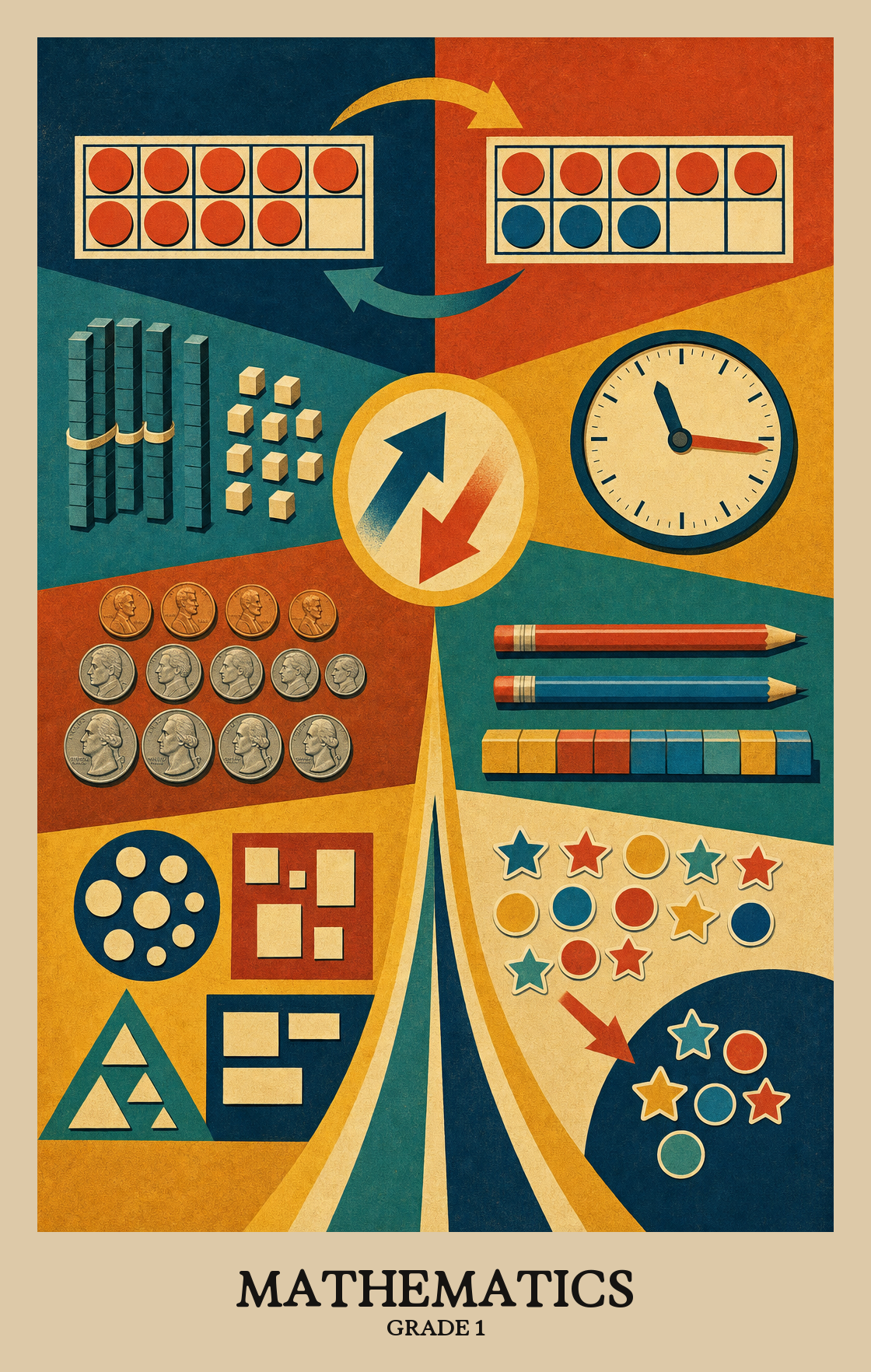
Students count, read, and write numbers all the way to 120. They start to see how tens and ones work together, so the number 47 means four tens and seven ones.
Students learn quick ways to add and subtract small numbers, like making a ten or counting on from the bigger number. Math facts start to feel automatic instead of slow.
Students solve short story problems about toys, snacks, and classroom items. They figure out whether to add or subtract and check that the answer makes sense.
Students compare lengths, line objects up end to end, and measure with paper clips or cubes. They also learn to read clocks to the hour and half hour and recognize coins.
Students name shapes like triangles, rectangles, and cubes, and sort them by sides and corners. They split shapes into halves and quarters and see that fair shares can look different.
Students gather simple data from the class and show it in tally charts and picture graphs. They also talk about saving and spending money in everyday situations.
Students stick with a math problem even when it gets hard, trying a different approach if the first one doesn't work.
Students look at everyday situations, like sharing snacks or counting toys, and figure out which math tool, number, or drawing best matches what is happening.
Students practice math tasks until the steps feel automatic, then choose the quickest, most reliable method to get the answer.
Students talk through math problems with classmates, asking questions when something is confusing and explaining their own thinking out loud. The goal is to understand the math more clearly, not just get the right answer.
Students look for patterns and shortcuts in math problems rather than just memorizing steps. Noticing that numbers and shapes follow rules helps them solve new problems faster.
Students check whether an answer makes sense given the problem. They ask themselves if the number is too big, too small, or about right before calling it done.
Students use math to figure out everyday situations, like counting coins, sharing snacks equally, or reading a number on a clock. Math isn't just for school problems; it connects to choices and questions students run into outside the classroom too.
| Standard | Definition | Code |
|---|---|---|
| Mathematical Thinking | Students stick with a math problem even when it gets hard, trying a different approach if the first one doesn't work. | FL-MATH.MTR.1.1 |
| Modeling Real-World Situations | Students look at everyday situations, like sharing snacks or counting toys, and figure out which math tool, number, or drawing best matches what is happening. | FL-MATH.MTR.1.2 |
| Complete Tasks with Fluency | Students practice math tasks until the steps feel automatic, then choose the quickest, most reliable method to get the answer. | FL-MATH.MTR.1.3 |
| Engage in Discourse | Students talk through math problems with classmates, asking questions when something is confusing and explaining their own thinking out loud. The goal is to understand the math more clearly, not just get the right answer. | FL-MATH.MTR.1.4 |
| Use Patterns and Structure | Students look for patterns and shortcuts in math problems rather than just memorizing steps. Noticing that numbers and shapes follow rules helps them solve new problems faster. | FL-MATH.MTR.1.5 |
| Assess Reasonableness | Students check whether an answer makes sense given the problem. They ask themselves if the number is too big, too small, or about right before calling it done. | FL-MATH.MTR.1.6 |
| Apply Mathematics in Real-World Contexts | Students use math to figure out everyday situations, like counting coins, sharing snacks equally, or reading a number on a clock. Math isn't just for school problems; it connects to choices and questions students run into outside the classroom too. | FL-MATH.MTR.1.7 |
Counting, comparing, and adding whole numbers are the building blocks of first-grade math. Students work with numbers up to 120, learn to add and subtract, and start making sense of how numbers fit together.
Students spot patterns in numbers and shapes, describe what they notice, and start building simple equations. This is the foundation for all the math reasoning that comes later.
Students measure lengths, compare weights, read a clock, and count coins to solve everyday math problems.
Students sort and describe flat shapes (like circles and squares) and solid shapes (like spheres and cubes), and practice measuring their sides. This is the building block for all geometry students will see later.
Students gather information, sort it into simple charts or picture graphs, and answer questions about what the data shows.
Students learn to make basic money choices: when to save what they earn, when to spend it, and what it means to borrow. The focus is on everyday decisions a first grader can understand, like saving coins for something they want.
| Standard | Definition | Code |
|---|---|---|
| Number Sense and Operations | Counting, comparing, and adding whole numbers are the building blocks of first-grade math. Students work with numbers up to 120, learn to add and subtract, and start making sense of how numbers fit together. | FL-MATH.K8.1.1 |
| Algebraic Reasoning | Students spot patterns in numbers and shapes, describe what they notice, and start building simple equations. This is the foundation for all the math reasoning that comes later. | FL-MATH.K8.1.2 |
| Measurement | Students measure lengths, compare weights, read a clock, and count coins to solve everyday math problems. | FL-MATH.K8.1.3 |
| Geometric Reasoning | Students sort and describe flat shapes (like circles and squares) and solid shapes (like spheres and cubes), and practice measuring their sides. This is the building block for all geometry students will see later. | FL-MATH.K8.1.4 |
| Data Analysis and Probability | Students gather information, sort it into simple charts or picture graphs, and answer questions about what the data shows. | FL-MATH.K8.1.5 |
| Financial Literacy | Students learn to make basic money choices: when to save what they earn, when to spend it, and what it means to borrow. The focus is on everyday decisions a first grader can understand, like saving coins for something they want. | FL-MATH.K8.1.6 |
FAST Mathematics for grades 3 through 5, given three times per year with PM3 as the summative result for accountability.
Students should add and subtract within 20, count to 120, and read a clock to the hour and half hour. They should also compare numbers, sort coins, and tell which of two objects is longer. By spring, simple word problems should feel doable.
Count steps to the car, sort spare coins on the table, or ask how many more minutes until dinner. Five minutes of real counting beats a worksheet. Talking through the answer matters as much as getting it right.
Quick recall of sums within 10 makes everything else easier later. Practice in short bursts, two or three minutes at a time, using flashcards, dice, or playing cards. Mix in subtraction once addition feels steady.
Start with sums and differences within 10, then build to 20 using strategies like making ten and doubles. Word problems should run alongside fact work, not after it. Save the trickiest problem types, such as comparing and start-unknown, for the second half of the year.
Telling time to the half hour, subtracting across ten, and comparing numbers with the symbols for greater than and less than tend to wobble. Plan to revisit each one a few times across the year rather than teaching it once and moving on.
Pull out objects to count, draw a quick picture, or read the problem out loud one sentence at a time. Getting stuck is part of math, not a sign something is wrong. Praise the try, then work through it together.
Plan roughly one shorter unit each for measurement, shapes, and graphing, with the bulk of the year on number and operations. Tuck measurement and data into morning routines and calendar time so they stay fresh. Money shows up best inside word problems.
Ready students add and subtract within 20 without counting every finger, solve a one-step word problem on their own, and tell time to the half hour. They can also explain their thinking in a sentence or two, even if the words are simple.