Asking questions and looking closely
Students start the year acting like scientists. They ask questions they can actually test, watch carefully, and talk about what they notice using drawings, words, and simple charts.
This is the year science becomes a habit of asking questions and looking for answers. Students watch the sky and notice patterns in day, night, and weather. They sort plants and animals by what they need to live and grow, and they push and pull objects to see how things move. By spring, they can ask a simple question about the world and describe what they saw to answer it.
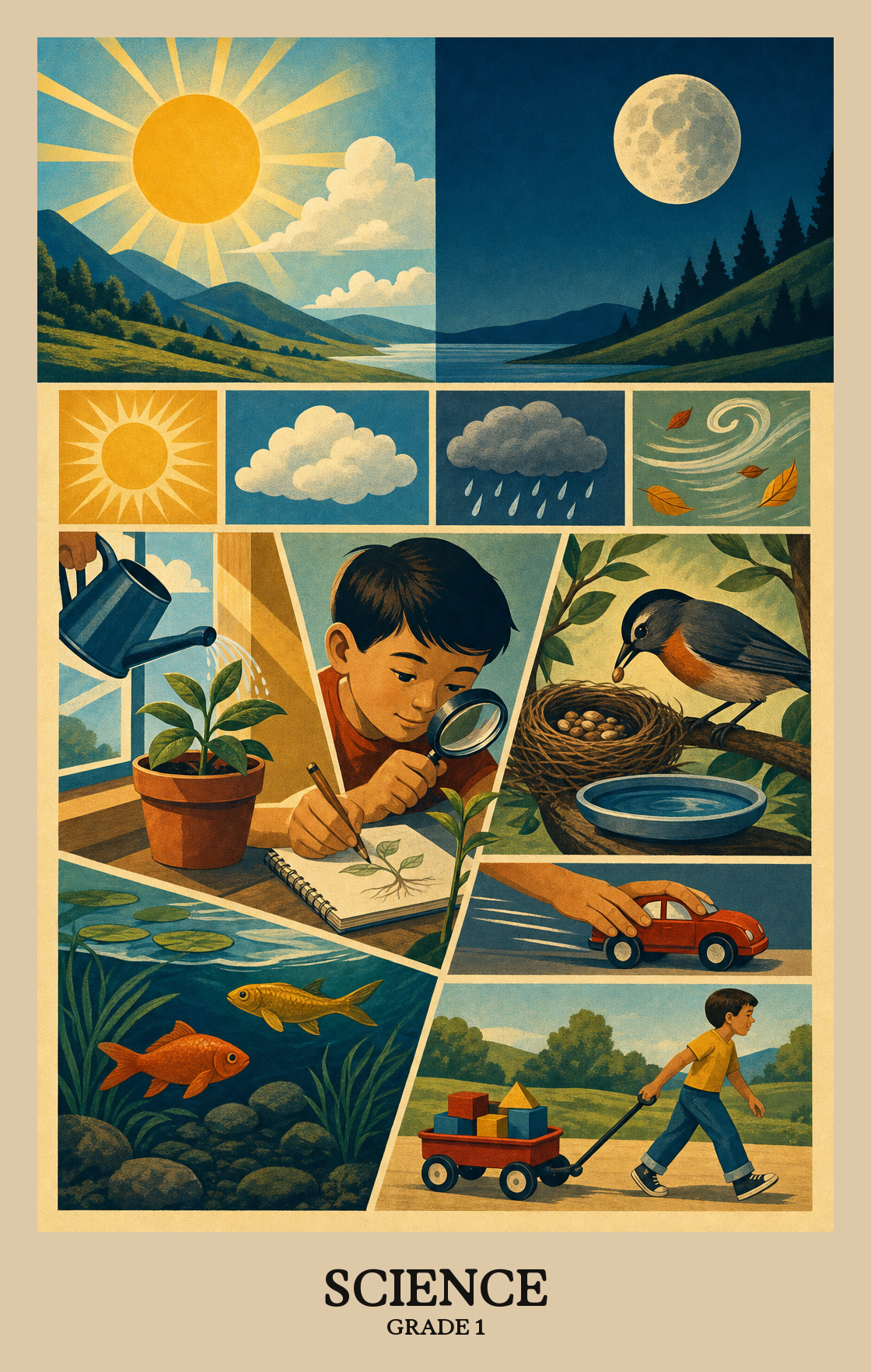
Students start the year acting like scientists. They ask questions they can actually test, watch carefully, and talk about what they notice using drawings, words, and simple charts.
Students track the weather, the position of the sun, and how day and night work. They notice patterns across the week and across the seasons, and learn what air, water, and land do around them.
Students look at how plants and animals grow, what their parts do, and what they need to live. They compare different living things and see how animals and plants in the same place depend on each other.
Students sort objects by what they are made of and how they feel, then explore pushes, pulls, and how things move. They also notice light, heat, and sound as different kinds of energy at work.
Students ask a question they can actually test, then plan a simple investigation to find the answer. They look at what they observed and use it to explain what happened.
Scientists test ideas, share results, and check each other's work to see if the findings hold up. Students learn that what we know about the world changes when new evidence comes in.
A hypothesis is a testable guess. A model shows how something works. A law describes what always happens. A theory explains why. Students learn to tell these apart and use each one to make sense of what they observe in nature.
| Standard | Definition | Code |
|---|---|---|
| The Practice of Science | Students ask a question they can actually test, then plan a simple investigation to find the answer. They look at what they observed and use it to explain what happened. | FL-SCI.NATURE.1.1 |
| The Characteristics of Scientific Knowledge | Scientists test ideas, share results, and check each other's work to see if the findings hold up. Students learn that what we know about the world changes when new evidence comes in. | FL-SCI.NATURE.1.2 |
| The Role of Theories, Laws, and Models | A hypothesis is a testable guess. A model shows how something works. A law describes what always happens. A theory explains why. Students learn to tell these apart and use each one to make sense of what they observe in nature. | FL-SCI.NATURE.1.3 |
Students learn why the sky looks different throughout the day and across the year. They study how Earth's movement causes day and night, and why summer feels warmer than winter.
Students learn that Earth is made of layers, including solid ground underfoot, water in oceans and rivers, and the air all around us. They explore how these parts work together and change over time.
Students learn that weather follows patterns, like rainy seasons or cold winters, and that where you live affects the kind of weather you get. They practice spotting those patterns using temperature, clouds, and rainfall.
| Standard | Definition | Code |
|---|---|---|
| Earth in Space and Time | Students learn why the sky looks different throughout the day and across the year. They study how Earth's movement causes day and night, and why summer feels warmer than winter. | FL-SCI.ESS.1.1 |
| Earth's Structures | Students learn that Earth is made of layers, including solid ground underfoot, water in oceans and rivers, and the air all around us. They explore how these parts work together and change over time. | FL-SCI.ESS.1.2 |
| Weather and Climate | Students learn that weather follows patterns, like rainy seasons or cold winters, and that where you live affects the kind of weather you get. They practice spotting those patterns using temperature, clouds, and rainfall. | FL-SCI.ESS.1.3 |
Living things are built from tiny cells, the way a house is built from bricks. Students learn how those cells work together to form tissues, organs, and whole bodies.
Students learn that living things (plants, animals, people) make more of their own kind and pass along traits like color, shape, or size to their offspring. This is why puppies look like their parents.
Living things come in countless shapes, sizes, and behaviors. Students learn why animals and plants look different from one another and how living things have slowly changed over many, many generations.
Plants and animals depend on each other to survive. A plant makes food from sunlight, an animal eats the plant, and when things die, they break down and feed the soil again.
| Standard | Definition | Code |
|---|---|---|
| Organization and Development | Living things are built from tiny cells, the way a house is built from bricks. Students learn how those cells work together to form tissues, organs, and whole bodies. | FL-SCI.LS.1.1 |
| Heredity and Reproduction | Students learn that living things (plants, animals, people) make more of their own kind and pass along traits like color, shape, or size to their offspring. This is why puppies look like their parents. | FL-SCI.LS.1.2 |
| Diversity and Evolution | Living things come in countless shapes, sizes, and behaviors. Students learn why animals and plants look different from one another and how living things have slowly changed over many, many generations. | FL-SCI.LS.1.3 |
| Interdependence | Plants and animals depend on each other to survive. A plant makes food from sunlight, an animal eats the plant, and when things die, they break down and feed the soil again. | FL-SCI.LS.1.4 |
Students sort everyday objects by how they look, feel, and behave. They notice what makes wood different from water, or a rock different from a sponge, and start to see that matter comes in different forms with different properties.
Sound, light, and heat are forms of energy students can observe and describe. They explore how energy moves from one place to another, like heat warming your hand or light bouncing off a mirror.
Students learn what makes things move, slow down, or change direction. They explore how pushes and pulls affect objects, like rolling a ball or stopping a toy car.
| Standard | Definition | Code |
|---|---|---|
| Properties of Matter | Students sort everyday objects by how they look, feel, and behave. They notice what makes wood different from water, or a rock different from a sponge, and start to see that matter comes in different forms with different properties. | FL-SCI.PS.1.1 |
| Forms of Energy | Sound, light, and heat are forms of energy students can observe and describe. They explore how energy moves from one place to another, like heat warming your hand or light bouncing off a mirror. | FL-SCI.PS.1.2 |
| Forces and Motion | Students learn what makes things move, slow down, or change direction. They explore how pushes and pulls affect objects, like rolling a ball or stopping a toy car. | FL-SCI.PS.1.3 |
Federally administered sample-based assessment in reading, mathematics, science, and writing. NAEP results inform state-by-state comparisons rather than individual student or school accountability.
Students spend the year asking questions about the world and looking for answers by trying things out. They learn a little about weather, plants and animals, the sky, and how things move. Most of it happens through hands-on activities, not reading from a textbook.
Go outside and notice things together. Watch the moon over a week, track the weather each morning, or plant a bean in a cup and check it daily. Ask students what they notice and what they wonder. That kind of talk is the heart of first-grade science.
Not really. Students should know basics like the days of the week, the seasons, and that living things need food, water, and air. The bigger goal is learning to observe carefully and explain what they saw, not reciting definitions.
A common pattern is life science in fall while the weather is still mild for outdoor observation, earth and sky in winter when night comes early, and physical science in spring with ramps, magnets, and water. Weave the nature of science work into every unit rather than teaching it on its own.
Two things tend to lag. First, the difference between a guess and a testable question. Second, recording what actually happened instead of what students hoped would happen. Both improve with short, repeated practice using a simple notice and wonder chart.
Students should ask a question, try a simple test, and say what they found out in their own words. They should describe basic patterns in weather and the sky, sort living and nonliving things, and explain how a push or pull made something move.
Some weeks will look like that, especially when students are recording observations or labeling a picture. If most weeks feel that way, ask the teacher what hands-on investigations are coming up. Real first-grade science should include touching, sorting, and trying things.