Imagining characters and stories
Students start the year by inventing characters, places, and short story ideas from their own lives and from books they know. Expect lots of pretend play with a purpose behind it.
This is the year pretend play starts to look like real theatre. Students invent characters and short scenes, then practice them so an audience can follow along. They also begin talking about plays they watch, sharing what a scene meant and what worked well. By spring, students can act out a simple story with a clear character and setting, and explain what they liked about a classmate's scene.
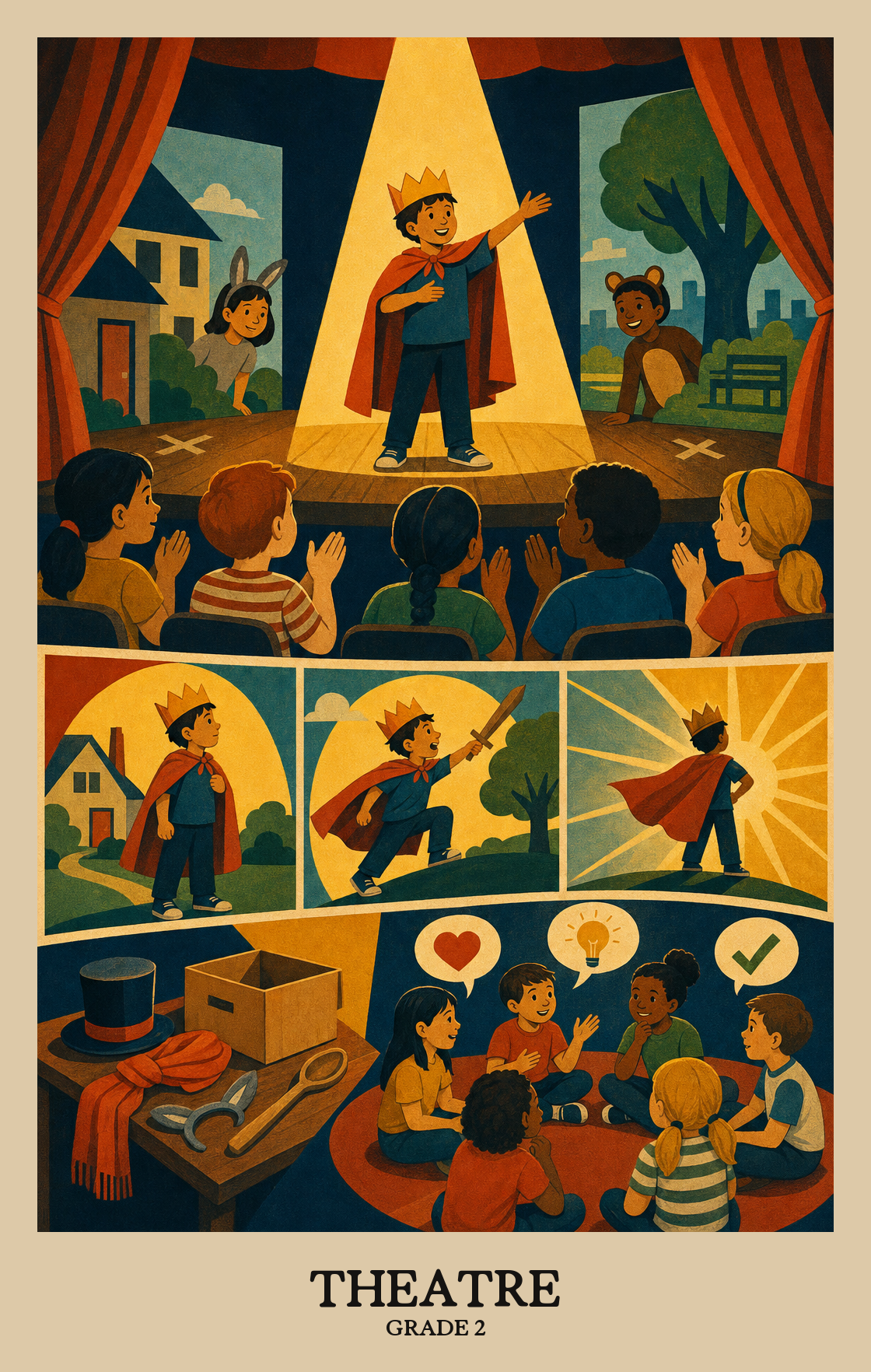
Students start the year by inventing characters, places, and short story ideas from their own lives and from books they know. Expect lots of pretend play with a purpose behind it.
Students take their ideas and shape them into short scenes with a beginning, middle, and end. They practice working as a group and adding details like setting and props.
Students rehearse how to use their voice, face, and body to show a character. They learn that small changes, like a louder voice or slower walk, change what the audience sees.
Students perform short pieces for classmates and watch each other's work. They talk about what the story meant, what felt clear, and what they would try differently next time.
Students link the stories they act out to their own experiences and to other times and places. They notice how a play can show what people care about.
Students draw on things they already know and moments from their own life to build a character or create a scene. Personal experience is part of the material.
Students connect a play or story to the time, place, or culture it comes from. Knowing that background helps them understand why characters act the way they do.
| Standard | Definition | Code |
|---|---|---|
| Synthesize and relate knowledge and personal experiences to make art | Students draw on things they already know and moments from their own life to build a character or create a scene. Personal experience is part of the material. | TH:Cn10.2 |
| Relate artistic ideas and works with societal, cultural | Students connect a play or story to the time, place, or culture it comes from. Knowing that background helps them understand why characters act the way they do. | TH:Cn11.2 |
Students come up with ideas for a short play or scene, then plan out the characters and what will happen in the story.
Students turn a story idea into a short scene by deciding who the characters are, what they want, and what happens. They put those pieces in order so the scene makes sense when performed.
Students look back at a scene or story they made and change at least one thing to make it clearer or more interesting before sharing it with others.
| Standard | Definition | Code |
|---|---|---|
| Generate and conceptualize artistic ideas and work | Students come up with ideas for a short play or scene, then plan out the characters and what will happen in the story. | TH:Cr1.2 |
| Organize and develop artistic ideas and work | Students turn a story idea into a short scene by deciding who the characters are, what they want, and what happens. They put those pieces in order so the scene makes sense when performed. | TH:Cr2.2 |
| Refine and complete artistic work | Students look back at a scene or story they made and change at least one thing to make it clearer or more interesting before sharing it with others. | TH:Cr3.2 |
Students pick a short scene or character to perform and explain why it feels like a good fit for them. Choosing well is part of the work.
Students practice a scene or performance more than once, making small adjustments to voice, movement, or timing until the work is ready to share with an audience.
Students act out a scene or story in front of an audience and make choices, like how to move or speak, so the audience understands what the character feels or wants.
| Standard | Definition | Code |
|---|---|---|
| Analyze, interpret, and select artistic work for presentation | Students pick a short scene or character to perform and explain why it feels like a good fit for them. Choosing well is part of the work. | TH:Pr4.2 |
| Develop and refine artistic techniques and work for presentation | Students practice a scene or performance more than once, making small adjustments to voice, movement, or timing until the work is ready to share with an audience. | TH:Pr5.2 |
| Convey meaning through the presentation of artistic work | Students act out a scene or story in front of an audience and make choices, like how to move or speak, so the audience understands what the character feels or wants. | TH:Pr6.2 |
Students watch a short performance and describe what they noticed, such as how a character moved or spoke. They start to explain why those choices made the scene feel a certain way.
Students explain what they think a character wants and why, based on what they saw in a performance or acted-out story.
Students look at a scene or performance and explain what worked and what didn't, using a simple set of reasons like "Did the actors speak clearly?" or "Did the story make sense?"
| Standard | Definition | Code |
|---|---|---|
| Perceive and analyze artistic work | Students watch a short performance and describe what they noticed, such as how a character moved or spoke. They start to explain why those choices made the scene feel a certain way. | TH:Re7.2 |
| Interpret intent and meaning in artistic work | Students explain what they think a character wants and why, based on what they saw in a performance or acted-out story. | TH:Re8.2 |
| Apply criteria to evaluate artistic work | Students look at a scene or performance and explain what worked and what didn't, using a simple set of reasons like "Did the actors speak clearly?" or "Did the story make sense?" | TH:Re9.2 |
Students act out short stories, play pretend characters, and put on small scenes for classmates. They make choices about voice, face, and body to show who a character is and how that character feels. Most work happens through play, not memorized scripts.
Ask students to act out a favorite story or invent a character at the dinner table. Take turns being different people in the scene and talk about why the character feels happy, scared, or surprised. Five minutes of pretend play counts as real practice.
Shy students can still do well. Start with puppets, stuffed animals, or voices behind a couch so the focus is on the character, not the performer. Confidence grows when students feel safe trying out a voice or a walk that is not their own.
Start with imagination and movement games, then move into building characters and short scenes. By spring, students should be shaping scenes with a beginning, middle, and end, and reflecting on what worked. Save sharing with an audience for after students have rehearsed.
Students can invent a character, make clear choices about voice and movement, and perform a short scene for classmates. They can also watch a peer and say one specific thing they noticed about the acting or the story.
No. At this age, scenes are usually improvised or built from a story students already know. Memorizing is less important than making strong character choices and staying in the scene with a partner.
Students draw on stories, holidays, family traditions, and books from class to build scenes. Acting out a folktale or a moment from history helps them think about why people behave the way they do. This builds reading comprehension and empathy at the same time.
Name one specific thing the performer did, such as a loud clear voice or a scared face, before suggesting a change. Ask the performer what they were trying to show, then offer one idea to try next time. Specific feedback matters more than praise.