Asking questions about our world
Students start the year learning how to ask good questions about people, places, and the past. They practice looking at pictures, maps, and short readings to find clues and share what they notice.
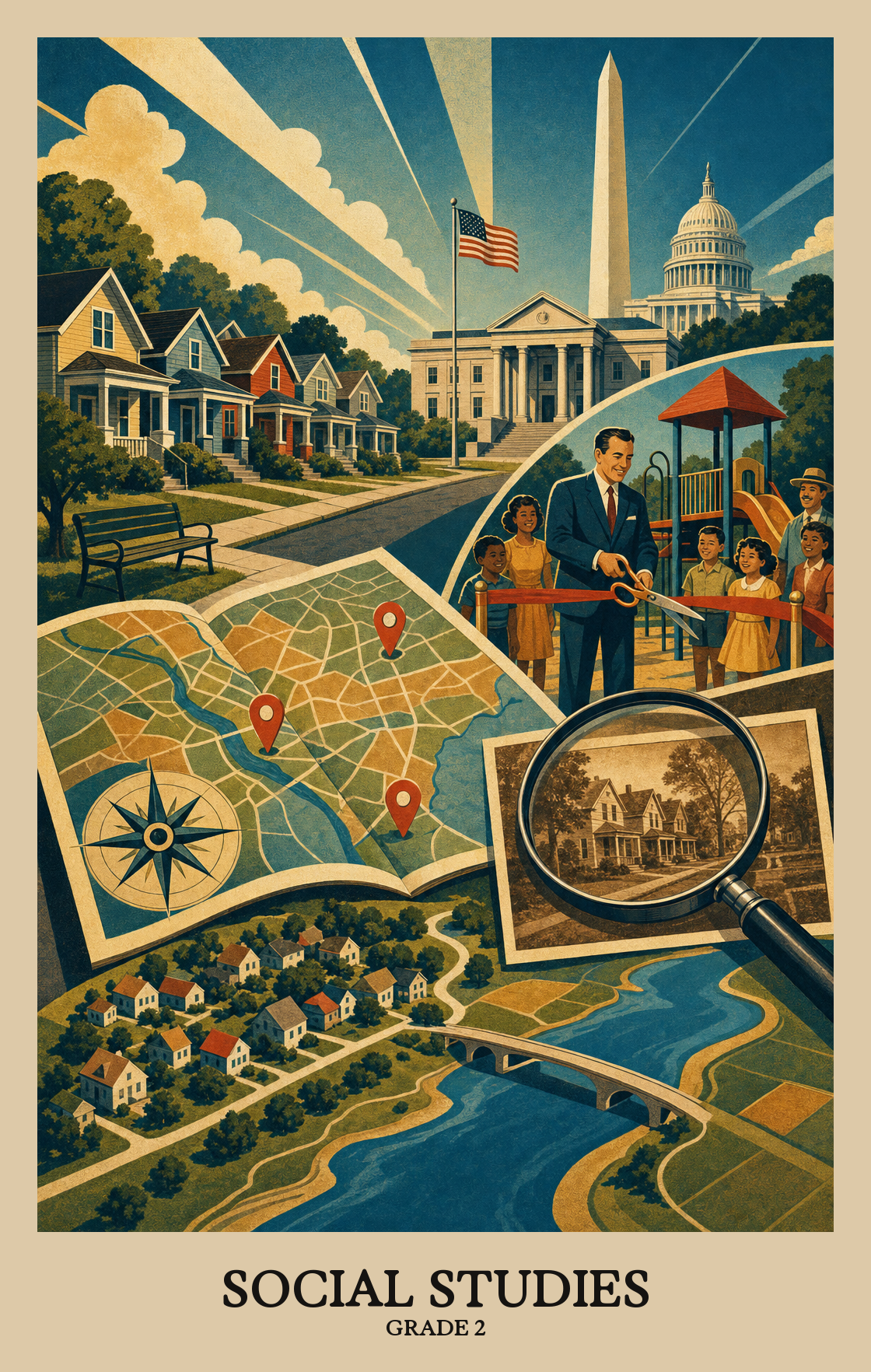
This is the year social studies stretches from the classroom out to the neighborhood. Students start asking real questions about how their community works, who makes the rules, and why people choose to live where they do. They read maps, look at old photos, and learn the story of Washington, DC alongside the country around it. By spring, students can explain a job a local leader does and point to a place on a map where people settled and why.
Students start the year learning how to ask good questions about people, places, and the past. They practice looking at pictures, maps, and short readings to find clues and share what they notice.
Students learn how DC and the country are run, who makes the rules, and why those rules matter. They talk about fairness, voting, and what it means to be a good neighbor at school and in the community.
Students explore how families and communities make choices when they cannot have everything. They learn what saving, spending, and trading look like in real life and how prices help people decide.
Students use maps and photos to study how land, weather, and cities shape daily life. They look at why people move from one place to another and how different groups share food, music, and ideas.
Students learn key moments and people from the history of Washington, DC and the wider country. They compare life in the past to life now and notice what has changed and what has stayed the same.
Students pull the year together by using primary sources, such as photos, letters, and short documents, to back up what they say about the past. They share what they learned through writing, talking, or a small project.
Students ask big "why" and "how" questions about history, government, places, and money, then come up with smaller follow-up questions that help them dig into the answers.
Students pick a question about their community, past events, or how money and places work, then use maps, timelines, or other tools to find answers.
Students look at sources like photos, letters, or books and decide whether each one can be trusted. Then they use what they find to back up what they say.
Students share what they learned from an inquiry by writing, speaking, or creating something, then use that knowledge to do something that matters in their school or community.
| Standard | Definition | Code |
|---|---|---|
| Develop Questions | Students ask big "why" and "how" questions about history, government, places, and money, then come up with smaller follow-up questions that help them dig into the answers. | DC-SS.INQ.2.1 |
| Apply Disciplinary Tools | Students pick a question about their community, past events, or how money and places work, then use maps, timelines, or other tools to find answers. | DC-SS.INQ.2.2 |
| Evaluate Sources and Use Evidence | Students look at sources like photos, letters, or books and decide whether each one can be trusted. Then they use what they find to back up what they say. | DC-SS.INQ.2.3 |
| Communicate and Take Action | Students share what they learned from an inquiry by writing, speaking, or creating something, then use that knowledge to do something that matters in their school or community. | DC-SS.INQ.2.4 |
Local, state, and national governments each handle different jobs. Students learn what those jobs are, who does them, and why communities need different levels of government working at the same time.
Students look at real rules, rights, and government decisions and explain how they connect to big ideas America was built on, like every person following the same laws or leaders sharing power.
Students learn what rights citizens have (like speaking up or voting when they're older) and what responsibilities come with those rights, like following rules and taking part in decisions that affect their community.
| Standard | Definition | Code |
|---|---|---|
| Government Institutions | Local, state, and national governments each handle different jobs. Students learn what those jobs are, who does them, and why communities need different levels of government working at the same time. | DC-SS.CIV.2.1 |
| Foundational Principles | Students look at real rules, rights, and government decisions and explain how they connect to big ideas America was built on, like every person following the same laws or leaders sharing power. | DC-SS.CIV.2.2 |
| Citizenship and Participation | Students learn what rights citizens have (like speaking up or voting when they're older) and what responsibilities come with those rights, like following rules and taking part in decisions that affect their community. | DC-SS.CIV.2.3 |
Scarcity means there isn't enough of something for everyone who wants it. Students learn how having less of something, or wanting a reward, pushes people to make choices, from picking a snack to setting a school rule.
Markets are places where people buy and sell things. Prices and competition help decide who gets what, whether students are looking at a local store, a national chain, or goods shipped from another country.
Saving means setting money aside for later. Students learn the basics of how money works: when to spend, when to save, and what it means to borrow or invest.
| Standard | Definition | Code |
|---|---|---|
| Economic Decision Making | Scarcity means there isn't enough of something for everyone who wants it. Students learn how having less of something, or wanting a reward, pushes people to make choices, from picking a snack to setting a school rule. | DC-SS.ECON.2.1 |
| Markets and Exchange | Markets are places where people buy and sell things. Prices and competition help decide who gets what, whether students are looking at a local store, a national chain, or goods shipped from another country. | DC-SS.ECON.2.2 |
| Personal Finance | Saving means setting money aside for later. Students learn the basics of how money works: when to spend, when to save, and what it means to borrow or invest. | DC-SS.ECON.2.3 |
Students read maps and look at photos to learn about real places and how people live in them. They notice how geography shapes what people build, grow, or do.
Students look at how people change the places they live, like building roads through forests or farming flat land, and how the land itself shapes what people do there.
Students look at why people move to new places and how those moves spread ideas, goods, and customs from one region to another.
| Standard | Definition | Code |
|---|---|---|
| Geographic Representations | Students read maps and look at photos to learn about real places and how people live in them. They notice how geography shapes what people build, grow, or do. | DC-SS.GEO.2.1 |
| Human-Environment Interaction | Students look at how people change the places they live, like building roads through forests or farming flat land, and how the land itself shapes what people do there. | DC-SS.GEO.2.2 |
| Movement and Connections | Students look at why people move to new places and how those moves spread ideas, goods, and customs from one region to another. | DC-SS.GEO.2.3 |
Students learn about important people and events that shaped Washington, D.C., and explain how the city's history connects to the rest of the country.
Students look at how American life has changed over time, from the first colonists through today, noticing what stayed the same and what shifted across different periods in history.
Students look at two or more ancient civilizations or historical events, note what made each one different, and talk about how those changes still shape the world today.
Students use old photographs, letters, and books to piece together what happened in the past, then explain why events unfolded the way they did. They consider how different people may have experienced the same event differently.
| Standard | Definition | Code |
|---|---|---|
| District of Columbia History | Students learn about important people and events that shaped Washington, D.C., and explain how the city's history connects to the rest of the country. | DC-SS.HIST.2.1 |
| United States History | Students look at how American life has changed over time, from the first colonists through today, noticing what stayed the same and what shifted across different periods in history. | DC-SS.HIST.2.2 |
| World History | Students look at two or more ancient civilizations or historical events, note what made each one different, and talk about how those changes still shape the world today. | DC-SS.HIST.2.3 |
| Historical Reasoning | Students use old photographs, letters, and books to piece together what happened in the past, then explain why events unfolded the way they did. They consider how different people may have experienced the same event differently. | DC-SS.HIST.2.4 |
Federally administered sample-based assessment in reading, mathematics, science, and writing. NAEP results inform state-by-state comparisons rather than individual student or school accountability.
Students learn about their city and country through four lenses: how the government works, how people make choices with money, how maps show places, and how the past shaped today. It is a first real introduction to citizenship, communities, and history.
Talk about the neighborhood on the way to school. Point out a city bus, a library, a stop sign, or a memorial and ask who pays for it or who decided where to put it. Short conversations about real places do more than worksheets.
Students should be able to ask a good question about a place or event, find a clue in a picture or short reading, and explain what it means in a sentence or two. They should also know basic facts about local government and money choices.
Most teachers start with geography and community, move into civics and local government, then build into economics and history later in the year. Inquiry skills are not a unit. Weave them into every strand so students practice asking questions and using sources from week one.
Students live in the capital, so the city is both their home and a national landmark. Lessons connect local sites like the Capitol, the Mall, and Anacostia to bigger ideas about government and history. That double role is a real teaching advantage.
It should not be. Students are expected to ask questions, look at pictures and short readings, and back up their ideas with evidence. If homework feels like a list of facts to recite, ask the teacher what question the unit is trying to answer.
Using evidence is the hardest part. Students can recall facts but struggle to point at a specific source and explain how it supports a claim. Plan to model this with short primary sources several times across each unit, not just once.
Use real moments at the store or at home. Compare two snacks and talk about why one costs more, or set aside a jar for saving toward something small. Choices about spending and saving are the heart of what students study.
A solid project has a clear question, two or three sources students actually used, and a short product where students share what they found and what they think should happen next. The action piece matters. It turns social studies into something students do, not just learn about.