Sparking ideas from real life
Students start the year by turning things they already know, like family stories, favorite songs, or playground moments, into ideas for photos, videos, drawings on a tablet, and short sound clips.
This is the year students start using cameras, drawings, sounds, and simple computer tools to tell their own short stories. They come up with ideas from things they care about, then plan and put the pieces together into a finished little project like a photo story or short video. Students also watch and listen to media made by others and talk about what it means. By spring, they can plan a short media project, share it with the class, and explain why they made the choices they did.
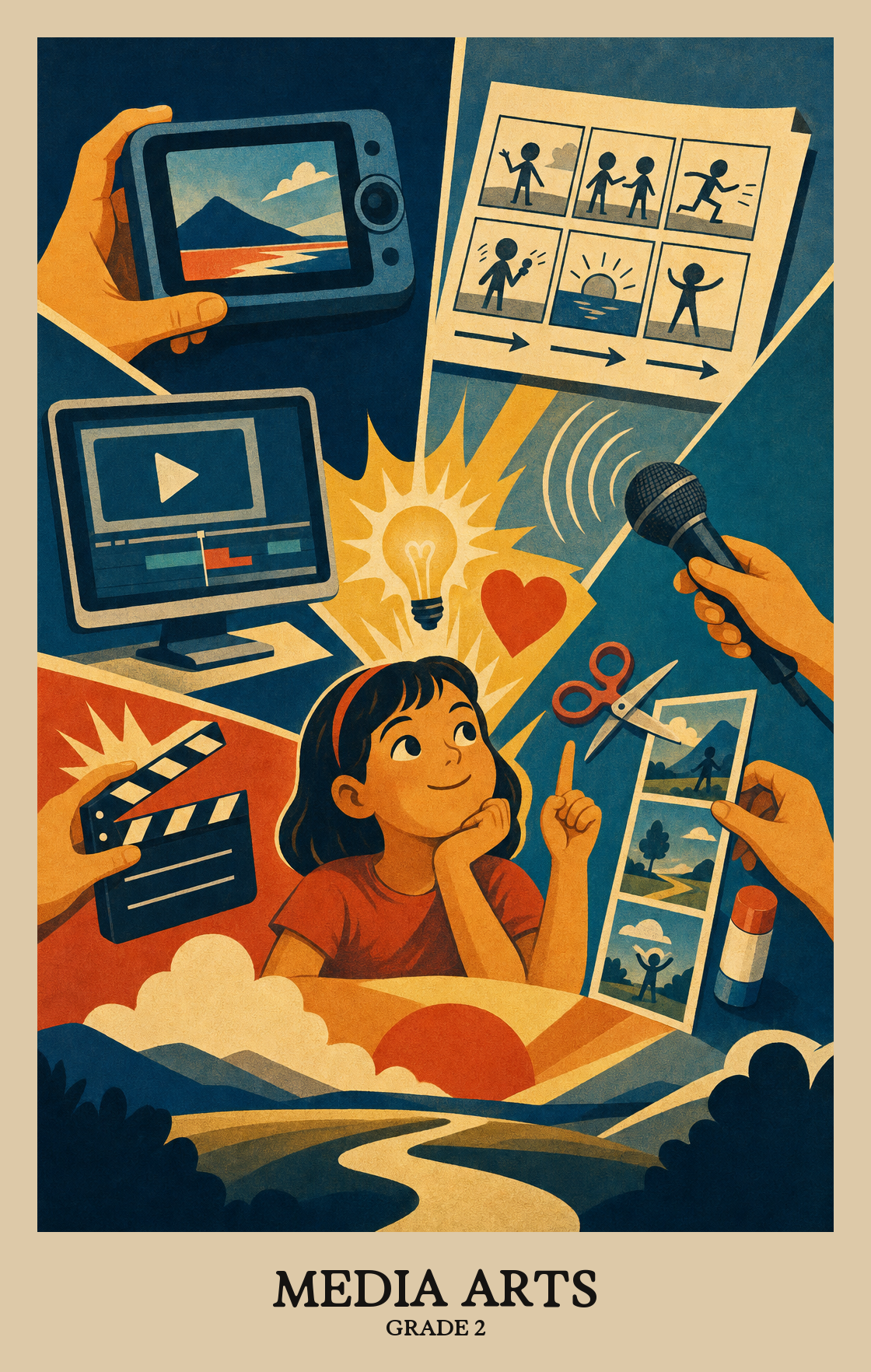
Students start the year by turning things they already know, like family stories, favorite songs, or playground moments, into ideas for photos, videos, drawings on a tablet, and short sound clips.
Students try out tools like cameras, recording apps, and simple drawing programs. They learn how to plan a small project, gather pictures or sounds, and put the pieces together in an order that makes sense.
Students revisit their projects to make them clearer and more interesting. They pick which photos, clips, or scenes to keep, fix rough spots, and get the work ready for a parent, classmate, or teacher to see.
Students present finished work and look closely at media made by others, including ads, cartoons, and short videos. They talk about what the maker was trying to say and what they liked or would change.
Students connect something from their own life to a media arts project, using what they know and what they've experienced to shape the work they make.
Students look at a photo, video, or artwork and talk about where it came from, who made it, and why. That context helps them understand what the work really means.
| Standard | Definition | Code |
|---|---|---|
| Synthesize and relate knowledge and personal experiences to make art | Students connect something from their own life to a media arts project, using what they know and what they've experienced to shape the work they make. | MA:Cn10.2 |
| Relate artistic ideas and works with societal, cultural | Students look at a photo, video, or artwork and talk about where it came from, who made it, and why. That context helps them understand what the work really means. | MA:Cn11.2 |
Students brainstorm ideas for a media project, like a photo, short video, or digital drawing, and start shaping those ideas into a plan before making anything.
Students plan their media art project before making it, choosing what images, sounds, or text to include and deciding how to arrange them.
Students look back at a media project they have started and make changes to improve it before calling it finished.
| Standard | Definition | Code |
|---|---|---|
| Generate and conceptualize artistic ideas and work | Students brainstorm ideas for a media project, like a photo, short video, or digital drawing, and start shaping those ideas into a plan before making anything. | MA:Cr1.2 |
| Organize and develop artistic ideas and work | Students plan their media art project before making it, choosing what images, sounds, or text to include and deciding how to arrange them. | MA:Cr2.2 |
| Refine and complete artistic work | Students look back at a media project they have started and make changes to improve it before calling it finished. | MA:Cr3.2 |
Students pick a piece of media work they've made or studied and explain why it's worth sharing with an audience.
Students practice and polish a media project, like a short video or digital image, until it looks and sounds the way they intended.
Students share a finished media project, like a photo, video, or digital image, and explain what feeling or idea they wanted it to show.
| Standard | Definition | Code |
|---|---|---|
| Analyze, interpret, and select artistic work for presentation | Students pick a piece of media work they've made or studied and explain why it's worth sharing with an audience. | MA:Pr4.2 |
| Develop and refine artistic techniques and work for presentation | Students practice and polish a media project, like a short video or digital image, until it looks and sounds the way they intended. | MA:Pr5.2 |
| Convey meaning through the presentation of artistic work | Students share a finished media project, like a photo, video, or digital image, and explain what feeling or idea they wanted it to show. | MA:Pr6.2 |
Students look closely at photos, videos, or digital art and explain what they notice. They describe what the image shows and share what they think the creator was trying to do.
Students look at a piece of media art, such as a photo, animation, or short video, and explain what they think the creator was trying to say. They talk about what the work means to them and why.
Students look at a piece of media art and decide what makes it work well or fall flat, using a simple checklist or set of questions to back up their thinking.
| Standard | Definition | Code |
|---|---|---|
| Perceive and analyze artistic work | Students look closely at photos, videos, or digital art and explain what they notice. They describe what the image shows and share what they think the creator was trying to do. | MA:Re7.2 |
| Interpret intent and meaning in artistic work | Students look at a piece of media art, such as a photo, animation, or short video, and explain what they think the creator was trying to say. They talk about what the work means to them and why. | MA:Re8.2 |
| Apply criteria to evaluate artistic work | Students look at a piece of media art and decide what makes it work well or fall flat, using a simple checklist or set of questions to back up their thinking. | MA:Re9.2 |
Media arts means making things like short videos, slideshows, simple animations, voice recordings, and digital drawings. Students learn that the photos, cartoons, and shows around them were made by people who planned them on purpose.
By spring, students can plan a simple project, like a short video or a digital story, and finish it from start to end. They can explain what they wanted to show and pick out one part they would change next time.
Let students use a phone or tablet to record a short story, photograph things they care about, or draw a comic. Ask them what their piece is about and who they made it for. Five minutes of real interest goes a long way.
No. A phone camera, a free drawing app, or even paper flipbooks are plenty. The skill at this age is planning an idea and finishing it, not the tools used to make it.
Start with short, single-step projects like a photo with a caption or a ten-second video. Move into multi-step work in the winter, such as a slideshow with narration. Save longer projects for spring, when students can plan, revise, and present with more independence.
Planning before making is the hardest part. Most second graders want to jump straight to the device. Build in a quick sketch or storyboard step every time, and revisit it until students do it on their own.
Give students two simple questions: what did the maker want me to notice, and how did they show it. Use these on their own projects and on picture books, cartoons, or short clips. Plain language matters more than art vocabulary.
Students often retell a reading passage as a short video, record themselves explaining a math idea, or photograph a science observation. These connections help students see that media is a way to share thinking, not a separate subject.
A student is ready for third grade when they can plan a small project, finish it, and say one thing they like about it and one thing they would change. If those steps feel natural at home, the skills are in place.