Looking closely at art
Students start the year by paying attention. They notice colors, lines, and shapes in pictures around them and talk about what they see in a painting or a drawing.
This is the year art becomes a way to share ideas on purpose. Students learn that a drawing or painting can come from something they saw, felt, or remember, and they practice using tools like crayons, paint, and clay with more care. They also start looking closely at art made by others and saying what they notice. By spring, students can pick a finished piece they are proud of, explain what it is about, and share it with the class.
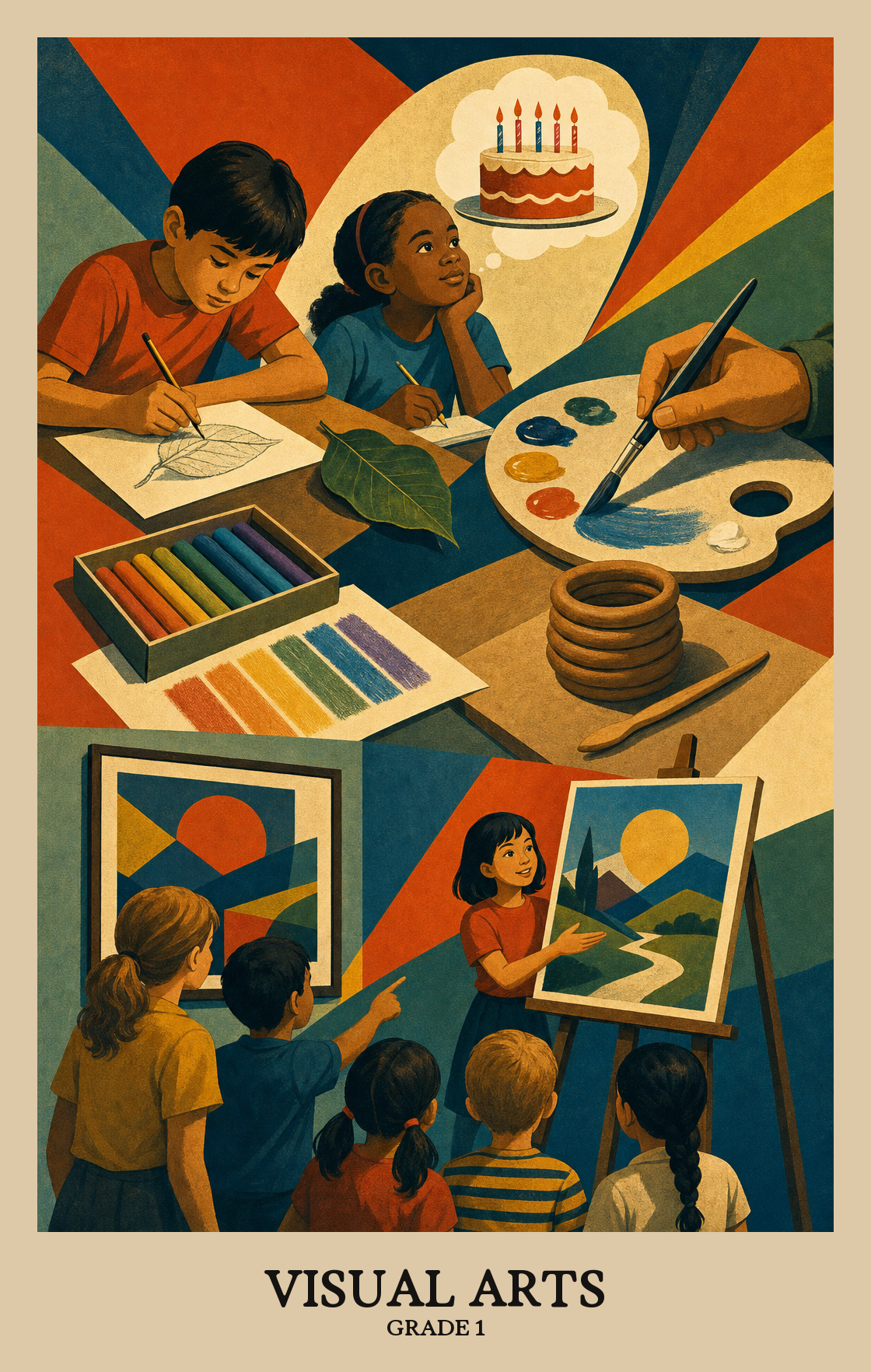
Students start the year by paying attention. They notice colors, lines, and shapes in pictures around them and talk about what they see in a painting or a drawing.
Students come up with their own ideas for art instead of copying. They draw from things they know, like their family, a pet, or a favorite place, and try out different ways to put an idea on paper.
Students practice with crayons, paint, paper, and clay. They learn to hold tools the right way, mix simple colors, and keep working on a piece until it looks closer to what they pictured.
Students look at art made by people from different cultures and time periods. They talk about what a picture might mean and connect it to their own life or a story they have heard.
Students pick a piece they are proud of and get it ready to show. They explain what their art is about and listen as classmates share theirs, using simple words to say what is working well.
Students use things they know and moments from their own lives as the starting point for making art.
Students look at a painting or craft and talk about where it came from, who made it, and what was happening in that place or time. Art tells a story beyond the image itself.
| Standard | Definition | Code |
|---|---|---|
| Synthesize and relate knowledge and personal experiences to make art | Students use things they know and moments from their own lives as the starting point for making art. | VA:Cn10.1 |
| Relate artistic ideas and works with societal, cultural | Students look at a painting or craft and talk about where it came from, who made it, and what was happening in that place or time. Art tells a story beyond the image itself. | VA:Cn11.1 |
Students come up with ideas for their own artwork. They think about what they want to make before they start drawing, painting, or building.
Students take a simple art idea (a shape, a color, a scene) and work through how to make it into a finished piece, deciding what to add, move, or change along the way.
Students look at their artwork, decide what needs fixing or finishing, and make changes before calling it done.
| Standard | Definition | Code |
|---|---|---|
| Generate and conceptualize artistic ideas and work | Students come up with ideas for their own artwork. They think about what they want to make before they start drawing, painting, or building. | VA:Cr1.1 |
| Organize and develop artistic ideas and work | Students take a simple art idea (a shape, a color, a scene) and work through how to make it into a finished piece, deciding what to add, move, or change along the way. | VA:Cr2.1 |
| Refine and complete artistic work | Students look at their artwork, decide what needs fixing or finishing, and make changes before calling it done. | VA:Cr3.1 |
Students look at their own drawings or artwork, pick the pieces they want to share, and explain why those pieces feel ready to show others.
Students practice and improve a piece of artwork before showing it to others. They learn to look at their own work and make it better.
Students choose how to display their artwork and think about what they want it to say to someone looking at it.
| Standard | Definition | Code |
|---|---|---|
| Analyze, interpret, and select artistic work for presentation | Students look at their own drawings or artwork, pick the pieces they want to share, and explain why those pieces feel ready to show others. | VA:Pr4.1 |
| Develop and refine artistic techniques and work for presentation | Students practice and improve a piece of artwork before showing it to others. They learn to look at their own work and make it better. | VA:Pr5.1 |
| Convey meaning through the presentation of artistic work | Students choose how to display their artwork and think about what they want it to say to someone looking at it. | VA:Pr6.1 |
Students look closely at a piece of art and describe what they notice, like shapes, colors, and lines. Then they start to explain what those choices might mean.
Students look at a piece of art and explain what they think the artist was trying to say or show. They use what they see in the image to back up their idea.
Students look at a piece of art and explain why they like it or think it works well, using specific reasons like color, shape, or how the picture makes them feel.
| Standard | Definition | Code |
|---|---|---|
| Perceive and analyze artistic work | Students look closely at a piece of art and describe what they notice, like shapes, colors, and lines. Then they start to explain what those choices might mean. | VA:Re7.1 |
| Interpret intent and meaning in artistic work | Students look at a piece of art and explain what they think the artist was trying to say or show. They use what they see in the image to back up their idea. | VA:Re8.1 |
| Apply criteria to evaluate artistic work | Students look at a piece of art and explain why they like it or think it works well, using specific reasons like color, shape, or how the picture makes them feel. | VA:Re9.1 |
Students make their own art, talk about what they made, and look at art by other people. They try out drawing, painting, cutting, gluing, and building with simple materials. They also start sharing why they chose certain colors or shapes.
Keep paper, crayons, scissors, and glue somewhere easy to reach. Ask students to tell the story behind a drawing instead of judging if it looks right. Visiting a library or museum and talking about one picture also counts.
No. First grade is about trying ideas, not making things look real. Praise the effort, the choices, and the story behind the work rather than how neat or accurate the picture is.
Start with line, shape, and color in the fall using drawing and simple collage. Move into mixing colors and basic sculpture in the winter. By spring, students can plan a piece, revise it, and explain their choices to a partner.
Students can come up with an idea, pick materials, and finish a piece without copying a neighbor. They can point to a part of someone else's art and say what they notice or what it might mean. They can also say one thing they would change.
Describing art builds vocabulary and careful looking, which help with reading and writing too. When students explain choices in their own work, they practice reasoning and giving evidence. A short sentence like "I picked blue because it felt cold" is a real start.
Two short blocks a week, around 30 to 45 minutes each, works well at this age. One block for making, one block for looking at and discussing art keeps both sides of the standards moving. Longer projects can stretch across two or three sessions.
Ask what part they like and what part feels hard, then help with that one part. Avoid fixing the picture for them. Saving finished pieces in a folder and looking back after a few months shows real growth and builds confidence.