Playing and pretending together
Students step into make-believe with classmates. They try on characters, use their voices and bodies to show feelings, and build the trust it takes to play a part in front of others.
This is the year pretend play starts to look like real theatre. Students make up characters, act out short scenes, and use their voices and bodies to show how someone feels. They also watch classmates perform and talk about what the story meant. By spring, students can plan a simple scene with a partner, perform it for the class, and say what they liked about another group's work.
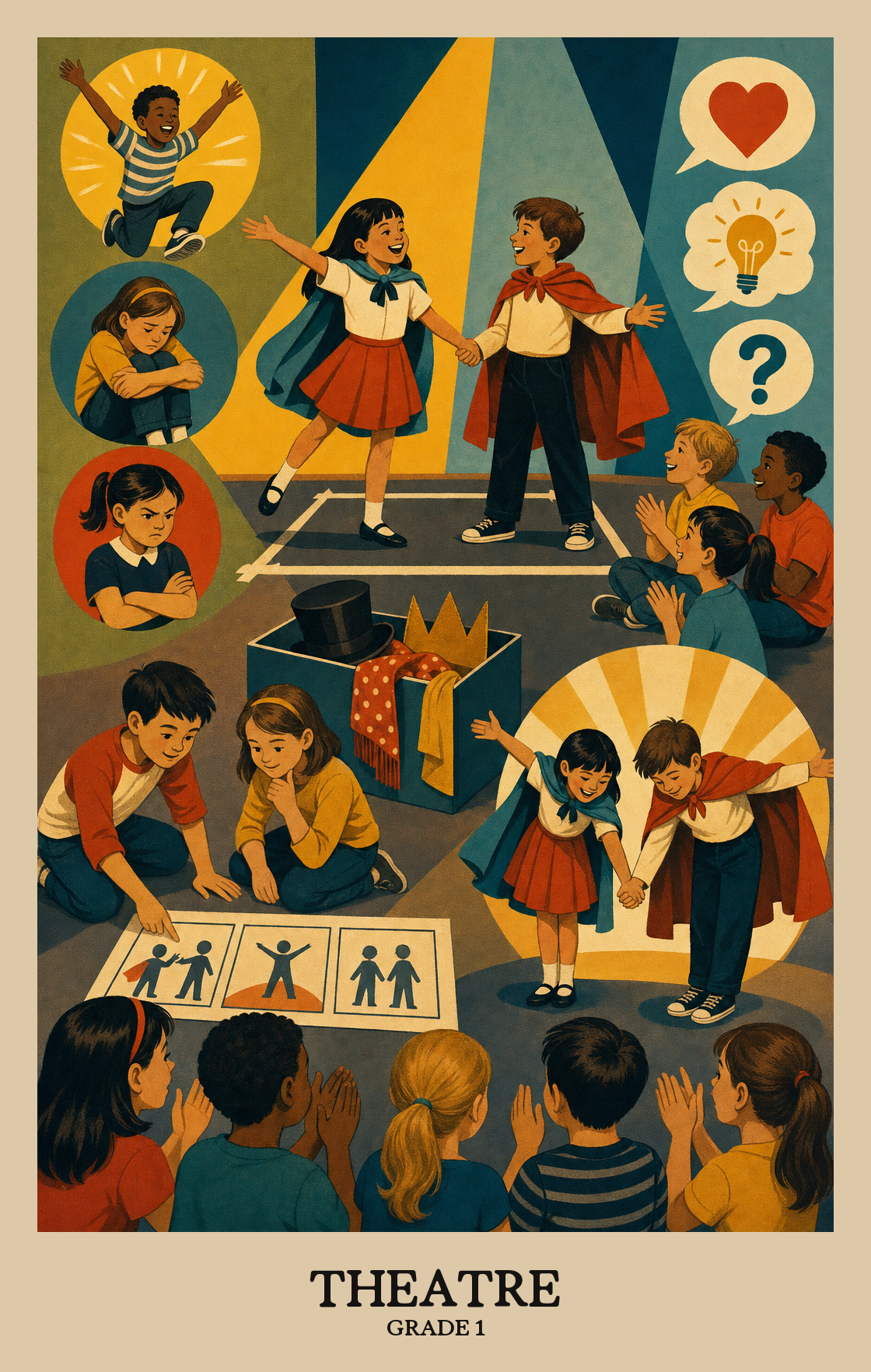
Students step into make-believe with classmates. They try on characters, use their voices and bodies to show feelings, and build the trust it takes to play a part in front of others.
Students start shaping short scenes from their own ideas. They decide who the characters are, where the story happens, and what should come first, next, and at the end.
Students rehearse a short piece and make it stronger. They try out different voices, add simple props or costumes, and rework parts that feel confusing.
Students become a thoughtful audience. They notice what the actors do, share what a scene might mean, and say what they liked and what they would change.
Students connect plays to their own families, neighborhoods, and the books they read. They use theatre to tell stories that matter to them and to learn from stories that come from other places.
Students draw on things they know and have lived through to make choices in drama and play. A memory, a feeling, or a story from real life can shape how they act out a scene.
Students connect a play or story to their own life, family, or community to understand why it matters. This helps them see that theatre reflects real people and real experiences.
| Standard | Definition | Code |
|---|---|---|
| Synthesize and relate knowledge and personal experiences to make art | Students draw on things they know and have lived through to make choices in drama and play. A memory, a feeling, or a story from real life can shape how they act out a scene. | TH:Cn10.1 |
| Relate artistic ideas and works with societal, cultural | Students connect a play or story to their own life, family, or community to understand why it matters. This helps them see that theatre reflects real people and real experiences. | TH:Cn11.1 |
Students make up characters and short scenes from their own imagination, then share the idea with the class or a partner before acting it out.
Students take a story idea and shape it into a short scene, deciding what the characters do and say. They practice and adjust until the scene feels ready to share.
Students look back at a scene or character idea they started and make it better before calling it done. Small fixes, like changing a gesture or a line, help the story come across more clearly.
| Standard | Definition | Code |
|---|---|---|
| Generate and conceptualize artistic ideas and work | Students make up characters and short scenes from their own imagination, then share the idea with the class or a partner before acting it out. | TH:Cr1.1 |
| Organize and develop artistic ideas and work | Students take a story idea and shape it into a short scene, deciding what the characters do and say. They practice and adjust until the scene feels ready to share. | TH:Cr2.1 |
| Refine and complete artistic work | Students look back at a scene or character idea they started and make it better before calling it done. Small fixes, like changing a gesture or a line, help the story come across more clearly. | TH:Cr3.1 |
Students choose a character or scene to perform and explain why it fits the story. They practice making basic decisions about how a character moves, speaks, or feels before presenting to an audience.
Students practice how to move, speak, and show emotion on stage. They keep working on a scene or character until it feels ready to perform for an audience.
Students share a short performance or scene and make choices about voice, movement, and expression to tell the story the way they intend.
| Standard | Definition | Code |
|---|---|---|
| Analyze, interpret, and select artistic work for presentation | Students choose a character or scene to perform and explain why it fits the story. They practice making basic decisions about how a character moves, speaks, or feels before presenting to an audience. | TH:Pr4.1 |
| Develop and refine artistic techniques and work for presentation | Students practice how to move, speak, and show emotion on stage. They keep working on a scene or character until it feels ready to perform for an audience. | TH:Pr5.1 |
| Convey meaning through the presentation of artistic work | Students share a short performance or scene and make choices about voice, movement, and expression to tell the story the way they intend. | TH:Pr6.1 |
Students look at a short play or performance and talk about what they noticed, such as what the characters did or how the story felt.
Students look at a short play or puppet show and explain what they think the actors or characters are trying to say or show.
Students look at a scene or performance and explain what worked and what didn't, using simple reasons like "the voice was too quiet" or "the character's feelings were clear."
| Standard | Definition | Code |
|---|---|---|
| Perceive and analyze artistic work | Students look at a short play or performance and talk about what they noticed, such as what the characters did or how the story felt. | TH:Re7.1 |
| Interpret intent and meaning in artistic work | Students look at a short play or puppet show and explain what they think the actors or characters are trying to say or show. | TH:Re8.1 |
| Apply criteria to evaluate artistic work | Students look at a scene or performance and explain what worked and what didn't, using simple reasons like "the voice was too quiet" or "the character's feelings were clear." | TH:Re9.1 |
Students act out short stories, pretend to be characters, and use their voices and bodies to show feelings. Most of the work happens through play, simple skits, and stories everyone makes up together. Performing for a real audience is a small part of the year.
Read a picture book and ask students to act out a character or show how a character feels with their face and voice. Five minutes of pretend play, puppet shows with stuffed animals, or retelling a story counts. The goal is comfort with making choices in front of others.
Start with imagination and body and voice warm-ups so students feel safe being silly. Move into short character and scene work built from familiar stories. End with small group performances where students make choices about how a story is told.
Shy students often do better in pairs or small groups before solo work. Roles like narrator, sound effects, or puppet handler give a way in without standing alone. Most students warm up by spring once routines feel familiar.
By spring, students can take on a character, stay in the scene for a short time, and explain a simple choice they made. They can also watch a classmate's scene and say one thing they noticed about the character or story.
Students practice noticing before judging. After watching a short scene, ask what the character wanted, how the actor showed feelings, and what could make it clearer. Sentence starters like "I noticed" and "I wonder" help students give kind, specific feedback.
Acting out a story builds reading comprehension because students have to figure out what a character wants and why. Theatre also connects to social studies when students play out scenes from different times or places. Many teachers fold short drama moments into reading blocks.
Not really. Most first grade theatre uses improvised dialogue, retellings, or very short repeated phrases. Memorizing a long script is not the point. Making clear choices about a character is.