Exploring sounds and singing
Students start the year by singing simple songs together and listening closely to different sounds. They learn to match pitch, keep a steady beat, and notice when music is loud or soft, fast or slow.
This is the year music shifts from simply singing along to making real musical choices. Students invent short rhythms and melodies, then practice and clean them up to share with others. They start describing what they hear in a song and why it makes them feel a certain way. By spring, they can perform a short piece they helped create and explain one thing they like about it.
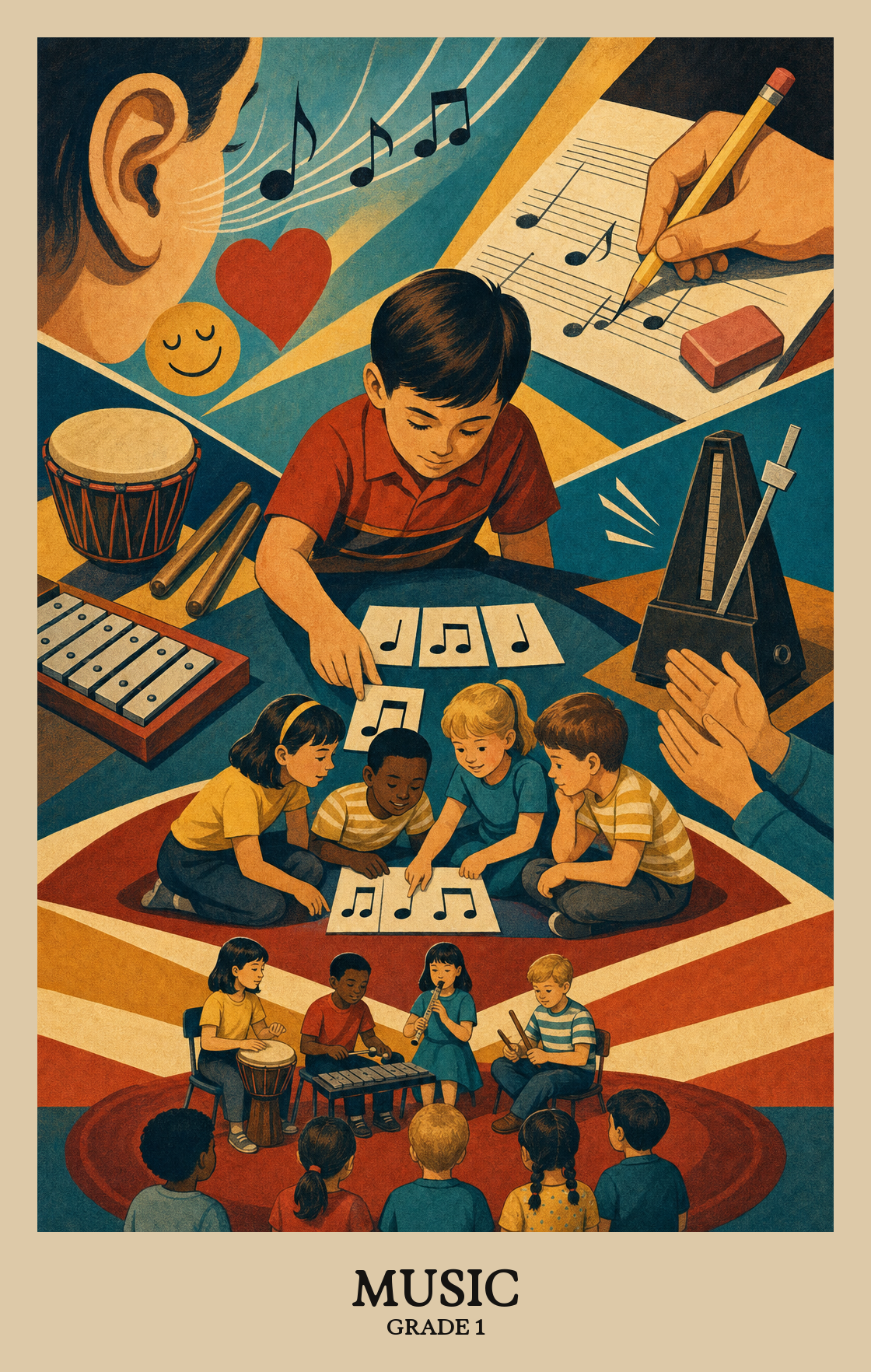
Students start the year by singing simple songs together and listening closely to different sounds. They learn to match pitch, keep a steady beat, and notice when music is loud or soft, fast or slow.
Students try out their own short musical ideas using their voices, classroom instruments, and body sounds like claps and stomps. They pick which ideas they like best and practice them to share with the class.
Students practice a few songs or rhythm pieces to play and sing for an audience. They work on starting and stopping together, singing clearly, and showing the feeling of the music through their faces and movement.
Students listen to music from different times and places and talk about what they hear. They describe how a song makes them feel, what it might be about, and connect it to their own lives at home and school.
Students connect something they know or have lived through to a song, a sound, or a musical idea they are making or exploring.
Songs and music come from somewhere. Students connect a piece of music to the time, place, or people it came from to better understand what it means.
| Standard | Definition | Code |
|---|---|---|
| Synthesize and relate knowledge and personal experiences to make art | Students connect something they know or have lived through to a song, a sound, or a musical idea they are making or exploring. | MU:Cn10.1 |
| Relate artistic ideas and works with societal, cultural | Songs and music come from somewhere. Students connect a piece of music to the time, place, or people it came from to better understand what it means. | MU:Cn11.1 |
Students come up with simple musical ideas, like a short rhythm to clap or a few notes to hum, and start turning those ideas into something they can share.
Students arrange sounds and musical ideas into a short piece or pattern. They make choices about what comes first, what repeats, and how it ends.
Students revisit a song or rhythm they created, make small changes to improve it, and decide when it's ready to share.
| Standard | Definition | Code |
|---|---|---|
| Generate and conceptualize artistic ideas and work | Students come up with simple musical ideas, like a short rhythm to clap or a few notes to hum, and start turning those ideas into something they can share. | MU:Cr1.1 |
| Organize and develop artistic ideas and work | Students arrange sounds and musical ideas into a short piece or pattern. They make choices about what comes first, what repeats, and how it ends. | MU:Cr2.1 |
| Refine and complete artistic work | Students revisit a song or rhythm they created, make small changes to improve it, and decide when it's ready to share. | MU:Cr3.1 |
Students choose a song or piece of music to perform and talk about why it fits the moment. They start learning what makes a piece worth sharing with an audience.
Students practice a song or rhythm until it sounds the way they want it to. They learn that getting better takes repetition and attention to the small details.
Students perform a song or rhythm for others and make choices, like how loud or soft to play, that help listeners feel or understand something.
| Standard | Definition | Code |
|---|---|---|
| Analyze, interpret, and select artistic work for presentation | Students choose a song or piece of music to perform and talk about why it fits the moment. They start learning what makes a piece worth sharing with an audience. | MU:Pr4.1 |
| Develop and refine artistic techniques and work for presentation | Students practice a song or rhythm until it sounds the way they want it to. They learn that getting better takes repetition and attention to the small details. | MU:Pr5.1 |
| Convey meaning through the presentation of artistic work | Students perform a song or rhythm for others and make choices, like how loud or soft to play, that help listeners feel or understand something. | MU:Pr6.1 |
Students listen to a short piece of music and describe what they notice, such as whether it feels fast or slow, loud or soft, or happy or sad.
Students listen to a short piece of music and explain what feeling or story they think it tells, using what they hear in the melody or rhythm to back up their idea.
Students listen to a short piece of music and decide what makes it good or not so good, using simple reasons like whether it felt fast or slow, loud or soft, or happy or sad.
| Standard | Definition | Code |
|---|---|---|
| Perceive and analyze artistic work | Students listen to a short piece of music and describe what they notice, such as whether it feels fast or slow, loud or soft, or happy or sad. | MU:Re7.1 |
| Interpret intent and meaning in artistic work | Students listen to a short piece of music and explain what feeling or story they think it tells, using what they hear in the melody or rhythm to back up their idea. | MU:Re8.1 |
| Apply criteria to evaluate artistic work | Students listen to a short piece of music and decide what makes it good or not so good, using simple reasons like whether it felt fast or slow, loud or soft, or happy or sad. | MU:Re9.1 |
Students sing simple songs, keep a steady beat, play classroom instruments, and move to music. They start making up short rhythms and melodies of their own, perform for classmates, and talk about what they hear in a piece of music.
Sing along to songs in the car, clap rhythms together, or tap a steady beat on the table while music plays. Ask what instruments students hear and how a song makes them feel. Five minutes a day is plenty.
Not yet in a formal way. Students at this age work mostly by ear and by feel, matching pitches, keeping a beat, and noticing patterns. Simple icons for loud and soft or fast and slow are common before standard notation arrives later.
Start with steady beat, call-and-response singing, and matching pitch. Add simple rhythm patterns and classroom instruments next, then move into short composing and performing tasks in the spring once routines are solid.
Keeping a steady beat while singing is the biggest hurdle, along with matching pitch in a group. Short daily practice with body percussion and echo singing helps more than longer weekly drills.
Students are not judged on talent. The goal is that students can make up a short rhythm or melody, try it out, change something to make it better, and share it with the class. Effort and willingness to share matter most.
Build up in small steps. Group singing first, then partner work, then short solo turns of four or eight beats. Letting students play a rhythm instrument instead of singing a solo often opens the door.
By spring, students should keep a steady beat, sing in tune with a group, echo a short rhythm, name a few instruments by sound, and say something specific about a song they heard, such as fast or slow, loud or quiet.
Hearing music from different places and eras helps students notice that music has a purpose, such as celebration, work, or storytelling. It also gives them more sounds and styles to draw on when they make up music of their own.