Moving in personal space
Students start the year exploring how their bodies move. They try out shapes, levels, and ways of traveling across the floor while learning to share space safely with classmates.
This is the year dance starts to feel like making something, not just moving around. Students come up with their own movement ideas, shape them into short dances, and practice them to share with classmates. They also start watching dance more carefully, noticing what a dancer is showing and connecting it to their own lives. By spring, students can perform a simple dance they helped create and say what it means.
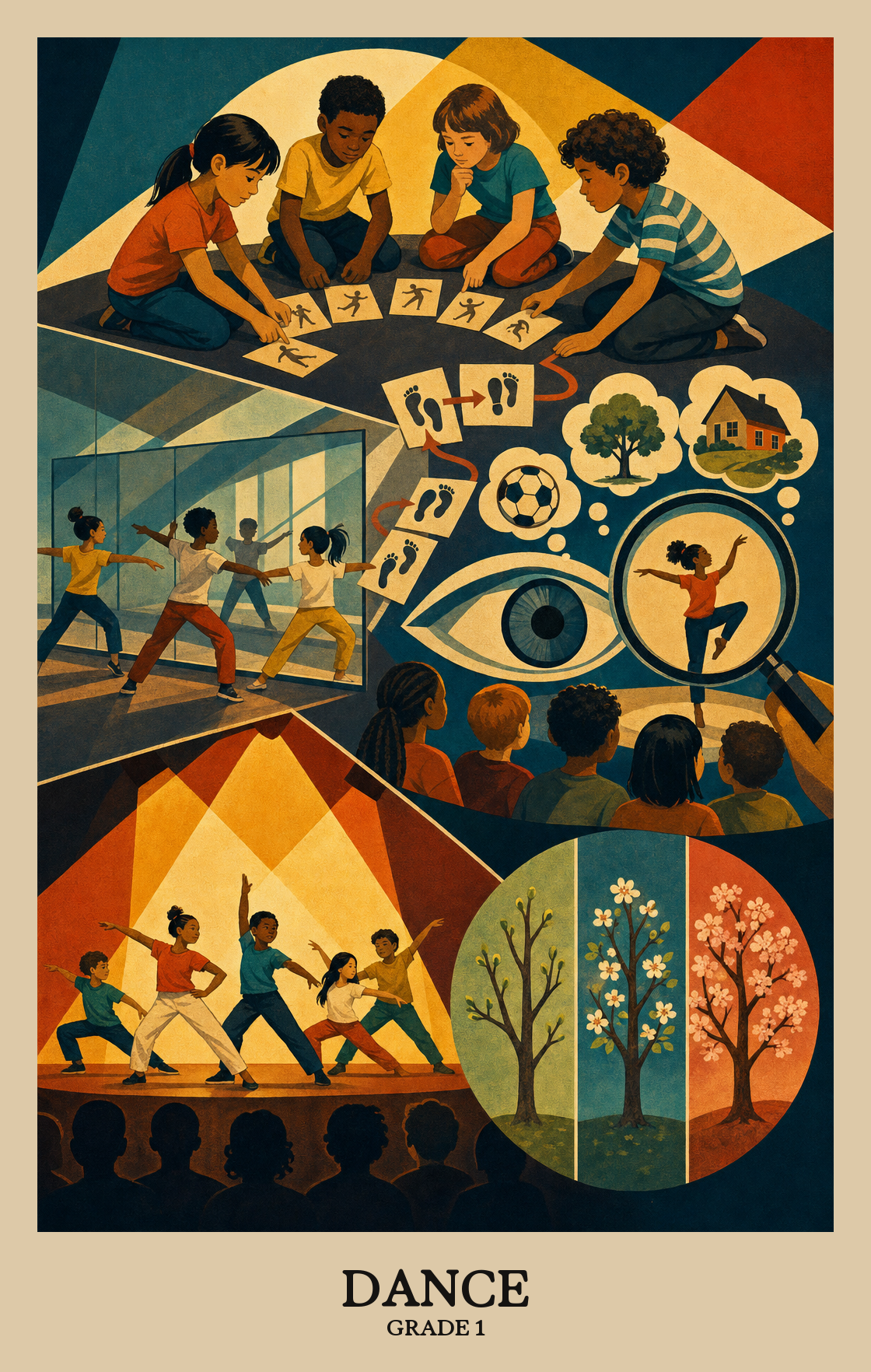
Students start the year exploring how their bodies move. They try out shapes, levels, and ways of traveling across the floor while learning to share space safely with classmates.
Students use pictures, stories, and their own experiences to invent short dances. They pick movements on purpose instead of just copying, and start to explain what their dance is about.
Students put movements in order and practice them so a dance has a clear beginning, middle, and end. They work on smoother steps and stronger shapes before showing their work to others.
Students watch each other and short dance clips, then describe what they noticed. They learn to say what worked, what a dance might mean, and how dance connects to people and places around them.
Students connect something from their own life to a dance they make or perform. A memory, a feeling, or something they've seen can shape the way they move.
Students learn that dances come from real places, times, and communities. Watching or performing a dance teaches them something about the people who made it.
| Standard | Definition | Code |
|---|---|---|
| Synthesize and relate knowledge and personal experiences to make art | Students connect something from their own life to a dance they make or perform. A memory, a feeling, or something they've seen can shape the way they move. | DA:Cn10.1 |
| Relate artistic ideas and works with societal, cultural | Students learn that dances come from real places, times, and communities. Watching or performing a dance teaches them something about the people who made it. | DA:Cn11.1 |
Students come up with their own ideas for a dance, then start shaping those ideas into simple movements they can show to others.
Students take a movement idea and shape it into a short dance by choosing how to arrange their steps and gestures in order.
Students look back at a dance they made, make changes to improve it, and practice until it feels finished.
| Standard | Definition | Code |
|---|---|---|
| Generate and conceptualize artistic ideas and work | Students come up with their own ideas for a dance, then start shaping those ideas into simple movements they can show to others. | DA:Cr1.1 |
| Organize and develop artistic ideas and work | Students take a movement idea and shape it into a short dance by choosing how to arrange their steps and gestures in order. | DA:Cr2.1 |
| Refine and complete artistic work | Students look back at a dance they made, make changes to improve it, and practice until it feels finished. | DA:Cr3.1 |
Students choose a dance or movement to share with an audience and explain why they picked it.
Students practice a dance until it's ready to share with an audience. They work on the movements, make improvements, and polish the performance before presenting it.
Students perform a dance in front of others and use movement to show an idea or feeling, not just steps.
| Standard | Definition | Code |
|---|---|---|
| Analyze, interpret, and select artistic work for presentation | Students choose a dance or movement to share with an audience and explain why they picked it. | DA:Pr4.1 |
| Develop and refine artistic techniques and work for presentation | Students practice a dance until it's ready to share with an audience. They work on the movements, make improvements, and polish the performance before presenting it. | DA:Pr5.1 |
| Convey meaning through the presentation of artistic work | Students perform a dance in front of others and use movement to show an idea or feeling, not just steps. | DA:Pr6.1 |
Students watch a dance and describe what they notice, like how the dancer moves fast or slow, uses big or small shapes, or travels across the space.
Students look at a dance and explain what feeling or story they think the dancer is trying to share.
Students give simple reasons why a dance works or doesn't, such as whether the movements match the music or tell a clear story.
| Standard | Definition | Code |
|---|---|---|
| Perceive and analyze artistic work | Students watch a dance and describe what they notice, like how the dancer moves fast or slow, uses big or small shapes, or travels across the space. | DA:Re7.1 |
| Interpret intent and meaning in artistic work | Students look at a dance and explain what feeling or story they think the dancer is trying to share. | DA:Re8.1 |
| Apply criteria to evaluate artistic work | Students give simple reasons why a dance works or doesn't, such as whether the movements match the music or tell a clear story. | DA:Re9.1 |
Students explore how their bodies move through space, using ideas like high and low, fast and slow, and big and small. They make up short movement sequences, perform them for classmates, and talk about what they noticed when watching others dance.
Put on music for five minutes and ask students to show a feeling, an animal, or a story with their body. Then ask what part felt strongest and why. That kind of quick reflection is exactly what they practice in class.
No. The work is about making choices, shaping ideas into movement, and talking about what they see. Effort, focus, and willingness to try new movements matter more than looking polished.
Start with body awareness and basic movement vocabulary so students have shared words to work with. Move into making short sequences with a clear beginning, middle, and end. Save performing and peer feedback for once routines and language are solid.
Refining work tends to be the hardest. Students often want to call a first try finished. Build in short revision cycles where they repeat a sequence, change one thing, and notice the difference.
Ask them to teach a short movement to a family member, or to make up a dance about something specific like a rainstorm or cooking dinner. Giving the movement a clear subject makes it easier to start and more fun to share.
Students watch short clips of dances from different places and times, then notice what the dancers are doing and why people might dance that way. The goal is curiosity and noticing, not memorizing facts about styles or traditions.
By spring, students should be able to plan a short sequence, perform it with focus, and describe what another dancer did using movement words. They should also be able to name what they would change if they did it again.