Skip to content

What does a student learn in ?

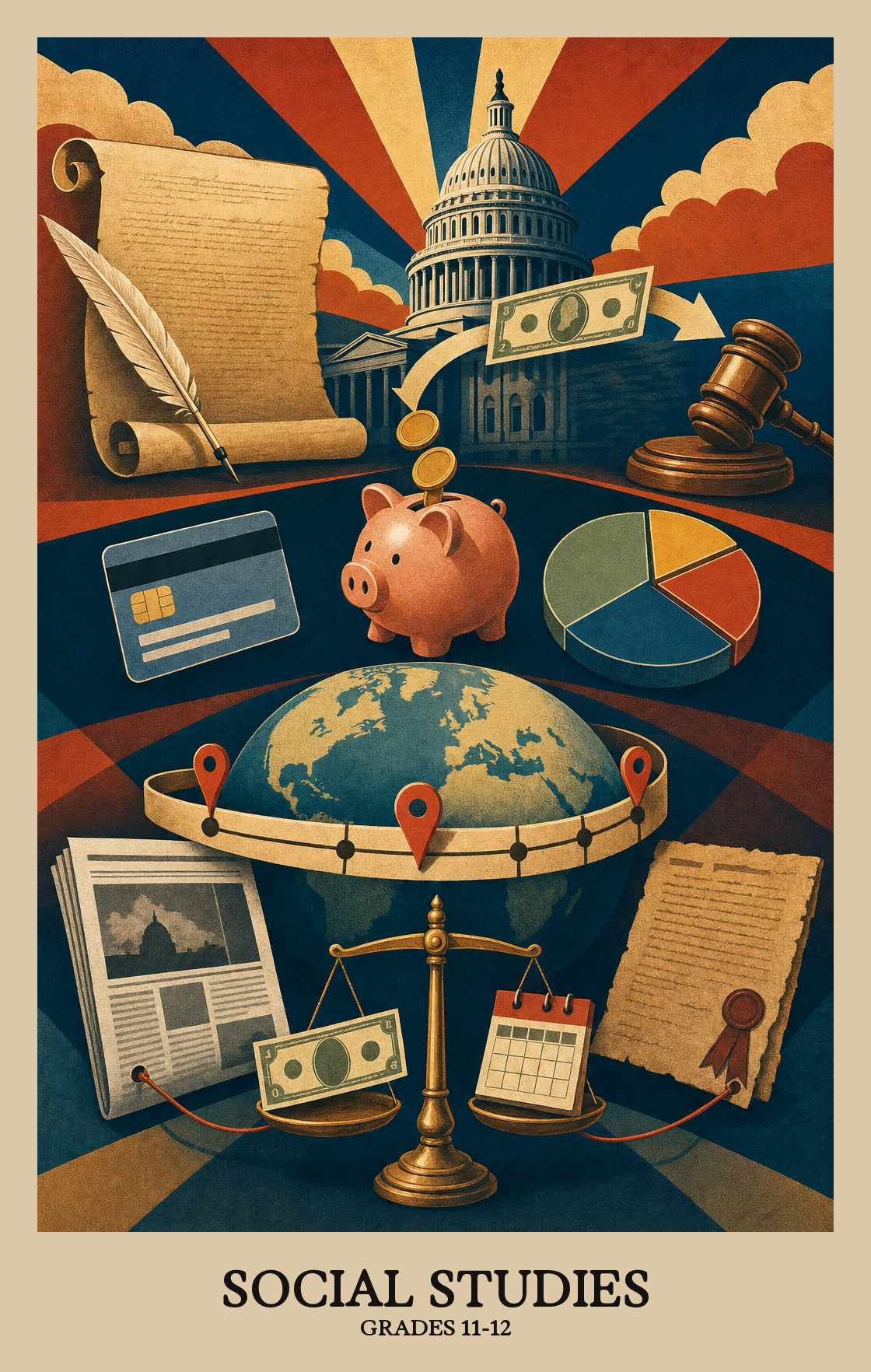
This is the year social studies pulls together. Students step back and see how America's founding ideas, world history, and the economy connect to the choices people make today. They read founding documents, trace turning points across centuries, and work through real money decisions like budgeting and credit. By spring, students can explain how a bill becomes law, weigh a personal finance trade-off, and tie a current event back to its historical roots.

  • Founding documents
  • American history
  • World history
  • Personal finance
  • How government works
  • Maps and regions
Source: Florida B.E.S.T. Standards
Year at a glance
How the year usually goes. Every school and district set their own curriculum, so treat this as a guide, not official pacing.
  1. 1

    Founding ideas and the Constitution

    Students study how the country started and what the founding documents actually say. They look at the Declaration of Independence, the Constitution, and the Bill of Rights, and trace where ideas like rights, voting, and limits on power came from.

  2. 2

    Eras of American history

    Students walk through major chapters of the American story and look at what changed for ordinary people along the way. They weigh the actions of leaders and everyday citizens, and explain why certain moments still shape the country today.

  3. 3

    World history and global exchange

    Students move out to the wider world, from ancient civilizations through the Renaissance and into the modern era. They see how trade, migration, war, and ideas moved between regions and changed how people lived.

  4. 4

    Geography and economics

    Students read maps and explain why people live, work, and move where they do. They also learn how prices, jobs, and markets work, and practice the personal money skills they will use after graduation, such as budgeting, saving, and using credit.

  5. 5

    Government and active citizenship

    Students study how federal, state, and local government fit together and what citizens can actually do. They look at elections, jury duty, advocacy, and service, and practice forming their own views on real issues.

Mastery Learning Standards
The required skills a student should display by the end of Grade 12.
American History
  • American Founding

    Grades 11-12

    Students read the Declaration of Independence, the Constitution, and other founding documents to understand how American government was designed and why those rules still shape the country today.

  • American Eras

    Grades 11-12

    Students place major American historical events into the right time periods and explain why those events mattered, not just that they happened.

  • Continuity and Change

    Grades 11-12

    Students study how American society has shifted over time and what has stayed the same, looking at the specific people and movements that drove those changes or held them back.

World History
  • Ancient and Classical Civilizations

    Grades 11-12

    Students study how early civilizations like ancient Greece, Rome, and Mesopotamia built governments, traded goods, and created art and ideas that still shape the modern world.

  • Grades 11-12

    Each major era shaped the world students live in today. Students trace how the Middle Ages gave way to the Renaissance, how exploration connected distant regions, and how modern history brought the conflicts and systems still visible now.

  • Global Interactions

    Grades 11-12

    Students examine how civilizations shaped each other through trade routes, wars, migrations, and borrowed ideas. They trace how contact between societies changed economies, cultures, and political power over time.

Geography
  • The World in Spatial Terms

    Grades 11-12

    Reading a map or globe, students identify where places are located and compare how large different regions are relative to each other.

  • Places and Regions

    Grades 11-12

    Students study why places look and feel the way they do, from the landscape and climate to the people, economies, and borders that shape them, and how those features shift over decades.

  • Human Systems

    Grades 11-12

    Students study why people move, where they settle, and how those choices reshape the land, cities, and customs around them.

Economics
  • Economic Decision Making

    Grades 11-12

    Scarcity means there is never enough of everything, so people have to choose. Students examine how individuals, families, and businesses decide what to buy, make, or give up when money and resources run short.

  • Markets and the Economy

    Grades 11-12

    Markets set prices based on what buyers want and what sellers offer. Students learn how that competition decides which goods get made, who gets them, and what they cost.

  • Personal Financial Literacy

    Grades 11-12

    Students use basic economic ideas to make real money decisions: how much to save, how to build a budget, and what it actually costs to borrow money.

Civics and Government
  • Foundations of Government

    Grades 11-12

    Students read the founding documents, like the Constitution and Declaration of Independence, and explain the core ideas behind how American government is structured and why it was built that way.

  • Roles, Rights, and Responsibilities

    Grades 11-12

    Citizens have rights the government must respect and responsibilities they're expected to meet. Students examine both sides: what the law protects and what active participation in a democracy actually looks like.

  • Government Structures

    Grades 11-12

    Students learn how federal, state, and local governments are organized, what each level is responsible for, and how they work together or divide power on issues like taxes, schools, and public safety.

  • Civic Engagement

    Grades 11-12

    Students learn how people participate in democracy beyond just voting, looking at how citizens run campaigns, lobby for change, contact elected officials, and volunteer in their communities.

Assessments
The state tests students at this grade and subject take.
National Monitoring

NAEP (National Assessment of Educational Progress)

Federally administered sample-based assessment in reading, mathematics, science, and writing. NAEP results inform state-by-state comparisons rather than individual student or school accountability.

When given:
biennial in winter
Frequency:
every two years
Official source
Common Questions
  • What does social studies look like in the last two years of high school?

    Students study American history, world history, geography, economics, and civics at a deeper level. They read primary sources like the Constitution, trace big eras across time, and connect past events to current issues. By the end, they should be able to back up an argument with specific evidence.

  • How can I help at home if history feels boring to my teen?

    Tie it to something they already care about. Watch a news story together and ask what happened before that led to it, or visit a local museum or historic site. Ten minutes of real conversation about a current event does more than a worksheet.

  • How do I sequence American history across the year?

    Most teachers anchor the year in eras: founding, expansion, Civil War and Reconstruction, industrial age, world wars, Cold War, and modern era. Build each unit around two or three big questions and a handful of primary sources. Leave room at the end for the last 30 years, which often gets squeezed.

  • What should my teen know about money before graduating?

    They should be able to read a paycheck, build a simple monthly budget, and explain how credit cards and interest work. Have them track their own spending for two weeks, or sit with them while paying a bill. Real numbers stick better than definitions.

  • Which skills usually need the most reteaching?

    Reading primary sources closely, writing a clear thesis with evidence, and basic geography literacy tend to lag. Many students also struggle to separate a source's claim from its bias. Short, repeated practice with one document at a time works better than long packets.

  • How can I help with a research paper or document-based question?

    Ask them to explain the argument in one sentence, then ask what evidence supports it. If they cannot answer either, the draft needs more work before grammar matters. Reading the paper out loud catches more problems than silent rereading.

  • How do I balance civics and current events without veering off topic?

    Pick a current event each week that connects to the unit, and frame it around a constitutional principle or branch of government. Stick to the structures and processes rather than personalities. A ten-minute discussion is plenty.

  • How do I know students are ready for college or the workforce?

    They can read a dense article and summarize the main argument, write a short essay that uses evidence, and explain how government and markets actually work in daily life. If they can do those three things under time pressure, they are in good shape.

  • Does my teen need to memorize dates and names?

    Some anchor dates and names help, but understanding causes and effects matters more. If they can explain why the Civil War happened and what changed afterward, the year 1865 will stick. Quiz them on the story, not the flashcard.