Polynomials and rational expressions
Students work with longer algebraic expressions and the equations built from them. They add, multiply, and divide these expressions and solve for the unknown values that make each equation true.
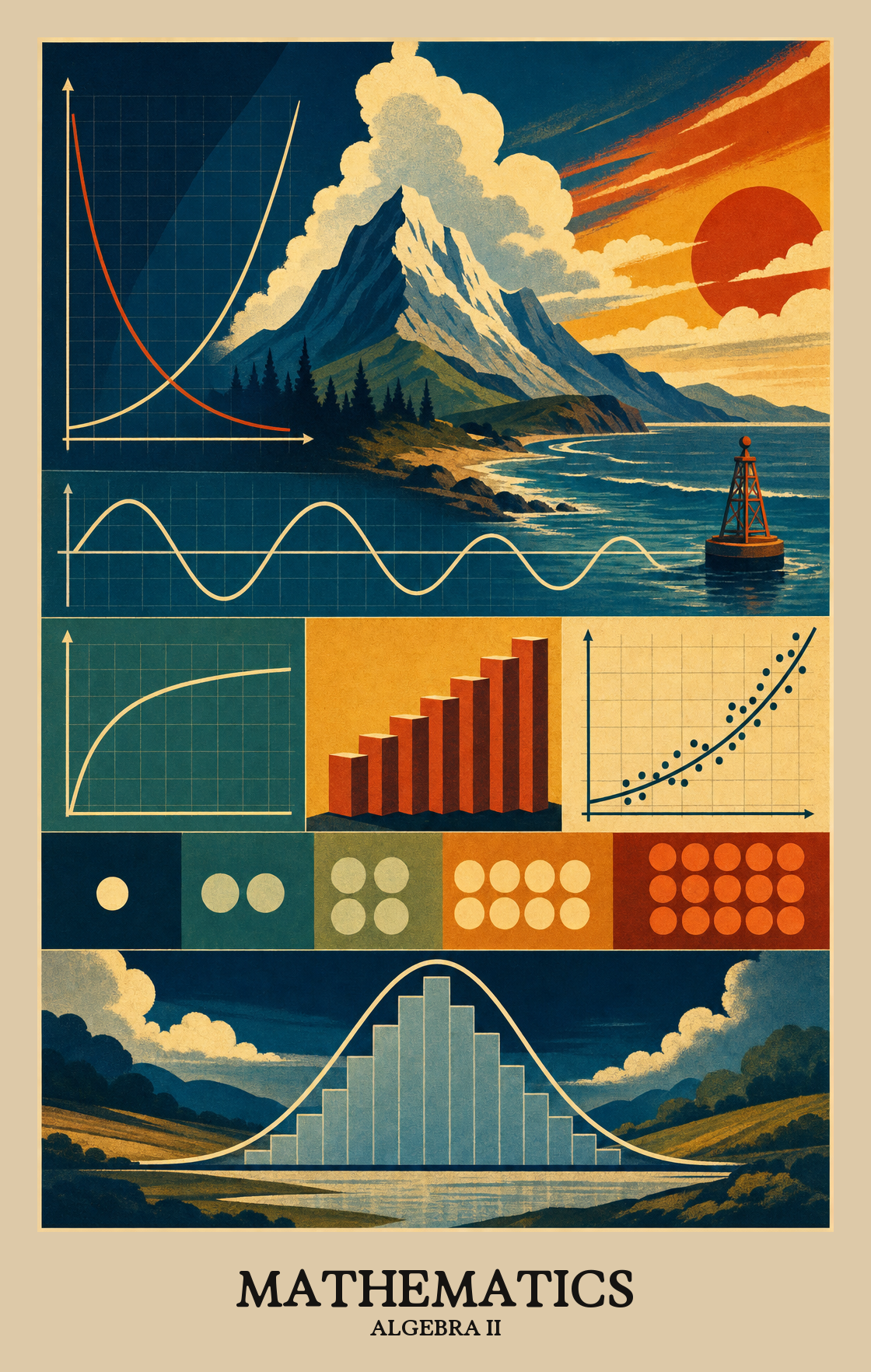
This is the year math stretches beyond straight lines into curves, waves, and growth. Students graph and bend new families of functions, including exponentials, logarithms, and the trig functions that describe anything repeating like tides or sound. They work with sequences that grow by a fixed amount or a fixed multiplier, and start using bell curves to reason about real data. By spring, students can model a real situation with the right kind of function and explain what the graph shows.
Students work with longer algebraic expressions and the equations built from them. They add, multiply, and divide these expressions and solve for the unknown values that make each equation true.
Students study the shape and behavior of several types of graphs, including curves that rise and fall, curves with gaps, and waves. They learn what each graph says about the situation it describes.
Students work with growth and decay, the math behind things like interest, populations, and how loud a sound is. They write equations for these patterns and use logarithms to solve them.
Students study lists of numbers that follow a rule, such as adding the same amount each step or multiplying by the same factor. They write formulas for these patterns and add up long lists efficiently.
Students use a circle on a coordinate grid to describe repeating motion, such as a wheel turning or a tide rising and falling. They write equations for waves and use identities to simplify them.
Students use the bell-shaped curve to describe data and estimate how much a sample can tell them about a larger group. They build confidence intervals and judge how much to trust a result.
When a math problem gets stuck, students slow down, try a different method, and keep going until something works. They treat wrong turns as part of the process, not a reason to quit.
Students take a real situation (a rising cost, a shrinking population, a cooling cup of coffee) and build a math model that describes it. The goal is a formula or graph that makes the situation easier to analyze and predict.
Students solve problems using efficient methods, choosing approaches that get to the right answer without unnecessary steps.
Students talk through math problems with classmates, asking questions when something is unclear and explaining their own thinking out loud. The goal is sharper understanding, not just a right answer.
Students look for patterns and structure in a problem before diving into the math. Spotting how a problem is put together often reveals a faster or clearer path to the answer.
Students check whether an answer actually makes sense for the situation. That means asking if the number is in the right ballpark, the units fit (miles, dollars, seconds), and any rounding didn't push the result too far off.
Students use algebra to work through real problems: figuring out costs, making predictions, or deciding between options. The math connects to situations outside of class, not just exercises on a page.
| Standard | Definition | Code |
|---|---|---|
| Mathematical Thinking Algebra II | When a math problem gets stuck, students slow down, try a different method, and keep going until something works. They treat wrong turns as part of the process, not a reason to quit. | FL-MATH.MTR.hs-algebra-2.1 |
| Modeling Real-World Situations Algebra II | Students take a real situation (a rising cost, a shrinking population, a cooling cup of coffee) and build a math model that describes it. The goal is a formula or graph that makes the situation easier to analyze and predict. | FL-MATH.MTR.hs-algebra-2.2 |
| Complete Tasks with Fluency Algebra II | Students solve problems using efficient methods, choosing approaches that get to the right answer without unnecessary steps. | FL-MATH.MTR.hs-algebra-2.3 |
| Engage in Discourse Algebra II | Students talk through math problems with classmates, asking questions when something is unclear and explaining their own thinking out loud. The goal is sharper understanding, not just a right answer. | FL-MATH.MTR.hs-algebra-2.4 |
| Use Patterns and Structure Algebra II | Students look for patterns and structure in a problem before diving into the math. Spotting how a problem is put together often reveals a faster or clearer path to the answer. | FL-MATH.MTR.hs-algebra-2.5 |
| Assess Reasonableness Algebra II | Students check whether an answer actually makes sense for the situation. That means asking if the number is in the right ballpark, the units fit (miles, dollars, seconds), and any rounding didn't push the result too far off. | FL-MATH.MTR.hs-algebra-2.6 |
| Apply Mathematics in Real-World Contexts Algebra II | Students use algebra to work through real problems: figuring out costs, making predictions, or deciding between options. The math connects to situations outside of class, not just exercises on a page. | FL-MATH.MTR.hs-algebra-2.7 |
Reading a graph tells you what a function is actually doing. Students study the shapes, peaks, valleys, and patterns of five major function families to predict behavior, find key features, and explain what the graph shows.
Students add, subtract, multiply, and divide expressions that include variables raised to powers or written as fractions. They also solve equations built from those expressions.
Students write and graph exponential and logarithmic functions, then use those functions to model real situations like population growth or the decay of a radioactive element.
Students write formulas for number patterns that either grow by adding the same amount each step or by multiplying by the same amount. They use those formulas to solve real problems, like predicting future values or finding a running total.
Students use a circle with radius 1 to understand how sine, cosine, and tangent repeat in predictable patterns. They apply those patterns to model real situations, like sound waves or seasonal temperature changes.
Students use bell-curve data and confidence intervals to draw conclusions from real-world numbers, like survey results or test scores. The focus is on making reasonable predictions, not just reading a graph.
| Standard | Definition | Code |
|---|---|---|
| Functions and Their Graphs Algebra II | Reading a graph tells you what a function is actually doing. Students study the shapes, peaks, valleys, and patterns of five major function families to predict behavior, find key features, and explain what the graph shows. | FL-MATH.A2.hs-algebra-2.1 |
| Polynomial and Rational Algebra II | Students add, subtract, multiply, and divide expressions that include variables raised to powers or written as fractions. They also solve equations built from those expressions. | FL-MATH.A2.hs-algebra-2.2 |
| Exponentials and Logarithms Algebra II | Students write and graph exponential and logarithmic functions, then use those functions to model real situations like population growth or the decay of a radioactive element. | FL-MATH.A2.hs-algebra-2.3 |
| Sequences and Series Algebra II | Students write formulas for number patterns that either grow by adding the same amount each step or by multiplying by the same amount. They use those formulas to solve real problems, like predicting future values or finding a running total. | FL-MATH.A2.hs-algebra-2.4 |
| Trigonometry Algebra II | Students use a circle with radius 1 to understand how sine, cosine, and tangent repeat in predictable patterns. They apply those patterns to model real situations, like sound waves or seasonal temperature changes. | FL-MATH.A2.hs-algebra-2.5 |
| Statistics Algebra II | Students use bell-curve data and confidence intervals to draw conclusions from real-world numbers, like survey results or test scores. The focus is on making reasonable predictions, not just reading a graph. | FL-MATH.A2.hs-algebra-2.6 |
Federally administered sample-based assessment in reading, mathematics, science, and writing. NAEP results inform state-by-state comparisons rather than individual student or school accountability.
Students work with several families of functions: polynomials, rational expressions, exponentials and logarithms, and the start of trigonometry. They also study sequences, series, and a unit on statistics that includes the normal curve. The year pulls these tools together to model real situations.
Ask them to explain what the question is asking and what they already tried. If they freeze, suggest sketching a quick graph or plugging in a small number to see what happens. The goal is to get them talking through the steps, not to solve it for them.
Some, but understanding beats memorizing. Students should know the shapes of common graphs, the basic log and exponent rules, and how the unit circle works. If they can sketch a parent function from memory, most of the rest follows from there.
Spend real time on polynomial and rational expressions before moving into exponentials and logs. Most struggles later in the year trace back to weak factoring, sign errors, or shaky function notation. Strong fluency here pays off in every later unit.
Logarithms and trigonometry are the two biggest hurdles. Students often memorize log rules without understanding what a log is, and they confuse degrees, radians, and reference angles on the unit circle. Build in spiral review for both well after the unit ends.
Short, regular practice works better than long weekend sessions. Twenty to thirty minutes most nights, focused on the current topic plus a few problems from earlier units, keeps skills sharp. If homework regularly takes more than an hour, check in with the teacher.
Anchor the unit circle first using right triangles and reference angles before introducing sine and cosine as functions of an angle. Graph the basic curves by hand before layering in transformations. Identities come last, once students are comfortable evaluating values fluently.
Students can look at a graph or a situation and pick the right type of function to model it, then solve and check whether the answer makes sense. They can move between equations, graphs, and tables without losing track of what the numbers mean.
Watch for two signs: they can solve a problem more than one way, and they catch their own mistakes when an answer looks off. Comfort with logs, the unit circle, and function transformations is the strongest predictor of a smooth start next year.