Building stories from real life
Students start the year turning their own experiences and ideas into short scenes. They try out characters, settings, and simple plots together as a class.
This is the year theatre shifts from playing pretend to making real choices about a character. Students draw on their own experiences to build characters and short scenes, then rehearse and rework them based on feedback. They also start watching plays with a sharper eye, asking what a scene means and whether it worked. By spring, students can perform a short scene they helped shape and explain why they made the choices they did.
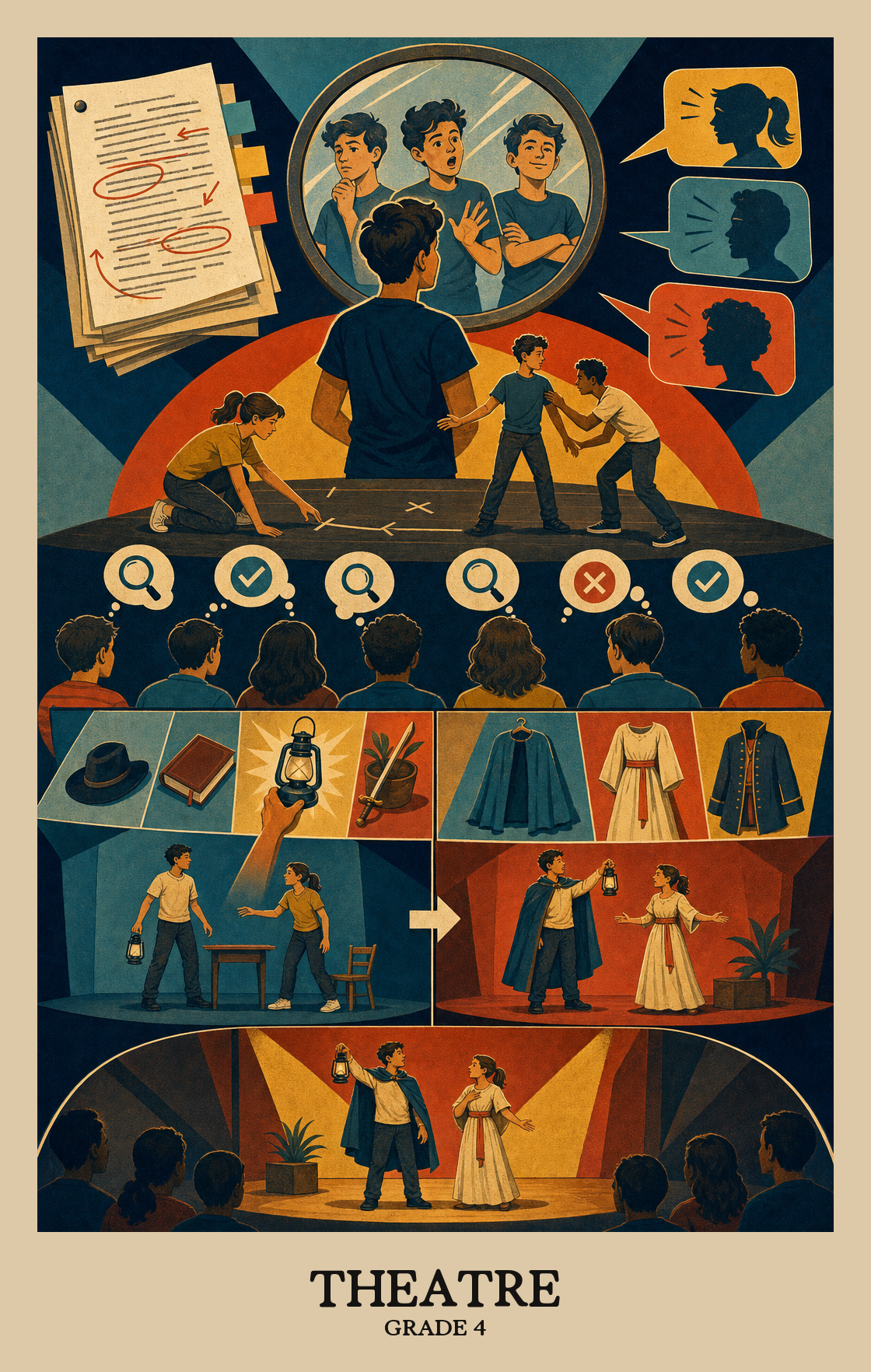
Students start the year turning their own experiences and ideas into short scenes. They try out characters, settings, and simple plots together as a class.
Students take rough ideas and build them into scenes they can perform. They practice using voice, body, and space, then revise based on what works and what falls flat.
Students look at stories from different cultures and time periods. They notice how a play reflects the place and people it came from, and bring that thinking into their own work.
Students prepare scenes for an audience and watch their classmates perform. They give specific feedback using shared criteria and talk about what the play was trying to say.
Students connect something from their own life to a scene or character they are creating, using that personal experience to shape what the performance looks, sounds, or feels like.
Students look at a play or performance and connect it to the time period, culture, or real-world event it comes from. That context helps them understand why the story was told and what it meant to the people who first saw it.
| Standard | Definition | Code |
|---|---|---|
| Synthesize and relate knowledge and personal experiences to make art | Students connect something from their own life to a scene or character they are creating, using that personal experience to shape what the performance looks, sounds, or feels like. | TH:Cn10.4 |
| Relate artistic ideas and works with societal, cultural | Students look at a play or performance and connect it to the time period, culture, or real-world event it comes from. That context helps them understand why the story was told and what it meant to the people who first saw it. | TH:Cn11.4 |
Students brainstorm ideas for a character, scene, or story they want to act out. They explore what a performance could look like before any rehearsing begins.
Students take their theatre ideas and shape them into a short scene, deciding what characters do and say, and how the story moves from beginning to end.
Students revisit a scene or character they've been developing and make specific changes to improve it before sharing it with an audience.
| Standard | Definition | Code |
|---|---|---|
| Generate and conceptualize artistic ideas and work | Students brainstorm ideas for a character, scene, or story they want to act out. They explore what a performance could look like before any rehearsing begins. | TH:Cr1.4 |
| Organize and develop artistic ideas and work | Students take their theatre ideas and shape them into a short scene, deciding what characters do and say, and how the story moves from beginning to end. | TH:Cr2.4 |
| Refine and complete artistic work | Students revisit a scene or character they've been developing and make specific changes to improve it before sharing it with an audience. | TH:Cr3.4 |
Students choose a scene or script to perform and explain why it fits the story they want to tell. Picking the right piece is part of the work.
Students practice their lines, movements, and voice until the performance is ready to share with an audience. Rehearsal is the work, not just a warmup for it.
Students perform a scene or monologue and make clear choices, like tone of voice or movement, so the audience understands what the character feels or wants.
| Standard | Definition | Code |
|---|---|---|
| Analyze, interpret, and select artistic work for presentation | Students choose a scene or script to perform and explain why it fits the story they want to tell. Picking the right piece is part of the work. | TH:Pr4.4 |
| Develop and refine artistic techniques and work for presentation | Students practice their lines, movements, and voice until the performance is ready to share with an audience. Rehearsal is the work, not just a warmup for it. | TH:Pr5.4 |
| Convey meaning through the presentation of artistic work | Students perform a scene or monologue and make clear choices, like tone of voice or movement, so the audience understands what the character feels or wants. | TH:Pr6.4 |
Students watch a short scene or performance and explain what they notice: how the actors move, speak, and react, and what those choices tell them about the story.
Students explain what a scene or performance is trying to say and why the playwright or actor made specific choices. They back up their interpretation with details from what they saw or heard.
Students look at a scene or performance and decide what works and what doesn't, using specific reasons like whether the acting felt believable or the story made sense.
| Standard | Definition | Code |
|---|---|---|
| Perceive and analyze artistic work | Students watch a short scene or performance and explain what they notice: how the actors move, speak, and react, and what those choices tell them about the story. | TH:Re7.4 |
| Interpret intent and meaning in artistic work | Students explain what a scene or performance is trying to say and why the playwright or actor made specific choices. They back up their interpretation with details from what they saw or heard. | TH:Re8.4 |
| Apply criteria to evaluate artistic work | Students look at a scene or performance and decide what works and what doesn't, using specific reasons like whether the acting felt believable or the story made sense. | TH:Re9.4 |
Students build short scenes from their own ideas, play characters with voice and body, and watch classmates perform. They also talk about what they saw and why a scene worked. Most of the year is hands-on, not reading plays at a desk.
Ask students to retell a story from their day as if they were the main character, using a different voice or posture. Watch a short film clip together and ask what the character wanted and how they showed it. Five minutes is plenty.
Some short scenes will have lines to learn, but memorizing is not the main point this year. The bigger goal is making clear choices about who the character is, what they want, and how they show it.
Start with imagination and ensemble games so students feel safe taking risks. Move into building short original scenes, then add revision and presentation in the second half of the year. Save reflection and peer feedback routines for ongoing use across every unit.
By spring, students can plan a short scene with a clear character and problem, rehearse and refine it with a partner, and perform it for the class. They can also explain what a classmate's scene was about and one specific thing that worked.
No. Many students start the year nervous about being watched. Practice at home in low-pressure ways, like reading a picture book in a silly voice or acting out a scene with stuffed animals. Confidence usually grows once students see classmates trying too.
Use a simple frame: what the scene was about, one choice that worked, and one question for the actor. Model it yourself first, then let students use the same frame with partners. Specific beats vague praise every time.
Students often act out moments from history, retell stories from reading class, or build scenes around a real-world problem. Ask what a scene reminded students of, or what they already knew about the time period or topic.