Place value and big numbers
Students read, write, and compare numbers into the hundred thousands. They round to a chosen place and use that skill to estimate answers before they calculate.
This is the year math stretches into bigger numbers and into parts of a whole. Students work with multi-digit numbers up into the hundred thousands, multiply and divide larger numbers, and start to think of fractions as real quantities they can add, compare, and place on a number line. They also handle word problems about money, time, and measurement that take more than one step. By spring, students can multiply a three-digit number by a one-digit number and explain whether a fraction like 3/4 is bigger or smaller than 2/3.
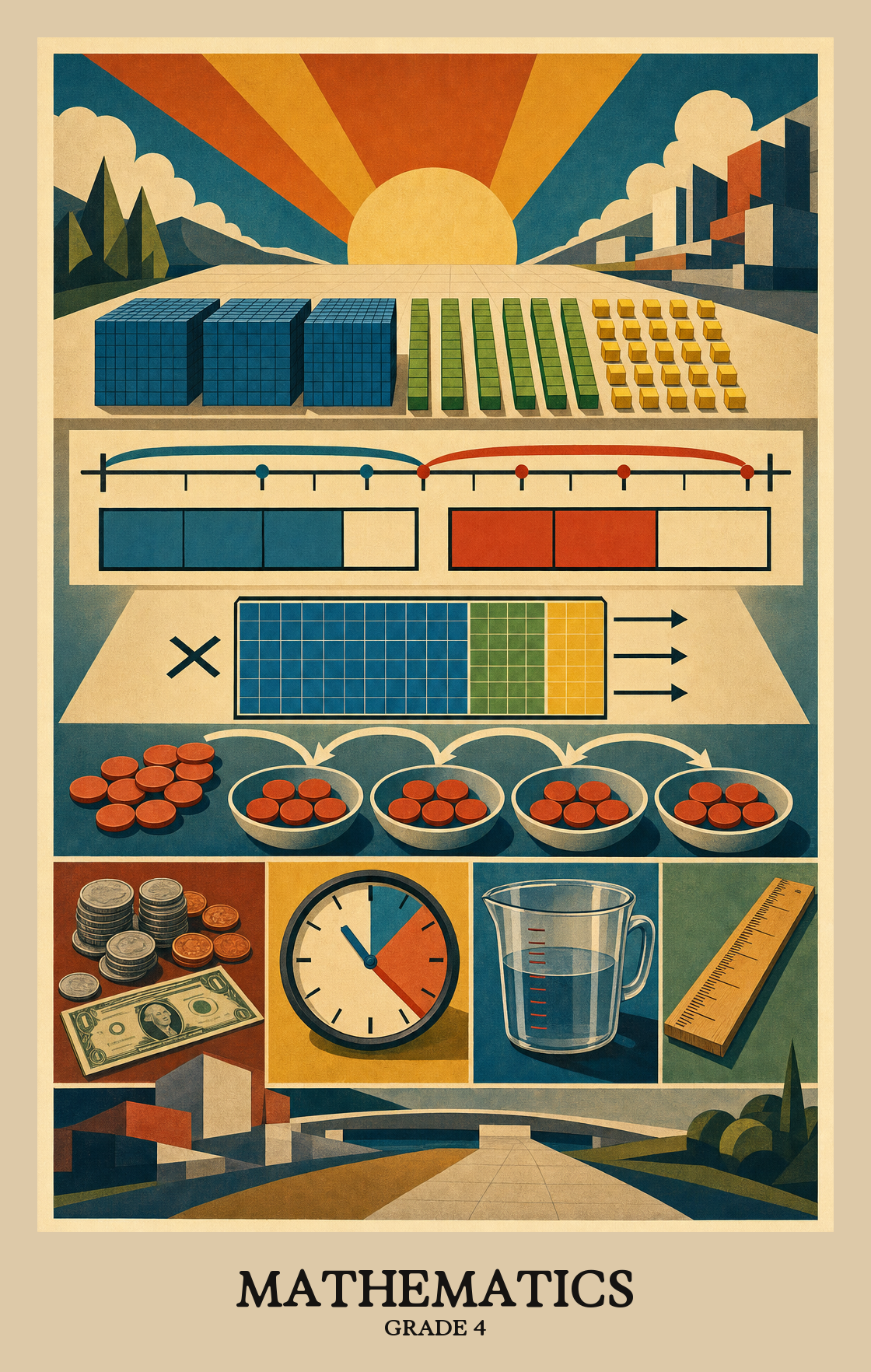
Students read, write, and compare numbers into the hundred thousands. They round to a chosen place and use that skill to estimate answers before they calculate.
Students multiply larger numbers and divide with remainders. They use these skills in word problems about groups, sharing, and money, and check whether the answer makes sense.
Students compare fractions, add and subtract fractions with the same bottom number, and connect fractions like one tenth and one hundredth to decimals and money.
Students work with length, weight, time, and money in real situations. They convert between units, read a clock, and start thinking about saving and spending choices.
Students classify shapes by their sides and angles, measure angles with a protractor, and read graphs and tables to answer questions about real data.
Students read a math problem more than once, try a strategy, and switch approaches when the first one gets stuck. The habit is about staying in the problem until it makes sense.
Students take a real-life situation, like splitting a pizza or saving allowance money, and turn it into a number sentence, diagram, or equation that shows what is happening.
Students solve math problems using methods that are both accurate and quick. The focus is on finding the most direct path to an answer, not just any path that works.
Students talk through math problems with classmates, asking questions when something is unclear and explaining their own thinking out loud. The goal is to build on each other's ideas, not just get the right answer.
Students look for patterns and shortcuts in math problems rather than starting from scratch each time. Spotting a pattern in a multiplication table or a shape sequence helps them solve new problems faster and with more confidence.
Students check whether an answer makes sense for the situation. They use rounding or estimation to decide if a calculated result is in the right ballpark, and they confirm the units fit what the problem is actually asking about.
Students use math skills to solve problems they might actually encounter outside school, like splitting a bill, reading a map, or figuring out how long a trip will take.
| Standard | Definition | Code |
|---|---|---|
| Mathematical Thinking | Students read a math problem more than once, try a strategy, and switch approaches when the first one gets stuck. The habit is about staying in the problem until it makes sense. | FL-MATH.MTR.4.1 |
| Modeling Real-World Situations | Students take a real-life situation, like splitting a pizza or saving allowance money, and turn it into a number sentence, diagram, or equation that shows what is happening. | FL-MATH.MTR.4.2 |
| Complete Tasks with Fluency | Students solve math problems using methods that are both accurate and quick. The focus is on finding the most direct path to an answer, not just any path that works. | FL-MATH.MTR.4.3 |
| Engage in Discourse | Students talk through math problems with classmates, asking questions when something is unclear and explaining their own thinking out loud. The goal is to build on each other's ideas, not just get the right answer. | FL-MATH.MTR.4.4 |
| Use Patterns and Structure | Students look for patterns and shortcuts in math problems rather than starting from scratch each time. Spotting a pattern in a multiplication table or a shape sequence helps them solve new problems faster and with more confidence. | FL-MATH.MTR.4.5 |
| Assess Reasonableness | Students check whether an answer makes sense for the situation. They use rounding or estimation to decide if a calculated result is in the right ballpark, and they confirm the units fit what the problem is actually asking about. | FL-MATH.MTR.4.6 |
| Apply Mathematics in Real-World Contexts | Students use math skills to solve problems they might actually encounter outside school, like splitting a bill, reading a map, or figuring out how long a trip will take. | FL-MATH.MTR.4.7 |
Grade 4 number work covers whole numbers, fractions, and decimals. Students add, subtract, multiply, and divide using all of them, building the number skills that carry through the rest of school math.
Students spot patterns in numbers, describe what's changing, and write simple equations to show how things relate. This is the foundation for algebra before variables have names.
Students use rulers, scales, clocks, and coins to solve real-world problems. They measure length, weight, and time, and work with money amounts at a fourth-grade level.
Students sort, describe, and measure flat shapes like squares and triangles, and solid shapes like cubes and cones. They learn what makes each shape unique, such as the number of sides, angles, or faces.
Students gather information, sort it into graphs or tables, and draw conclusions from what they see. At this level, that means reading bar graphs, finding the most common value, and noticing patterns in the data.
Students practice making smart money choices: deciding how much to save, how much to spend, and what it means to borrow money and pay it back.
| Standard | Definition | Code |
|---|---|---|
| Number Sense and Operations | Grade 4 number work covers whole numbers, fractions, and decimals. Students add, subtract, multiply, and divide using all of them, building the number skills that carry through the rest of school math. | FL-MATH.K8.4.1 |
| Algebraic Reasoning | Students spot patterns in numbers, describe what's changing, and write simple equations to show how things relate. This is the foundation for algebra before variables have names. | FL-MATH.K8.4.2 |
| Measurement | Students use rulers, scales, clocks, and coins to solve real-world problems. They measure length, weight, and time, and work with money amounts at a fourth-grade level. | FL-MATH.K8.4.3 |
| Geometric Reasoning | Students sort, describe, and measure flat shapes like squares and triangles, and solid shapes like cubes and cones. They learn what makes each shape unique, such as the number of sides, angles, or faces. | FL-MATH.K8.4.4 |
| Data Analysis and Probability | Students gather information, sort it into graphs or tables, and draw conclusions from what they see. At this level, that means reading bar graphs, finding the most common value, and noticing patterns in the data. | FL-MATH.K8.4.5 |
| Financial Literacy | Students practice making smart money choices: deciding how much to save, how much to spend, and what it means to borrow money and pay it back. | FL-MATH.K8.4.6 |
FAST Mathematics for grades 3 through 5, given three times per year with PM3 as the summative result for accountability.
Federally administered sample-based assessment in reading, mathematics, science, and writing. NAEP results inform state-by-state comparisons rather than individual student or school accountability.
Students should multiply and divide larger numbers, work with fractions and simple decimals, and measure things like length, weight, and time. They should also read graphs and tables, and solve word problems that take more than one step.
Cook together and double a recipe to practice fractions. Count change at the store, read the clock to figure out how long until dinner, or measure a room with a tape measure. Short, real moments matter more than worksheets.
Ask students to read the problem out loud and draw a quick picture of what is happening. Then ask what the question is really asking before any numbers come out. Drawing slows things down and usually shows the next step.
Build place value and multi-digit multiplication first, since fractions and decimals lean on that understanding. Layer in measurement and data through the middle of the year, then bring fractions and decimals together in the spring. Geometry and money work well in shorter focused units.
Fractions cause the most trouble, especially comparing them and finding equivalent ones. Long division and multi-step word problems also need extra time. Plan to revisit these in short bursts across the year rather than one big unit.
Yes. Quick recall of multiplication and division facts frees up brain space for harder work like fractions and long division. Five minutes a day of flash cards, games, or a fact app at home makes a real difference.
Ready students can multiply a three-digit number by a one-digit number, add and subtract fractions with the same bottom number, and solve a two-step word problem without giving up. They also explain their thinking out loud, even when the answer is wrong.
Explaining the steps shows whether students really understand or just guessed. It also builds the habit of checking if an answer makes sense. Ask at home, how did you get that, and is that answer reasonable.