Listening with a sharper ear
Students start the year by really listening. They notice the mood of a song, pick out instruments they hear, and start using words to describe what makes a piece feel happy, sad, or exciting.
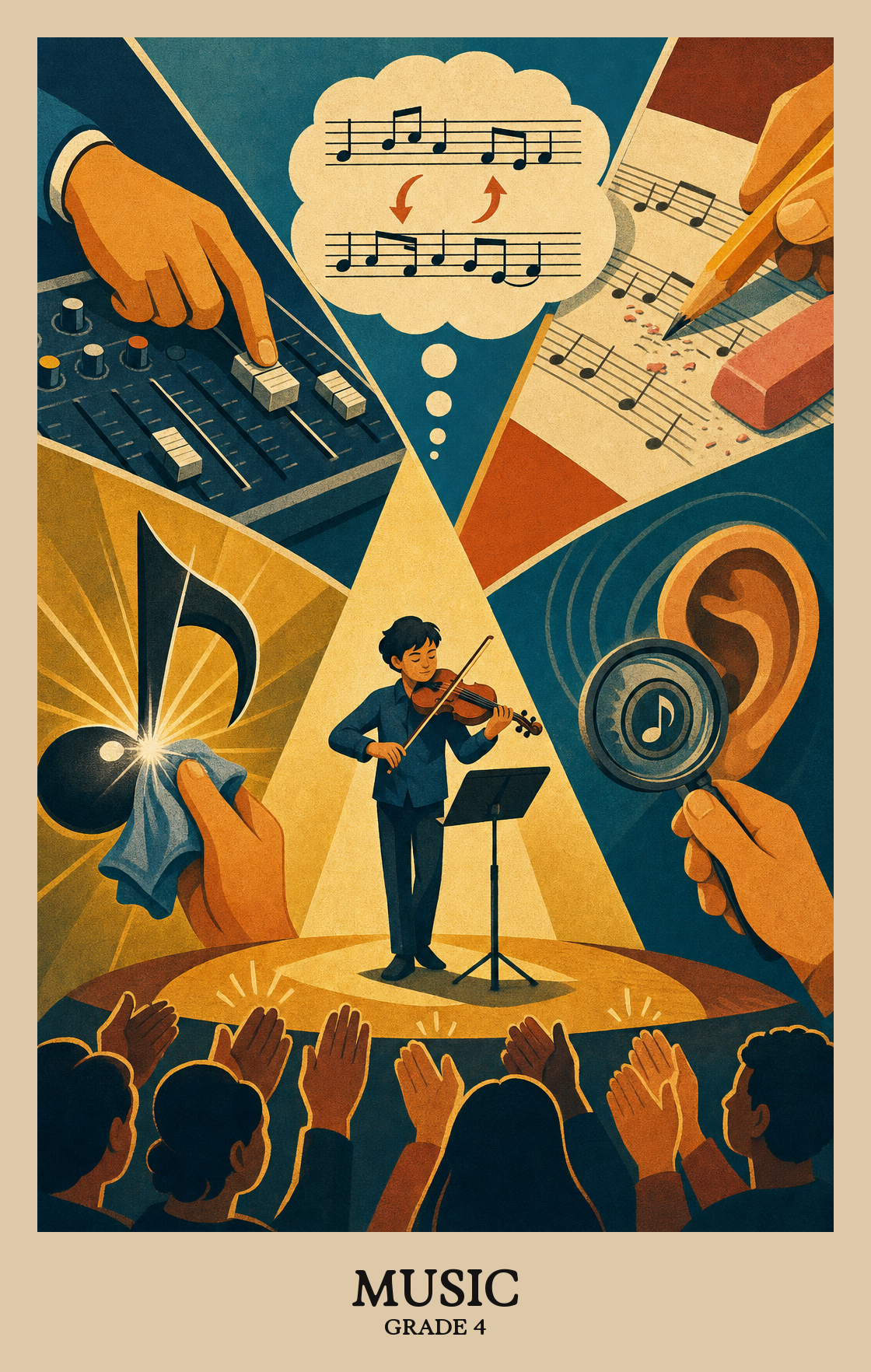
This is the year music shifts from playing along to making real choices about sound. Students come up with their own short musical ideas, shape them with a purpose in mind, and polish a piece before sharing it. They also start listening like critics, asking what a song is trying to say and whether it pulls it off. By spring, students can perform a prepared piece and explain why they made the choices they did.
Students start the year by really listening. They notice the mood of a song, pick out instruments they hear, and start using words to describe what makes a piece feel happy, sad, or exciting.
Students learn to read simple rhythms and melodies on the page and try writing their own short patterns. They sing and play instruments using what they read instead of only copying by ear.
Students pick songs to perform and work on the details that make a performance land. They practice clean starts, steady tempo, and matching the feeling of the song with their voice or instrument.
Students connect songs to where they come from and why people wrote them. They compare music from different places and time periods and talk about what a piece might have meant to the people who first heard it.
Students present pieces for an audience and give thoughtful feedback on their own work and on classmates. They use simple criteria to explain what worked and what they would change next time.
Students connect what they already know and have lived through to the music they create or perform. Personal experience shapes the choices they make in the work.
Students connect a song or piece of music to the time, place, or culture it came from. Understanding that context helps them make sense of why the music sounds the way it does.
| Standard | Definition | Code |
|---|---|---|
| Synthesize and relate knowledge and personal experiences to make art | Students connect what they already know and have lived through to the music they create or perform. Personal experience shapes the choices they make in the work. | MU:Cn10.4 |
| Relate artistic ideas and works with societal, cultural | Students connect a song or piece of music to the time, place, or culture it came from. Understanding that context helps them make sense of why the music sounds the way it does. | MU:Cn11.4 |
Students brainstorm musical ideas, like rhythms or melodies, and start shaping them into something they could perform or share.
Students take a musical idea and shape it into something more complete, choosing which sounds, rhythms, or patterns to keep and how to arrange them into a short piece.
Students revisit a piece of music they started, fix what isn't working, and finish it in a form they're ready to share.
| Standard | Definition | Code |
|---|---|---|
| Generate and conceptualize artistic ideas and work | Students brainstorm musical ideas, like rhythms or melodies, and start shaping them into something they could perform or share. | MU:Cr1.4 |
| Organize and develop artistic ideas and work | Students take a musical idea and shape it into something more complete, choosing which sounds, rhythms, or patterns to keep and how to arrange them into a short piece. | MU:Cr2.4 |
| Refine and complete artistic work | Students revisit a piece of music they started, fix what isn't working, and finish it in a form they're ready to share. | MU:Cr3.4 |
Students choose a piece of music to perform and explain why it suits the occasion or audience. They think through what the music means before they play or sing it.
Students practice a piece of music repeatedly, fixing small mistakes in rhythm, pitch, or timing until it is ready to perform in front of others.
Students perform a song or piece of music with a clear purpose, making choices about how to play or sing so the audience understands the feeling or idea behind the music.
| Standard | Definition | Code |
|---|---|---|
| Analyze, interpret, and select artistic work for presentation | Students choose a piece of music to perform and explain why it suits the occasion or audience. They think through what the music means before they play or sing it. | MU:Pr4.4 |
| Develop and refine artistic techniques and work for presentation | Students practice a piece of music repeatedly, fixing small mistakes in rhythm, pitch, or timing until it is ready to perform in front of others. | MU:Pr5.4 |
| Convey meaning through the presentation of artistic work | Students perform a song or piece of music with a clear purpose, making choices about how to play or sing so the audience understands the feeling or idea behind the music. | MU:Pr6.4 |
Students listen carefully to a piece of music and describe what they notice, like changes in speed, volume, or the way instruments work together.
Students explain what a piece of music is trying to say and why the composer may have made specific choices, such as using a slow tempo or loud dynamics.
Students listen to a piece of music and use a set of criteria to explain why it works well or where it falls short. They back up their opinion with specific details from what they heard.
| Standard | Definition | Code |
|---|---|---|
| Perceive and analyze artistic work | Students listen carefully to a piece of music and describe what they notice, like changes in speed, volume, or the way instruments work together. | MU:Re7.4 |
| Interpret intent and meaning in artistic work | Students explain what a piece of music is trying to say and why the composer may have made specific choices, such as using a slow tempo or loud dynamics. | MU:Re8.4 |
| Apply criteria to evaluate artistic work | Students listen to a piece of music and use a set of criteria to explain why it works well or where it falls short. They back up their opinion with specific details from what they heard. | MU:Re9.4 |
Students sing, play simple instruments, read basic rhythms and notes, and make up short pieces of their own. They also listen to music and talk about what they hear, why it was written, and whether it works. The year balances performing, creating, and responding to music.
Play music in the car and ask what instruments they hear, or whether the song feels fast or slow, happy or sad. Clap a short rhythm and ask them to clap it back, then let them invent one for you. Five minutes of this a few times a week builds real listening skills.
Students learn to read basic rhythms and a small set of notes on the staff, usually enough to play a short tune on a recorder or xylophone. They are not expected to sight-read full pieces. Steady progress with simple patterns is the goal.
Most teachers build performing skills first so students have a vocabulary to create and respond with. Composing tasks fit well in the middle of the year once students can read short rhythms and melodies. Responding shows up in every unit through quick listening prompts.
Rhythm reading past quarter and eighth notes is the common sticking point, especially rests and dotted rhythms. Notating original ideas also takes longer than expected because students can sing a pattern before they can write it. Plan extra time for both.
Ask them to perform the piece for you at home and listen without correcting. Then ask one question: what part felt strongest, and what part needs more practice? That short reflection is exactly the kind of thinking fourth graders are expected to do about their own work.
By spring, students should sing or play a short piece with steady beat and clear pitch, read basic rhythms on sight, and give a reason for their opinion about a piece of music. They should also be able to revise a short composition after feedback rather than starting over.
Students connect songs to where and when they came from so the music means something beyond the notes. A spiritual, a folk dance, and a film score all carry different stories, and knowing the story changes how students perform and listen. It also builds vocabulary they use when talking about their own work.