Finding ideas to move
Students start the year turning everyday experiences into movement. They pull ideas from memories, stories, and pictures, then shape those ideas into short dances they can show a partner.
This is the year dance becomes a way to tell a story on purpose. Students take an idea from their own life and shape it into a short piece, choosing movements that match the feeling they want to share. They practice cleaning up steps so a dance looks the same the second time through. By spring, they can perform a short dance for the class and explain what it means and why they chose those moves.
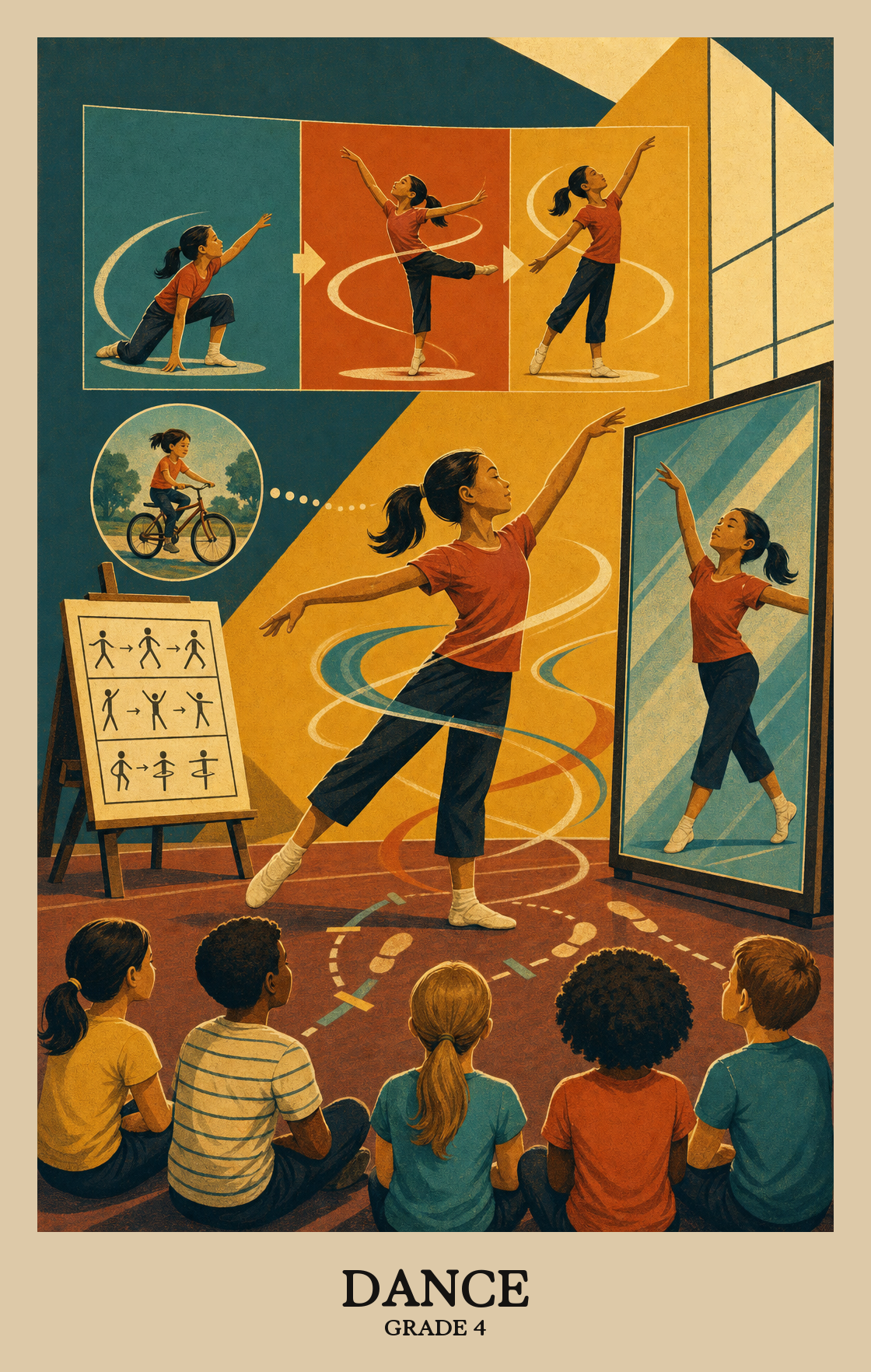
Students start the year turning everyday experiences into movement. They pull ideas from memories, stories, and pictures, then shape those ideas into short dances they can show a partner.
Students learn how to organize movement into a real piece. They pick a beginning, middle, and end, try different choices, and revise the parts that do not feel right yet.
Students focus on how the body moves. They practice balance, control, and clear shapes, and rehearse small sections over and over so the dance looks ready for an audience.
Students look at dances from other places and other eras. They notice what the movement says about the people who made it and use those ideas in their own work.
Students present finished dances and watch each other perform. They give specific feedback using clear criteria and talk about what the choreographer was trying to say.
Students connect something from their own life to the dances they create or perform. A memory, a feeling, or a moment outside school can shape the choices they make in movement.
Students look at a dance and connect it to where, when, and why it was made. That context helps them understand what the movement actually means.
| Standard | Definition | Code |
|---|---|---|
| Synthesize and relate knowledge and personal experiences to make art | Students connect something from their own life to the dances they create or perform. A memory, a feeling, or a moment outside school can shape the choices they make in movement. | DA:Cn10.4 |
| Relate artistic ideas and works with societal, cultural | Students look at a dance and connect it to where, when, and why it was made. That context helps them understand what the movement actually means. | DA:Cn11.4 |
Students brainstorm movement ideas and begin shaping them into a short dance. They explore different ways the body can move before settling on the choices that fit their vision.
Students take a movement idea and shape it into a short dance phrase, making choices about order, timing, and how the body moves to turn an idea into something others can watch.
Students revisit a dance they've been building, make changes to improve how it looks and feels, and prepare it to share with an audience.
| Standard | Definition | Code |
|---|---|---|
| Generate and conceptualize artistic ideas and work | Students brainstorm movement ideas and begin shaping them into a short dance. They explore different ways the body can move before settling on the choices that fit their vision. | DA:Cr1.4 |
| Organize and develop artistic ideas and work | Students take a movement idea and shape it into a short dance phrase, making choices about order, timing, and how the body moves to turn an idea into something others can watch. | DA:Cr2.4 |
| Refine and complete artistic work | Students revisit a dance they've been building, make changes to improve how it looks and feels, and prepare it to share with an audience. | DA:Cr3.4 |
Students choose which dances to perform and explain why those pieces are worth sharing with an audience.
Students practice and improve a dance piece until it's ready to share with an audience. That means working on technique, cleaning up movements, and making choices about how the performance should look and feel.
Students perform a dance to share a specific idea or feeling with an audience, using movement choices they made intentionally. The performance itself is the message.
| Standard | Definition | Code |
|---|---|---|
| Analyze, interpret, and select artistic work for presentation | Students choose which dances to perform and explain why those pieces are worth sharing with an audience. | DA:Pr4.4 |
| Develop and refine artistic techniques and work for presentation | Students practice and improve a dance piece until it's ready to share with an audience. That means working on technique, cleaning up movements, and making choices about how the performance should look and feel. | DA:Pr5.4 |
| Convey meaning through the presentation of artistic work | Students perform a dance to share a specific idea or feeling with an audience, using movement choices they made intentionally. The performance itself is the message. | DA:Pr6.4 |
Students watch a dance performance and describe what they notice, from the shapes a dancer's body makes to how the movement changes across the piece.
Students explain what a dance is trying to say and why the choreographer made specific choices, such as a repeated movement or a sudden change in tempo.
Students watch a dance and judge how well it works, using clear reasons tied to specific choices the choreographer made.
| Standard | Definition | Code |
|---|---|---|
| Perceive and analyze artistic work | Students watch a dance performance and describe what they notice, from the shapes a dancer's body makes to how the movement changes across the piece. | DA:Re7.4 |
| Interpret intent and meaning in artistic work | Students explain what a dance is trying to say and why the choreographer made specific choices, such as a repeated movement or a sudden change in tempo. | DA:Re8.4 |
| Apply criteria to evaluate artistic work | Students watch a dance and judge how well it works, using clear reasons tied to specific choices the choreographer made. | DA:Re9.4 |
Students make up their own dances, learn steps from a teacher, perform for an audience, and watch other dances to talk about what they noticed. They also start connecting dances to where they come from, like a folk dance from another country or a dance tied to a holiday.
It can look like play, but there is real thinking underneath. Students are choosing movements on purpose, repeating them in an order, and revising what does not work. That is the same process a choreographer uses.
Put on a song and ask students to show you a movement that matches the mood, then a different one for a slower part. Ask why they chose each move. That short back and forth builds the same skills they practice in class.
Spend the first weeks on body control, spatial awareness, and clear shapes. Students who can stop, balance, and travel safely are ready to start making short movement phrases. Without that base, choreography work falls apart fast.
Run all three in every unit rather than teaching them in blocks. A typical cycle is making a short phrase, refining it with feedback, performing it, and then watching classmates and giving specific comments. The cycle gets longer and more detailed as the year goes on.
Students learn a dance and find out where it came from, who danced it, and why. A square dance, a hula, or a step from a West African tradition all work. The goal is understanding that dances carry meaning, not memorizing facts.
Start with a short list of things to look for, like clear shapes, matching the music, or a strong ending. Students use that list to comment on what they saw, not whether they liked it. Specific feedback is the goal.
No. Fourth grade dance is about ideas, control, and expression, not splits or turns. Students who have never taken a class can do well as long as they are willing to try movements and talk about what they made.
By spring, students should be able to plan a short dance with a beginning, middle, and end, perform it with focus, and explain what they were trying to show. They should also be able to watch a dance and describe specific choices the dancer made.