Sketchbooks and idea-building
Students start the year keeping a sketchbook of ideas drawn from their own lives, memories, and interests. They learn that a finished piece usually begins as a rough sketch, a note, or a quick experiment.
This is the year art shifts from following directions to making real choices. Students start with their own ideas and experiences, then plan and revise a piece until it says what they want it to say. They also look closely at other artists' work and explain what it means and why it works. By spring, students can show a finished piece, talk through the choices they made, and give a thoughtful opinion about another artist's work.
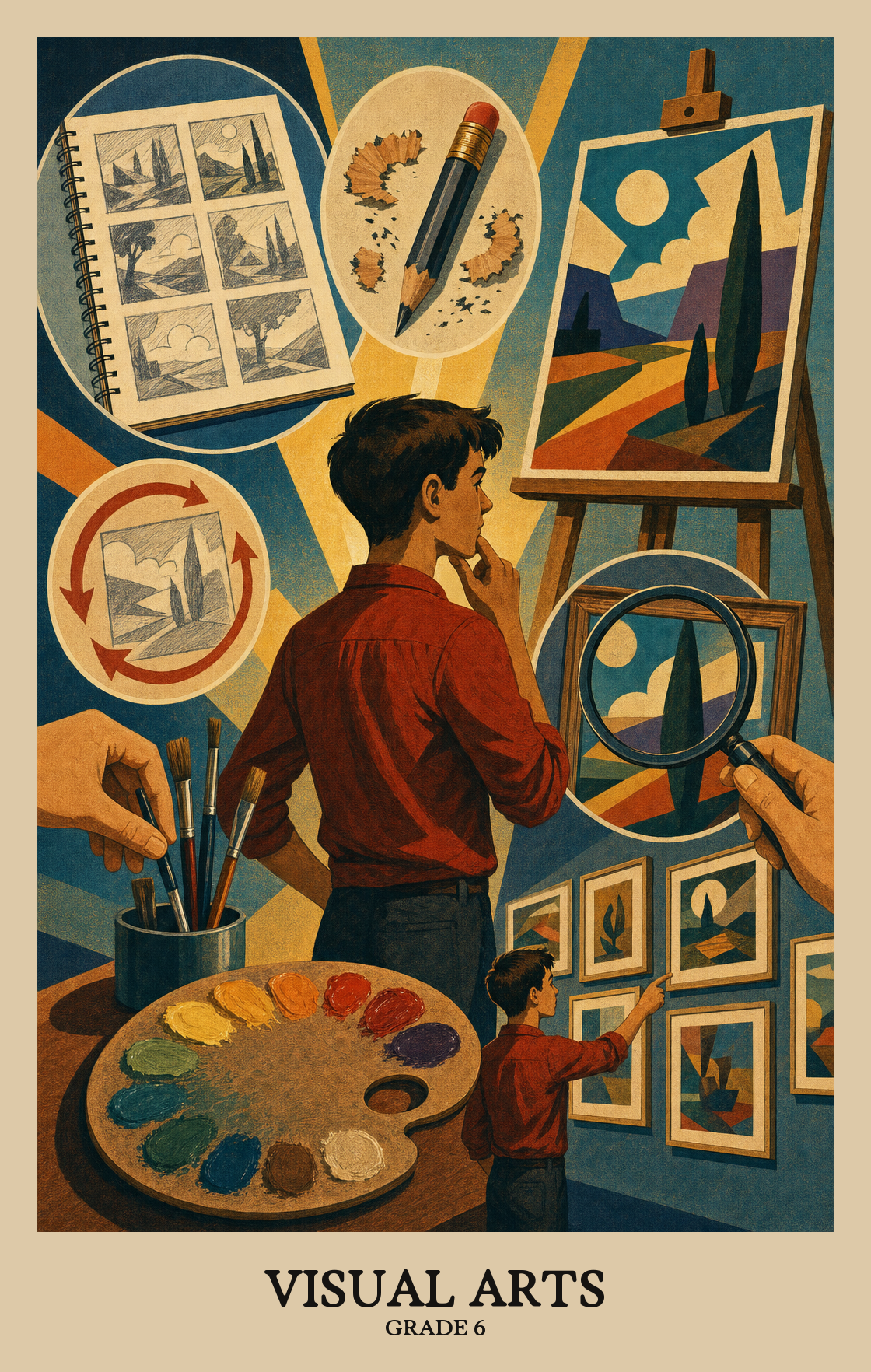
Students start the year keeping a sketchbook of ideas drawn from their own lives, memories, and interests. They learn that a finished piece usually begins as a rough sketch, a note, or a quick experiment.
Students practice with pencil, paint, clay, collage, or digital tools. The focus is on learning how each material behaves and how to make choices about color, line, texture, and composition.
Students study artwork from different times and places, including their own community. They talk and write about what they see, what the artist might have meant, and how the work connects to history and culture.
Students take a project from rough draft to finished work. They get feedback from classmates and the teacher, then make changes to improve the piece before it is ready to share.
Students choose pieces for a display or class show and decide how to present them. They think about what each piece says to a viewer and write short artist statements to go with the work.
Students pull from what they know and what they've lived through to make their artwork feel personal and intentional, not just decorative.
Students look at a piece of artwork and explain what was happening in the world when it was made. They connect the artist's choices to the time, place, or community the work came from.
| Standard | Definition | Code |
|---|---|---|
| Synthesize and relate knowledge and personal experiences to make art | Students pull from what they know and what they've lived through to make their artwork feel personal and intentional, not just decorative. | VA:Cn10.6 |
| Relate artistic ideas and works with societal, cultural | Students look at a piece of artwork and explain what was happening in the world when it was made. They connect the artist's choices to the time, place, or community the work came from. | VA:Cn11.6 |
Students brainstorm and develop original ideas before picking up a brush or pencil. This standard covers the thinking and planning that happens before the actual art-making begins.
Students take a rough idea and plan it into a finished piece, making deliberate choices about composition, materials, and how the work will look before they start creating.
Students revisit a piece of artwork, make deliberate changes, and decide when it is finished. The focus is on improving the work with intention, not just adding more.
| Standard | Definition | Code |
|---|---|---|
| Generate and conceptualize artistic ideas and work | Students brainstorm and develop original ideas before picking up a brush or pencil. This standard covers the thinking and planning that happens before the actual art-making begins. | VA:Cr1.6 |
| Organize and develop artistic ideas and work | Students take a rough idea and plan it into a finished piece, making deliberate choices about composition, materials, and how the work will look before they start creating. | VA:Cr2.6 |
| Refine and complete artistic work | Students revisit a piece of artwork, make deliberate changes, and decide when it is finished. The focus is on improving the work with intention, not just adding more. | VA:Cr3.6 |
Students look at a collection of their own artwork, decide which pieces are strong enough to share, and explain why those pieces represent their best work.
Students practice and improve a piece of visual artwork until it's ready to share with an audience. That might mean adjusting color, fixing proportions, or reworking a composition based on feedback.
Students choose how to display or share a piece of art so the viewer understands what the work is meant to express. The arrangement, setting, and context all shape how the message lands.
| Standard | Definition | Code |
|---|---|---|
| Analyze, interpret, and select artistic work for presentation | Students look at a collection of their own artwork, decide which pieces are strong enough to share, and explain why those pieces represent their best work. | VA:Pr4.6 |
| Develop and refine artistic techniques and work for presentation | Students practice and improve a piece of visual artwork until it's ready to share with an audience. That might mean adjusting color, fixing proportions, or reworking a composition based on feedback. | VA:Pr5.6 |
| Convey meaning through the presentation of artistic work | Students choose how to display or share a piece of art so the viewer understands what the work is meant to express. The arrangement, setting, and context all shape how the message lands. | VA:Pr6.6 |
Students look closely at a piece of art and describe what they notice, from color and line to mood and meaning. They explain what the artist's choices add up to.
Students look closely at a piece of art and explain what the artist was trying to say. They support their reading of the work with specific details from what they see.
Students look at a piece of art and judge it using a set of criteria, explaining why it works or falls short based on specific evidence from the work itself.
| Standard | Definition | Code |
|---|---|---|
| Perceive and analyze artistic work | Students look closely at a piece of art and describe what they notice, from color and line to mood and meaning. They explain what the artist's choices add up to. | VA:Re7.6 |
| Interpret intent and meaning in artistic work | Students look closely at a piece of art and explain what the artist was trying to say. They support their reading of the work with specific details from what they see. | VA:Re8.6 |
| Apply criteria to evaluate artistic work | Students look at a piece of art and judge it using a set of criteria, explaining why it works or falls short based on specific evidence from the work itself. | VA:Re9.6 |
Students learn to come up with their own ideas, plan a piece of art, and refine it before they share it. They also look at art made by other people and explain what it means. The work moves beyond following directions and into making real choices.
Skill with a pencil is not the point. Ask students to talk about what they made, why they chose those colors or shapes, and what they would change next time. Keeping a small sketchbook on the kitchen table for five minute drawings goes a long way.
Start with idea generation and sketchbook habits in the first quarter so students have a way to gather material. Build technique through short studies in the middle of the year. Save longer projects with revision and an exhibition for the last quarter, when students have something to say.
No. A pencil, eraser, a few markers, scrap paper, and glue cover most of what students need at home. A cheap sketchbook is more useful than a fancy set of paints because it gets used every day.
Revision is the hardest shift. Sixth graders tend to call a piece done as soon as they finish the first version. Build in a required second pass on every major project and teach students how to give a useful critique without being mean or vague.
Students look at a piece of art and ask who made it, when, and why it mattered to people at the time. Visiting a museum, or even scrolling through a museum website together, gives plenty of starting points for a short conversation at home.
A ready student can start a project from their own idea, work through a rough draft and a stronger version, and talk about what is working in their piece and in someone else's. They use art words like composition, contrast, and texture without being prompted.
Most sixth graders compare their work to cartoons or social media and decide they cannot draw. Praise the thinking and the choices, not the finished look. Short daily sketching, even doodles during a phone call, builds confidence faster than any single big project.