Listening with a sharper ear
Students start the year by listening closely to songs and short pieces. They notice the mood, the instruments, and how the music is put together, and they talk about what they hear using musical words.
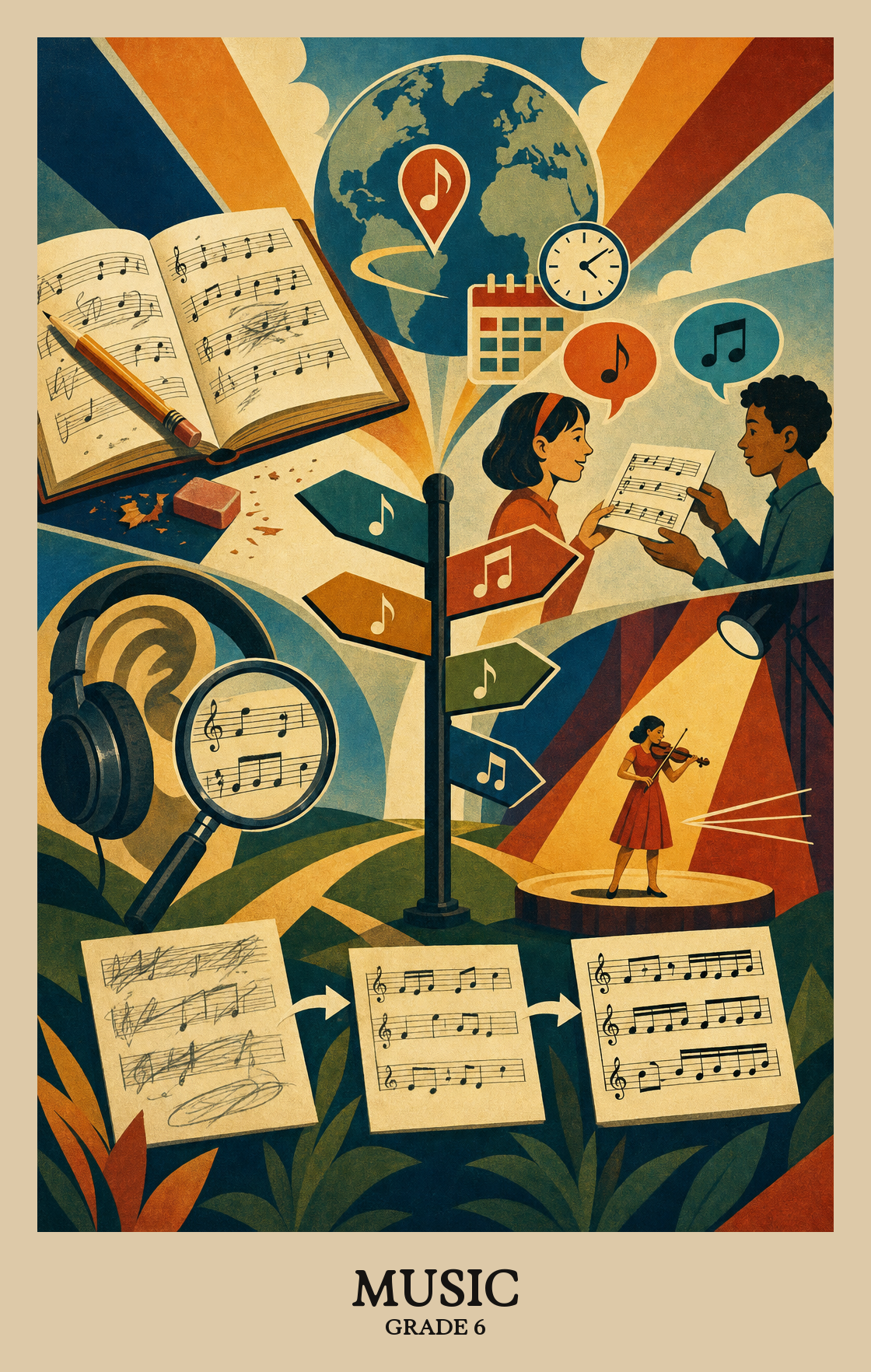
This is the year music shifts from playing what is put in front of students to making real choices about it. Students start their own short pieces, then revise them based on feedback. They also learn to listen more carefully, explaining why a song works and how it connects to the time and place it came from. By spring, they can perform a piece with clear expression and talk about the choices behind it.
Students start the year by listening closely to songs and short pieces. They notice the mood, the instruments, and how the music is put together, and they talk about what they hear using musical words.
Students try out their own short melodies, rhythms, and patterns. They play with ideas on instruments or with their voices and pick the ones worth keeping.
Students take a rough idea and work it into a finished short piece. They revise, practice, and use feedback to make their music clearer and more interesting to listen to.
Students choose a piece to share and rehearse it with care. They think about what the music is trying to say and how to bring that across for an audience.
Students connect songs to where and when they came from and to their own lives. They judge music using clear reasons and notice how culture and history shape what people make and listen to.
Students connect their own experiences and feelings to the music they create or perform, explaining how those personal connections shape the choices they make.
Students connect a piece of music to the time, place, and culture it came from. That context helps them understand why it sounds the way it does and what it meant to the people who made it.
| Standard | Definition | Code |
|---|---|---|
| Synthesize and relate knowledge and personal experiences to make art | Students connect their own experiences and feelings to the music they create or perform, explaining how those personal connections shape the choices they make. | MU:Cn10.6 |
| Relate artistic ideas and works with societal, cultural | Students connect a piece of music to the time, place, and culture it came from. That context helps them understand why it sounds the way it does and what it meant to the people who made it. | MU:Cn11.6 |
Students brainstorm musical ideas, like a rhythm pattern or a short melody, and start shaping them into something original.
Students take a musical idea and shape it into something more complete, choosing how to arrange, layer, or revise it until it holds together as a piece.
Students revisit a piece of music they've started, make deliberate changes to improve it, and bring it to a finished state ready to share or perform.
| Standard | Definition | Code |
|---|---|---|
| Generate and conceptualize artistic ideas and work | Students brainstorm musical ideas, like a rhythm pattern or a short melody, and start shaping them into something original. | MU:Cr1.6 |
| Organize and develop artistic ideas and work | Students take a musical idea and shape it into something more complete, choosing how to arrange, layer, or revise it until it holds together as a piece. | MU:Cr2.6 |
| Refine and complete artistic work | Students revisit a piece of music they've started, make deliberate changes to improve it, and bring it to a finished state ready to share or perform. | MU:Cr3.6 |
Students choose a piece of music to perform and explain why it suits their skills and the audience. They think through what the music asks of them before they start practicing.
Students practice and improve a piece of music before performing it, working on technique, tone, and accuracy until the performance is ready to share.
Students perform a piece of music and make deliberate choices about how to play or sing it so the audience feels what the music is meant to express.
| Standard | Definition | Code |
|---|---|---|
| Analyze, interpret, and select artistic work for presentation | Students choose a piece of music to perform and explain why it suits their skills and the audience. They think through what the music asks of them before they start practicing. | MU:Pr4.6 |
| Develop and refine artistic techniques and work for presentation | Students practice and improve a piece of music before performing it, working on technique, tone, and accuracy until the performance is ready to share. | MU:Pr5.6 |
| Convey meaning through the presentation of artistic work | Students perform a piece of music and make deliberate choices about how to play or sing it so the audience feels what the music is meant to express. | MU:Pr6.6 |
Students listen to a piece of music and describe what they notice, like changes in rhythm, mood, or instruments. Then they explain how those choices shape the way the music sounds and feels.
Students listen to a piece of music and explain what the composer or performer was trying to express, using what they hear in the melody, rhythm, or dynamics to back up their thinking.
Students listen to a piece of music and judge it using a specific set of criteria, like how well the melody, rhythm, or dynamics work together. They explain why something succeeds or falls short, not just whether they liked it.
| Standard | Definition | Code |
|---|---|---|
| Perceive and analyze artistic work | Students listen to a piece of music and describe what they notice, like changes in rhythm, mood, or instruments. Then they explain how those choices shape the way the music sounds and feels. | MU:Re7.6 |
| Interpret intent and meaning in artistic work | Students listen to a piece of music and explain what the composer or performer was trying to express, using what they hear in the melody, rhythm, or dynamics to back up their thinking. | MU:Re8.6 |
| Apply criteria to evaluate artistic work | Students listen to a piece of music and judge it using a specific set of criteria, like how well the melody, rhythm, or dynamics work together. They explain why something succeeds or falls short, not just whether they liked it. | MU:Re9.6 |
Students make music, perform music, respond to music they hear, and connect music to history and their own lives. They write or improvise short pieces, rehearse and present them, and learn to talk about music using specific words instead of just liking or disliking a song.
Listen to a song together and ask what the music is doing, like which instrument carries the tune or where it gets louder. Five minutes of real listening counts. Play music from different countries and time periods so students hear more than one style.
Students work with written music, but the goal is using it as a tool, not memorizing every symbol. Helpful home practice is clapping rhythms from a page, following along while a song plays, or watching a short video that shows the notes moving.
Most teachers start with responding and short performance tasks to build shared vocabulary, then move into creating once students can describe what they hear. Save longer composition and presentation projects for the second half, when students have enough technique to refine their own work.
Refining work is the hardest part. Students will draft a melody or rehearse a piece once and call it done. Plan repeated cycles of feedback and revision, and give students clear criteria so they can hear what to fix on the next pass.
Ready students can take a musical idea, develop it, rehearse it, and present it with intent. They can explain why a piece sounds the way it does, point to specific moments in the music, and use criteria to judge their own work and a peer's.
Yes. Careful listening is a real skill at this grade and feeds everything else. Ask what students noticed in class, such as the mood, the instruments, or how the piece changed from start to finish. Those conversations are exactly what the class is building.
Students learn that a song carries the time and place it came from. Expect projects that ask where a piece of music came from, who made it, and why it mattered. At home, share music tied to family background or events students are studying in other classes.