Finding ideas for movement
Students start the year exploring where dance ideas come from. They pull from personal experiences, stories, and images to invent short movement phrases they can build on later.
This is the year dance becomes intentional. Students take their own ideas, feelings, and memories and shape them into short dances with a clear beginning, middle, and end. They sharpen movements through practice, watch other dancers with a careful eye, and talk about what a piece is trying to say. By spring, they can plan and perform a short dance that expresses a chosen idea.
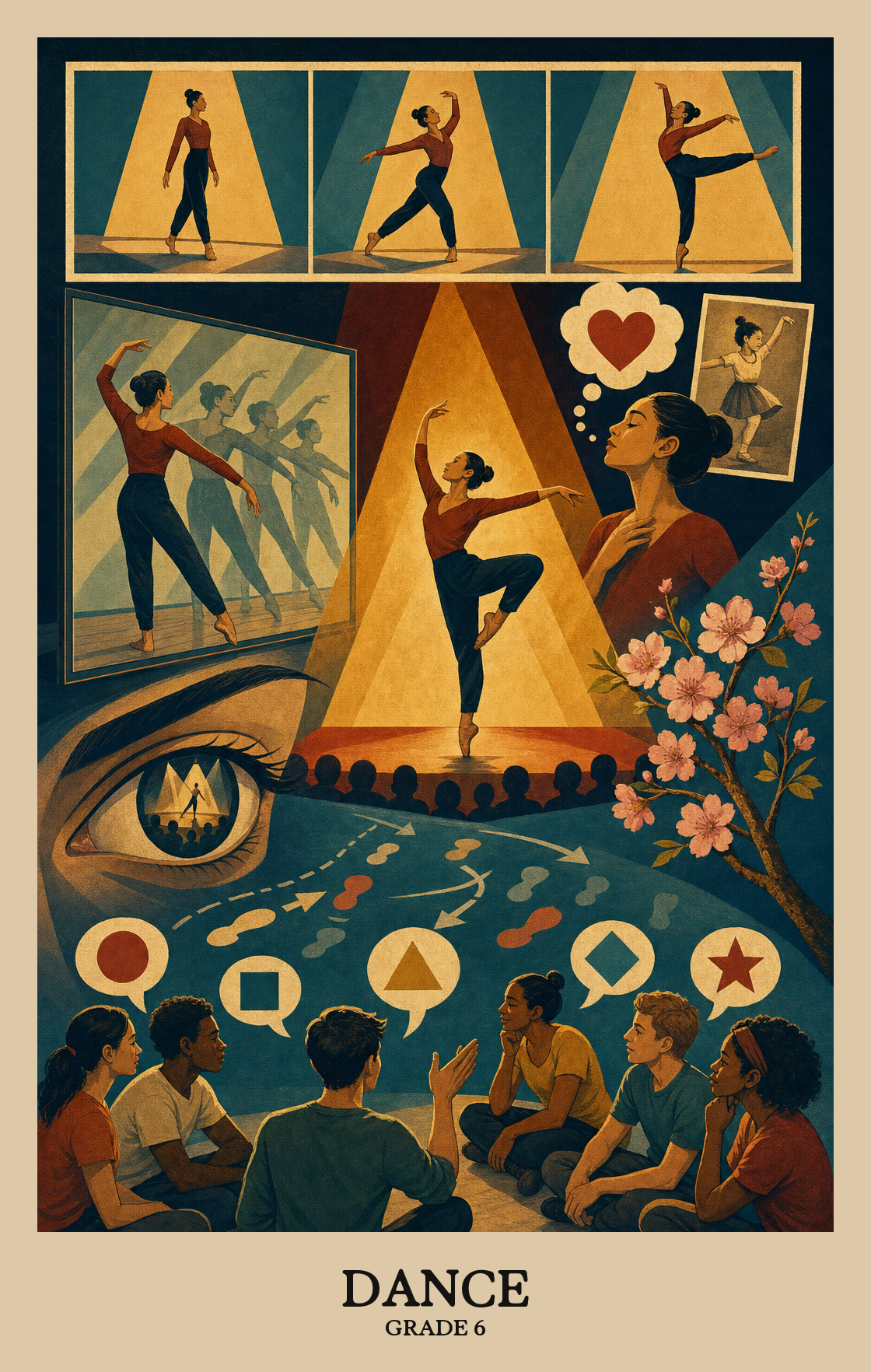
Students start the year exploring where dance ideas come from. They pull from personal experiences, stories, and images to invent short movement phrases they can build on later.
Students take their early ideas and turn them into organized dances. They make choices about order, timing, and space, then revise based on feedback from classmates and the teacher.
Students look at dances from different places and time periods. They notice what each dance says about the people who made it and connect those ideas back to their own choreography.
Students sharpen technique and rehearse pieces for presentation. They focus on clear movement, confident performance, and choices that help an audience understand the meaning behind the dance.
Students close the year by watching performances carefully and talking about what they see. They use clear criteria to describe what works, what the dance might mean, and how it could grow.
Students connect what they already know and what they've lived through to the dances they create. Personal history and outside knowledge shape every movement choice.
Students look at a dance and ask where it came from. They connect the moves, music, and style to the culture or time period that shaped it.
| Standard | Definition | Code |
|---|---|---|
| Synthesize and relate knowledge and personal experiences to make art | Students connect what they already know and what they've lived through to the dances they create. Personal history and outside knowledge shape every movement choice. | DA:Cn10.6 |
| Relate artistic ideas and works with societal, cultural | Students look at a dance and ask where it came from. They connect the moves, music, and style to the culture or time period that shaped it. | DA:Cn11.6 |
Students brainstorm movement ideas and start shaping them into a dance. They explore different ways the body can move before settling on an approach that feels intentional.
Students take a rough dance idea and shape it into something that holds together, choosing which movements to keep, which to cut, and how to order them into a clear piece.
Students revisit a dance they've been building, make deliberate changes to sharpen the movement or meaning, and bring it to a finished form ready to share.
| Standard | Definition | Code |
|---|---|---|
| Generate and conceptualize artistic ideas and work | Students brainstorm movement ideas and start shaping them into a dance. They explore different ways the body can move before settling on an approach that feels intentional. | DA:Cr1.6 |
| Organize and develop artistic ideas and work | Students take a rough dance idea and shape it into something that holds together, choosing which movements to keep, which to cut, and how to order them into a clear piece. | DA:Cr2.6 |
| Refine and complete artistic work | Students revisit a dance they've been building, make deliberate changes to sharpen the movement or meaning, and bring it to a finished form ready to share. | DA:Cr3.6 |
Students review a piece of choreography or movement sequence and decide whether it is ready to share with an audience, explaining why it works or what still needs to change.
Students practice and improve a dance piece until it is ready to show an audience. That means refining movements, fixing timing, and making deliberate choices about how the piece looks and feels in performance.
Students perform a dance for an audience with a clear purpose in mind, making choices about movement and expression so the piece communicates something specific to the people watching.
| Standard | Definition | Code |
|---|---|---|
| Analyze, interpret, and select artistic work for presentation | Students review a piece of choreography or movement sequence and decide whether it is ready to share with an audience, explaining why it works or what still needs to change. | DA:Pr4.6 |
| Develop and refine artistic techniques and work for presentation | Students practice and improve a dance piece until it is ready to show an audience. That means refining movements, fixing timing, and making deliberate choices about how the piece looks and feels in performance. | DA:Pr5.6 |
| Convey meaning through the presentation of artistic work | Students perform a dance for an audience with a clear purpose in mind, making choices about movement and expression so the piece communicates something specific to the people watching. | DA:Pr6.6 |
Students watch a dance performance and break down what they see: how the movement, timing, and use of space work together to create meaning.
Students explain what a dance is trying to say and why the choreographer may have made specific choices, such as repeating a movement or using slow, heavy steps to show a feeling.
Students use a set of criteria to judge a dance, explaining what makes a performance effective and where it falls short.
| Standard | Definition | Code |
|---|---|---|
| Perceive and analyze artistic work | Students watch a dance performance and break down what they see: how the movement, timing, and use of space work together to create meaning. | DA:Re7.6 |
| Interpret intent and meaning in artistic work | Students explain what a dance is trying to say and why the choreographer may have made specific choices, such as repeating a movement or using slow, heavy steps to show a feeling. | DA:Re8.6 |
| Apply criteria to evaluate artistic work | Students use a set of criteria to judge a dance, explaining what makes a performance effective and where it falls short. | DA:Re9.6 |
Students move through four big areas: making up their own dances, performing them, watching dance and talking about it, and connecting dance to their own lives and the wider world. Expect more independence this year, with students shaping short pieces from start to finish instead of just following along.
Clear a small space and let students show what they are working on. Ask them to teach a short sequence and explain why they chose those movements. Five minutes of stretching and a quick run-through of their piece is plenty.
Not at this level. The focus is on making thoughtful movement choices, not on talent or technique alone. Students who think carefully about ideas, shapes, and timing can do well even without a studio background.
Start with short improvisation tasks that feed into a movement vocabulary. Move into structured composition with clear choices about space, time, and energy. End the year with a polished piece students can perform and discuss using criteria they helped build.
Refining work is the hardest part. Students often want to call a first draft finished. Plan extra time for revision cycles where students rework a section after feedback, then perform it again so the change is visible.
Give them a simple starting point: a word, a picture, or a piece of music. Ask what the movement should feel like to a person watching. Pulling one clear idea out of their head is usually enough to get them moving again.
Students should describe what they saw before saying whether they liked it. Ask about shapes, speed, repeated movements, and what the piece seemed to be about. Using shared criteria keeps the conversation honest and avoids quick thumbs-up or thumbs-down reactions.
By the end of the year, students should be able to plan a short dance with a clear idea behind it, refine it after feedback, perform it for an audience, and explain choices using dance terms. They should also connect a piece to a culture, time period, or personal experience.