First words and greetings
Students start using the new language for everyday basics. They greet people, introduce themselves, and pick out familiar words in short conversations and simple texts.
This is the year a new language stops being a list of vocabulary words and starts being something students can actually use. Students hold short conversations on familiar topics like family, school, and food. They learn how everyday customs work in another culture and notice what is different from their own. By spring, they can introduce themselves, ask and answer simple questions, and read a short passage well enough to explain what it says.
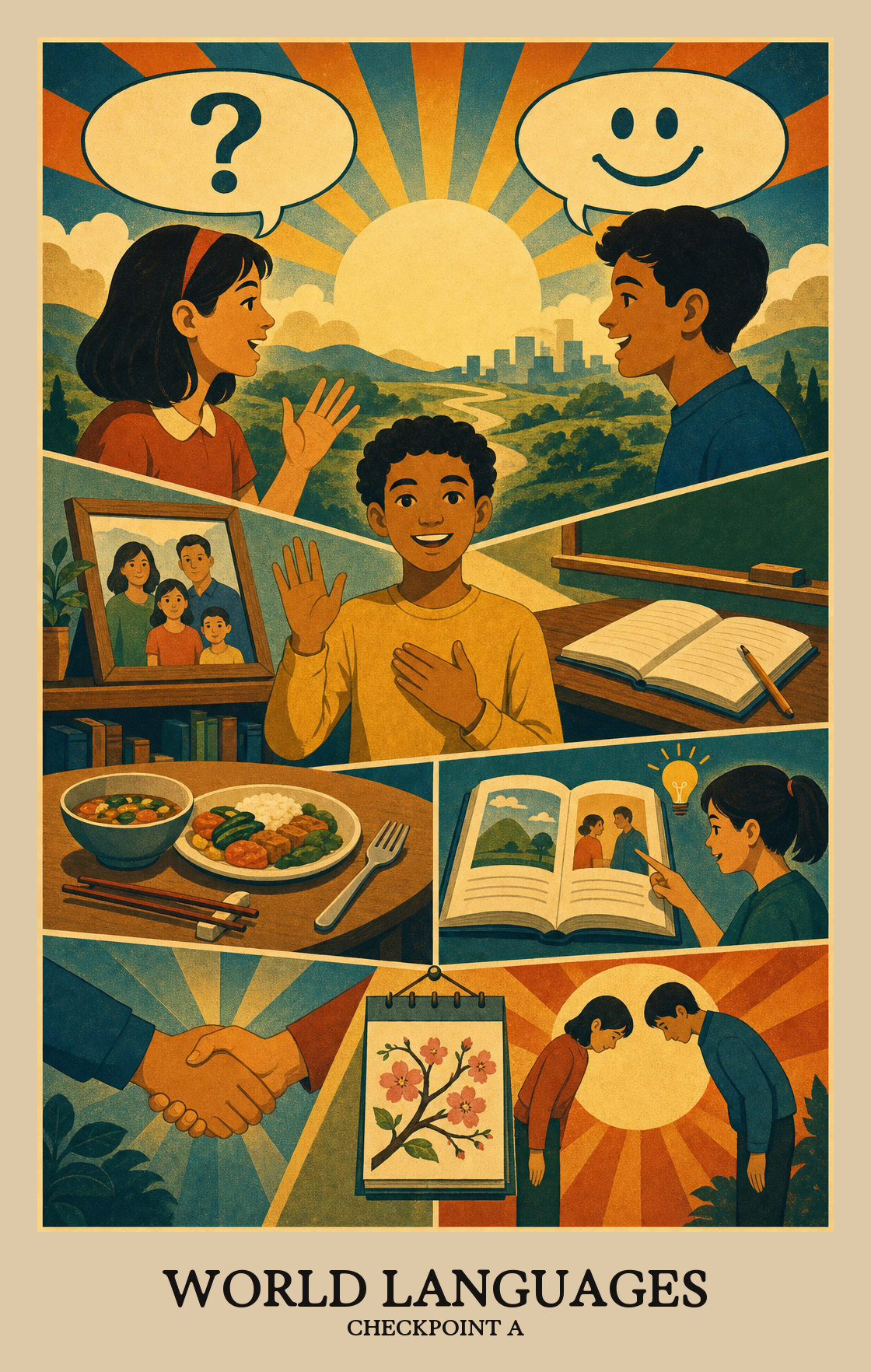
Students start using the new language for everyday basics. They greet people, introduce themselves, and pick out familiar words in short conversations and simple texts.
Students trade short questions and answers about family, school, food, and free time. They can share a like or dislike and react to what someone else says.
Students look at how people in other countries celebrate, eat, dress, and spend their days. They compare those habits to their own and notice what is similar and what is different.
Students write notes, captions, and short paragraphs, and give brief talks about themselves or a topic they have studied. They start adjusting how they speak for different listeners.
Students use the language with people beyond the classroom, through pen pals, videos, songs, or local events. They set small goals and notice how far they have come since the start of the year.
Students listen to, read, or watch material in another language and show they understood what it was about. At this level, topics are simple and familiar, like greetings, family, or everyday routines.
Students hold simple back-and-forth conversations in the language they are learning, sharing opinions, reactions, and basic information with a partner. They listen and respond, not just recite.
Students share information or tell a story out loud, in writing, or through media, adjusting how they speak or write based on who is listening or reading.
| Standard | Definition | Code |
|---|---|---|
| Learners understand, interpret Checkpoint A | Students listen to, read, or watch material in another language and show they understood what it was about. At this level, topics are simple and familiar, like greetings, family, or everyday routines. | DC-WL.1.1.wl-checkpoint-a |
| Learners interact and negotiate meaning in spoken, signed Checkpoint A | Students hold simple back-and-forth conversations in the language they are learning, sharing opinions, reactions, and basic information with a partner. They listen and respond, not just recite. | DC-WL.1.2.wl-checkpoint-a |
| Learners present information, concepts Checkpoint A | Students share information or tell a story out loud, in writing, or through media, adjusting how they speak or write based on who is listening or reading. | DC-WL.1.3.wl-checkpoint-a |
Students explore why people in other cultures do things the way they do, connecting everyday customs and habits to the beliefs and values behind them.
Students look at everyday objects, art, or traditions from another culture and explain in the target language what those things reveal about how people in that culture think and live.
| Standard | Definition | Code |
|---|---|---|
| Learners use the language to investigate, explain Checkpoint A | Students explore why people in other cultures do things the way they do, connecting everyday customs and habits to the beliefs and values behind them. | DC-WL.2.1.wl-checkpoint-a |
| Learners use the language to investigate, explain Checkpoint A | Students look at everyday objects, art, or traditions from another culture and explain in the target language what those things reveal about how people in that culture think and live. | DC-WL.2.2.wl-checkpoint-a |
Learning a new language doubles as practice in other subjects. Students use the language to think through problems in history, science, or math, connecting what they already know to new ideas.
Students read, listen to, or watch real content in the language they are learning to discover how people from that culture see the world. They think about whether the information is useful or reliable.
| Standard | Definition | Code |
|---|---|---|
| Learners build, reinforce Checkpoint A | Learning a new language doubles as practice in other subjects. Students use the language to think through problems in history, science, or math, connecting what they already know to new ideas. | DC-WL.3.1.wl-checkpoint-a |
| Learners access and evaluate information and diverse perspectives that are… Checkpoint A | Students read, listen to, or watch real content in the language they are learning to discover how people from that culture see the world. They think about whether the information is useful or reliable. | DC-WL.3.2.wl-checkpoint-a |
Students notice how the new language works differently from their own. They compare things like word order, grammar, or phrases to figure out what makes each language unique.
Students compare everyday life in another culture to their own: food, school, celebrations, or family routines. They use the new language to explain what's similar, what's different, and what those differences tell them.
| Standard | Definition | Code |
|---|---|---|
| Learners use the language to investigate, explain Checkpoint A | Students notice how the new language works differently from their own. They compare things like word order, grammar, or phrases to figure out what makes each language unique. | DC-WL.4.1.wl-checkpoint-a |
| Learners use the language to investigate, explain Checkpoint A | Students compare everyday life in another culture to their own: food, school, celebrations, or family routines. They use the new language to explain what's similar, what's different, and what those differences tell them. | DC-WL.4.2.wl-checkpoint-a |
Students practice the new language outside class too, not just during lessons. They use it to talk, work, and connect with people in their school, neighborhood, and wider world.
Students pick a goal for using the new language outside class, then look back at how far they've come. It could be watching a show, reading, or moving ahead in school or work.
| Standard | Definition | Code |
|---|---|---|
| Learners use the language both within and beyond the classroom to interact and… Checkpoint A | Students practice the new language outside class too, not just during lessons. They use it to talk, work, and connect with people in their school, neighborhood, and wider world. | DC-WL.5.1.wl-checkpoint-a |
| Learners set goals and reflect on their progress in using languages for… Checkpoint A | Students pick a goal for using the new language outside class, then look back at how far they've come. It could be watching a show, reading, or moving ahead in school or work. | DC-WL.5.2.wl-checkpoint-a |
Students learn to handle everyday topics like greetings, family, food, school, and free time. They listen, speak, read, and write in short, simple chunks. By the end of the year they can swap basic information with someone in the new language without needing English to fall back on.
Ask students to teach a few words at dinner, or to label items around the kitchen. Watch a short video or song in the language together and let them explain what they caught. Five minutes of regular practice beats an hour once a week.
Not a full chat, but short exchanges on familiar topics. Think introducing themselves, ordering food, asking for directions, or talking about what they like. Conversations stay simple and often need repetition or rephrasing.
Start with personal topics like name, age, and family, then move outward to school, food, hobbies, and daily routines. Recycle vocabulary and grammar across units so students keep using earlier material in new contexts. Culture work should ride alongside each theme rather than sit as a separate unit.
Pronunciation, basic verb forms, and the habit of staying in the target language during pair work. Students also tend to translate word for word from English, which breaks down quickly. Short, frequent speaking tasks help more than long grammar lessons.
Some structure helps, but communication comes first. Students need enough grammar to form simple sentences and ask questions, not a full rulebook. If a student can be understood and can understand others on familiar topics, the grammar is doing its job.
Culture is woven into everything, not a side topic. Students compare holidays, school life, food, and daily habits in the places where the language is spoken. The point is to notice differences and similarities, then reflect on what shapes them.
Look for students who can ask and answer simple questions on familiar topics, write a short paragraph about themselves or their day, and follow the gist of a slow conversation or short text. They should also show some independence, like guessing meaning from context instead of asking for every word.
Early progress can feel slow because students notice every mistake. Remind them that listening and reading often run ahead of speaking, and that mixing up words is part of learning. Short daily practice with an app, a song, or a show in the language builds confidence faster than cramming.