Building character and story ideas
Students start the year by pulling from their own lives and what they observe around them to invent characters and story ideas. Parents may hear them talk about a person they made up or a scene they want to try.
This is the year theatre work gets more deliberate. Students build characters and scenes by pulling from their own lives and from the world around the play, asking what a story means and why it matters now. They rehearse with a plan, take notes from each other, and revise before they perform. By spring, students can shape a short scene, perform it for an audience, and explain the choices behind it.
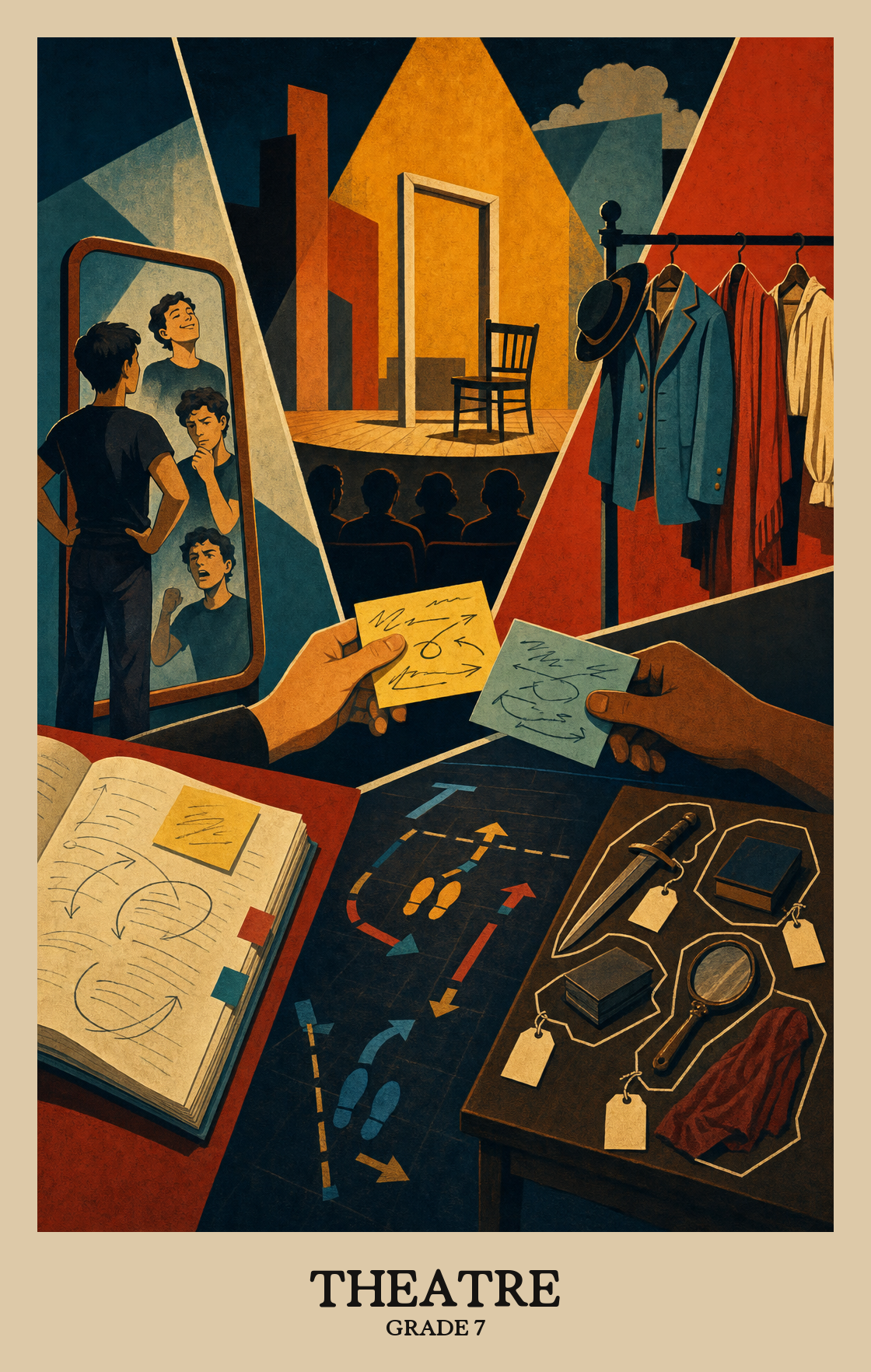
Students start the year by pulling from their own lives and what they observe around them to invent characters and story ideas. Parents may hear them talk about a person they made up or a scene they want to try.
Students take rough ideas and turn them into scenes with a beginning, middle, and end. They work in small groups, try different choices, and rewrite until the scene holds together.
Students pick which pieces to perform and practice the craft behind acting: voice, movement, timing, and reacting to other actors. They go back and adjust based on what is working onstage.
Students bring their work to a real audience and aim to communicate a clear meaning, not just say the lines. They think about what they want the audience to feel and shape their choices around that.
Students watch live and recorded performances and figure out what the artists were trying to say. They give specific feedback using agreed-upon criteria and connect plays to the time and place they came from.
Students connect what they know from their own life to what they're creating in theatre. A memory, a feeling, or a real event can become the raw material for a scene, a character, or a performance.
Students look at a play or performance and ask where it came from. They connect what they see on stage to the time, place, and people that shaped it.
| Standard | Definition | Code |
|---|---|---|
| Synthesize and relate knowledge and personal experiences to make art | Students connect what they know from their own life to what they're creating in theatre. A memory, a feeling, or a real event can become the raw material for a scene, a character, or a performance. | TH:Cn10.7 |
| Relate artistic ideas and works with societal, cultural | Students look at a play or performance and ask where it came from. They connect what they see on stage to the time, place, and people that shaped it. | TH:Cn11.7 |
Students brainstorm and develop original ideas for a theatrical piece, such as a character, a scene, or a story premise. The goal is to move from a spark of inspiration to a workable concept ready to build on.
Students take a rough theatre idea and shape it into something that could actually be rehearsed, deciding what to keep, what to cut, and how the pieces fit together.
Students revise a scene or performance based on feedback, then prepare it to share with an audience. The focus is on making deliberate choices until the work is ready to present.
| Standard | Definition | Code |
|---|---|---|
| Generate and conceptualize artistic ideas and work | Students brainstorm and develop original ideas for a theatrical piece, such as a character, a scene, or a story premise. The goal is to move from a spark of inspiration to a workable concept ready to build on. | TH:Cr1.7 |
| Organize and develop artistic ideas and work | Students take a rough theatre idea and shape it into something that could actually be rehearsed, deciding what to keep, what to cut, and how the pieces fit together. | TH:Cr2.7 |
| Refine and complete artistic work | Students revise a scene or performance based on feedback, then prepare it to share with an audience. The focus is on making deliberate choices until the work is ready to present. | TH:Cr3.7 |
Students choose a scene or monologue to perform and explain why it fits the story they want to tell. The choice has to connect to a clear artistic reason, not just personal preference.
Students practice and revise their acting choices to get a scene or performance ready to share with an audience. The focus is on sharpening what works and fixing what doesn't before the curtain goes up.
Students perform a scene or monologue with a clear intention, making choices about voice, movement, and character so the audience understands what the piece is about.
| Standard | Definition | Code |
|---|---|---|
| Analyze, interpret, and select artistic work for presentation | Students choose a scene or monologue to perform and explain why it fits the story they want to tell. The choice has to connect to a clear artistic reason, not just personal preference. | TH:Pr4.7 |
| Develop and refine artistic techniques and work for presentation | Students practice and revise their acting choices to get a scene or performance ready to share with an audience. The focus is on sharpening what works and fixing what doesn't before the curtain goes up. | TH:Pr5.7 |
| Convey meaning through the presentation of artistic work | Students perform a scene or monologue with a clear intention, making choices about voice, movement, and character so the audience understands what the piece is about. | TH:Pr6.7 |
Students watch or read a scene and explain what choices the playwright or actor made, and why those choices shape how the story feels.
Students explain what a scene or performance is really about, looking past the surface to say what choices the playwright or actor made and why those choices matter.
Students pick a set of standards (like believable characters or clear staging) and use them to judge a theatre performance, explaining what worked and what fell short.
| Standard | Definition | Code |
|---|---|---|
| Perceive and analyze artistic work | Students watch or read a scene and explain what choices the playwright or actor made, and why those choices shape how the story feels. | TH:Re7.7 |
| Interpret intent and meaning in artistic work | Students explain what a scene or performance is really about, looking past the surface to say what choices the playwright or actor made and why those choices matter. | TH:Re8.7 |
| Apply criteria to evaluate artistic work | Students pick a set of standards (like believable characters or clear staging) and use them to judge a theatre performance, explaining what worked and what fell short. | TH:Re9.7 |
Students build short scenes from their own ideas, rehearse and refine them, and perform for an audience. They also watch plays and other students' work and talk about what choices the actors and writers made. A lot of the year is about turning a rough idea into something worth watching.
Most theatre classes give students many ways to take part, including writing scenes, designing, directing, or playing smaller roles. Performing in front of classmates is usually expected, but it builds up slowly from partner work to short group scenes. Talk with the teacher early if stage fright is a real worry.
Ask them to run the lines with you and try the same line three different ways: angry, hopeful, then tired. Ask what the character wants in the scene and what is getting in the way. Ten minutes of this beats an hour of silent memorising.
A common arc is to start with ensemble work and improvisation, move into scene study and character work, then into devising original short pieces, and end with a polished performance or showcase. Build response and critique routines from day one so students have a shared vocabulary by the time stakes get higher.
Specific choices and revision. Students often play a feeling in general (sad, mad, happy) instead of choosing a clear action, and they treat the first rehearsal as the final version. Plan to reteach objective, obstacle, and tactic, and build in at least one round of feedback and rework before any performance.
Grade the process and the craft, not the talent. Use a rubric that names what students can control: preparation, specific choices, use of voice and body, response to direction, and thoughtful feedback to peers. Share the rubric before the work starts so students know what counts.
Watching and talking about theatre is half of how students get better at making it. Students learn to notice the choices behind a moment, connect a story to their own lives or to history, and use that to make stronger choices in their own scenes.
Yes, some memorisation is part of the year, but pieces are usually short: a monologue of a minute or two, or a scene split with a partner. The bigger goal is understanding the lines well enough to say them like a real person, not reciting them perfectly.
By the end of the year students should be able to take a prompt, develop a short scene with a clear character and conflict, rehearse with feedback, and perform it with intention. They should also be able to watch a piece and explain what worked, what didn't, and why, using theatre vocabulary.