Finding ideas worth making
Students start the year gathering ideas from their own lives, memories, and things they care about. They learn to sketch, brainstorm, and pick an idea that feels worth turning into real artwork.
This is the year art moves from making pictures to making choices on purpose. Students plan their work, try different ideas, and revise a piece until it says what they want it to say. They start talking about art with real reasons, explaining why a painting or sculpture works and what the artist might have meant. By spring, students can finish a piece, prepare it for display, and explain the choices behind it.
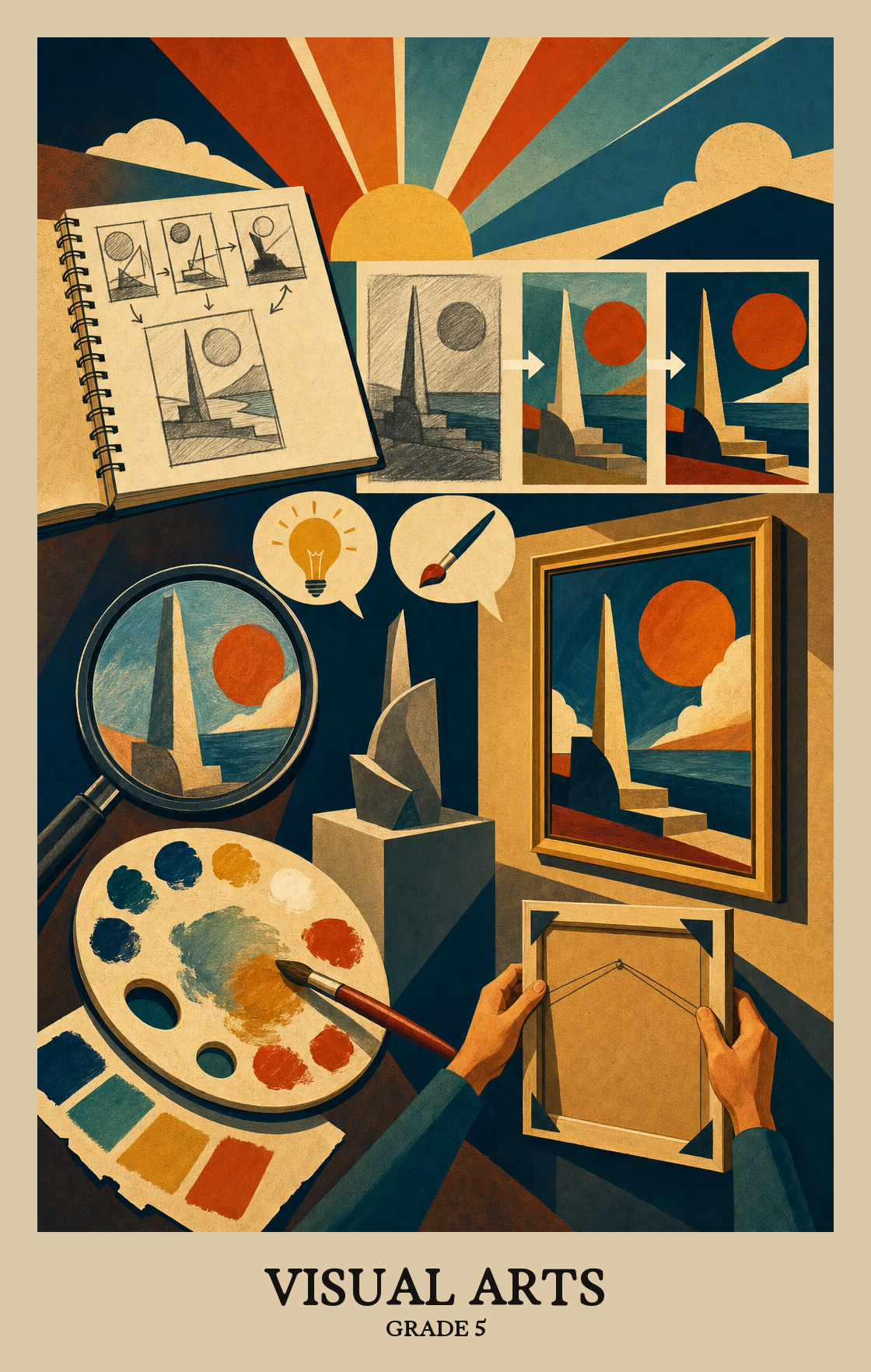
Students start the year gathering ideas from their own lives, memories, and things they care about. They learn to sketch, brainstorm, and pick an idea that feels worth turning into real artwork.
Students practice with different materials like paint, clay, pencil, and collage. They learn how artists plan a piece, fix mistakes, and keep working on something until it looks the way they wanted.
Students study artwork from different times and places and talk about what the artist might have meant. They learn that art carries history and culture, not just pretty pictures.
Students choose pieces they are proud of, get them ready to display, and explain the choices behind them. They also give thoughtful feedback on classmates' work using clear reasons, not just likes and dislikes.
Students connect something from their own life to an idea or feeling, then use that connection to drive the choices they make in an artwork.
Students look at a painting, sculpture, or other artwork and connect it to the time period, place, or culture that shaped it. Understanding that context helps explain why the artwork looks the way it does and what it meant to the people who made it.
| Standard | Definition | Code |
|---|---|---|
| Synthesize and relate knowledge and personal experiences to make art | Students connect something from their own life to an idea or feeling, then use that connection to drive the choices they make in an artwork. | VA:Cn10.5 |
| Relate artistic ideas and works with societal, cultural | Students look at a painting, sculpture, or other artwork and connect it to the time period, place, or culture that shaped it. Understanding that context helps explain why the artwork looks the way it does and what it meant to the people who made it. | VA:Cn11.5 |
Students brainstorm and develop original ideas before starting an art project, thinking through what they want to make and why.
Students plan and refine their artwork by making deliberate choices about composition, materials, and technique before and during the creative process.
Students revisit a finished piece, looking for places to sharpen a line, adjust a color, or strengthen the composition before calling it done.
| Standard | Definition | Code |
|---|---|---|
| Generate and conceptualize artistic ideas and work | Students brainstorm and develop original ideas before starting an art project, thinking through what they want to make and why. | VA:Cr1.5 |
| Organize and develop artistic ideas and work | Students plan and refine their artwork by making deliberate choices about composition, materials, and technique before and during the creative process. | VA:Cr2.5 |
| Refine and complete artistic work | Students revisit a finished piece, looking for places to sharpen a line, adjust a color, or strengthen the composition before calling it done. | VA:Cr3.5 |
Students look at several pieces of their own artwork, decide which ones are strongest, and choose what to present to others.
Students practice and improve a piece of visual art until it's ready to share with an audience. That might mean reworking a drawing, adjusting color choices, or cleaning up the final details before putting the work on display.
Students choose how to display their artwork and explain what they want viewers to notice or feel. The way a piece is shown is part of the message it sends.
| Standard | Definition | Code |
|---|---|---|
| Analyze, interpret, and select artistic work for presentation | Students look at several pieces of their own artwork, decide which ones are strongest, and choose what to present to others. | VA:Pr4.5 |
| Develop and refine artistic techniques and work for presentation | Students practice and improve a piece of visual art until it's ready to share with an audience. That might mean reworking a drawing, adjusting color choices, or cleaning up the final details before putting the work on display. | VA:Pr5.5 |
| Convey meaning through the presentation of artistic work | Students choose how to display their artwork and explain what they want viewers to notice or feel. The way a piece is shown is part of the message it sends. | VA:Pr6.5 |
Students look closely at a piece of art and describe what they notice, from the colors and shapes on the surface to the deeper choices the artist made and why those choices matter.
Students look at a piece of art and explain what they think the artist was trying to say. They support their reading of the work with details from the image itself.
Students use a set of criteria, like balance, detail, or color choice, to judge their own artwork or a classmate's. They explain why the work succeeds or where it could improve.
| Standard | Definition | Code |
|---|---|---|
| Perceive and analyze artistic work | Students look closely at a piece of art and describe what they notice, from the colors and shapes on the surface to the deeper choices the artist made and why those choices matter. | VA:Re7.5 |
| Interpret intent and meaning in artistic work | Students look at a piece of art and explain what they think the artist was trying to say. They support their reading of the work with details from the image itself. | VA:Re8.5 |
| Apply criteria to evaluate artistic work | Students use a set of criteria, like balance, detail, or color choice, to judge their own artwork or a classmate's. They explain why the work succeeds or where it could improve. | VA:Re9.5 |
Students make art from their own ideas and experiences instead of just copying a model. They try different materials like paint, clay, paper, and digital tools, and they learn to plan a piece, revise it, and talk about why they made the choices they did.
Ask what they are trying to show and what they have tried so far. A few sketches on scrap paper before the real piece often helps more than starting over. Praise the thinking, not just the finished look.
No. The work at this age is about generating ideas, planning, and improving a piece over time. Neat realistic drawing is one skill among many, alongside color, shape, texture, and meaning.
Start with idea generation and sketchbook routines so students have a way to plan before they make. Build technique units around a few materials students will return to, and save presentation and critique work for the second half once students have pieces worth selecting from.
A student can take an idea from their own life or from something they have studied, plan it out, choose materials on purpose, revise the work, and explain what it means. They can also look at another artist's piece and say what it is about and how it was made.
At a museum, a library book, or even an ad, ask what they notice first and what they think it means. Two or three minutes is plenty. The habit of looking closely matters more than knowing the right vocabulary.
Revision. Students at this age often want to call a piece done the moment it looks like something. Building in planned checkpoints, peer feedback, and a clear reason to go back into the work helps more than asking for one more pass at the end.
They keep a sketchbook or idea list, can talk about why they made a choice in a piece, and can connect their art to something they have read, seen, or lived through. Comfort with critique, giving it and taking it, is the other big signal.