Finding ideas for movement
Students start the year by turning ideas, memories, and things they notice into movement. They try out steps and shapes on their own and pick the ones worth keeping.
This is the year dance becomes about choices and meaning, not just steps. Students shape their own movement ideas into short pieces, polish them with cleaner technique, and think about what a dance is trying to say. They also start connecting dances to the people, places, and times they come from. By spring, students can perform a short dance they helped create and explain what it means and why they made those choices.
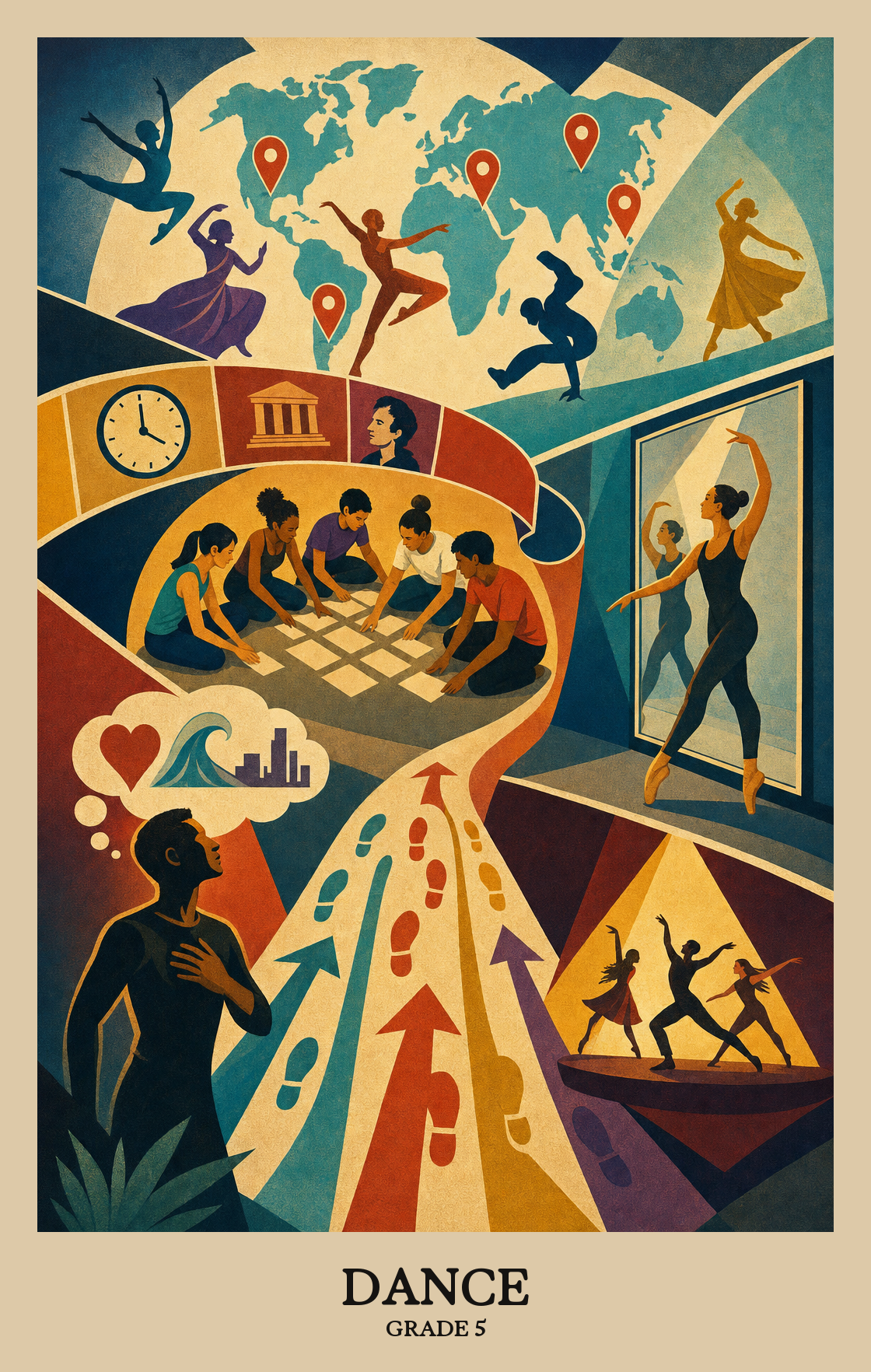
Students start the year by turning ideas, memories, and things they notice into movement. They try out steps and shapes on their own and pick the ones worth keeping.
Students put their movements in order to build short dances. They work with a partner or small group to decide what comes first, what repeats, and how the dance ends.
Students sharpen the steps they plan to perform. They focus on timing, balance, and clear shapes so the dance reads well to someone watching from across the room.
Students look at dances from different cultures and time periods. They talk about why people made these dances and connect what they see to their own lives.
Students watch dances and explain what the choreographer might have meant. They use a short list of agreed-upon rules to say what worked and what could be stronger.
Students connect what they know from life outside class to the dances they create and perform. Personal memories, observations, and feelings shape the choices they make in movement.
Students look at a dance and ask where it came from. They connect the movement to the culture, time period, or community that shaped it.
| Standard | Definition | Code |
|---|---|---|
| Synthesize and relate knowledge and personal experiences to make art | Students connect what they know from life outside class to the dances they create and perform. Personal memories, observations, and feelings shape the choices they make in movement. | DA:Cn10.5 |
| Relate artistic ideas and works with societal, cultural | Students look at a dance and ask where it came from. They connect the movement to the culture, time period, or community that shaped it. | DA:Cn11.5 |
Students brainstorm and develop original ideas for a dance, then shape those ideas into movement that expresses something specific. The work starts from their own imagination, not a set routine to copy.
Students take their movement ideas and shape them into a short dance, choosing which moments to keep, cut, or rearrange until the piece feels intentional.
Students revisit a dance they've been building, fix what isn't working, and bring the piece to a finished form they're ready to share.
| Standard | Definition | Code |
|---|---|---|
| Generate and conceptualize artistic ideas and work | Students brainstorm and develop original ideas for a dance, then shape those ideas into movement that expresses something specific. The work starts from their own imagination, not a set routine to copy. | DA:Cr1.5 |
| Organize and develop artistic ideas and work | Students take their movement ideas and shape them into a short dance, choosing which moments to keep, cut, or rearrange until the piece feels intentional. | DA:Cr2.5 |
| Refine and complete artistic work | Students revisit a dance they've been building, fix what isn't working, and bring the piece to a finished form they're ready to share. | DA:Cr3.5 |
Students choose which dances to perform and explain why those pieces are worth presenting. They look closely at the work and make a case for their choices.
Students practice and improve a dance to get it ready to perform for an audience. They refine their technique and make deliberate choices about how the piece will look and feel.
Students rehearse and perform a dance to share a clear idea or feeling with an audience. Every choice, from movement to timing, serves what the dance is trying to say.
| Standard | Definition | Code |
|---|---|---|
| Analyze, interpret, and select artistic work for presentation | Students choose which dances to perform and explain why those pieces are worth presenting. They look closely at the work and make a case for their choices. | DA:Pr4.5 |
| Develop and refine artistic techniques and work for presentation | Students practice and improve a dance to get it ready to perform for an audience. They refine their technique and make deliberate choices about how the piece will look and feel. | DA:Pr5.5 |
| Convey meaning through the presentation of artistic work | Students rehearse and perform a dance to share a clear idea or feeling with an audience. Every choice, from movement to timing, serves what the dance is trying to say. | DA:Pr6.5 |
Students watch a dance performance and explain what they notice, describing how the movement choices shape what the piece feels like overall.
Students explain what a dance is trying to say and what choices the choreographer made to say it. They back up their reading of the dance with specific movements or moments they observed.
Students use a clear set of criteria to judge a dance, explaining what works, what doesn't, and why, based on specific things they saw in the performance.
| Standard | Definition | Code |
|---|---|---|
| Perceive and analyze artistic work | Students watch a dance performance and explain what they notice, describing how the movement choices shape what the piece feels like overall. | DA:Re7.5 |
| Interpret intent and meaning in artistic work | Students explain what a dance is trying to say and what choices the choreographer made to say it. They back up their reading of the dance with specific movements or moments they observed. | DA:Re8.5 |
| Apply criteria to evaluate artistic work | Students use a clear set of criteria to judge a dance, explaining what works, what doesn't, and why, based on specific things they saw in the performance. | DA:Re9.5 |
Students make up their own short dances, learn movement from teachers, and perform for classmates. They also watch dances and talk about what the movement made them think or feel. Expect a mix of creating, performing, and responding.
Clear a small space and ask students to make a short movement piece about a feeling, a story, or a song. Watch it, then ask what they were trying to show. Five minutes of moving and talking about it goes a long way.
No. The work is about making and shaping movement, not about being a trained dancer. Students who like sports, acting, or building things often find a way in once they see dance as a way to express an idea.
Start with exploring movement and generating ideas, then move into shaping and refining short pieces. Bring in responding and connecting work alongside creating so students build the vocabulary to talk about what they see. Save longer performance pieces for later in the year.
Refining a piece is the hardest part. Students often want to call a first draft finished. Plan repeated cycles of perform, give feedback, revise. Applying criteria to evaluate someone else's work also takes practice and clear language.
Students look at dances from different times and places and think about why people made them. A piece might connect to a holiday, a community, or a moment in history. The goal is to see dance as something people do for reasons, not just steps.
Students should be able to create a short dance with a clear idea, revise it based on feedback, and perform it for an audience. They should also be able to watch a dance and explain what they think it means using evidence from the movement.
Ask what the dancers did with their bodies, what it reminded them of, and what they think the dance was about. There is no single right answer. The point is to notice details in the movement and connect them to an idea.