Listening with a musician's ear
Students start the year by listening closely to songs and pieces of music. They notice things like tempo, mood, and instruments, and they start using music words to describe what they hear.
This is the year music gets thoughtful. Students stop just playing and singing along and start making real choices about how a piece should sound and why. They tie songs to their own lives and to the time and place the music came from, and they use simple standards to judge what is working. By spring, they can rehearse a piece, explain the choices behind it, and perform it for an audience.
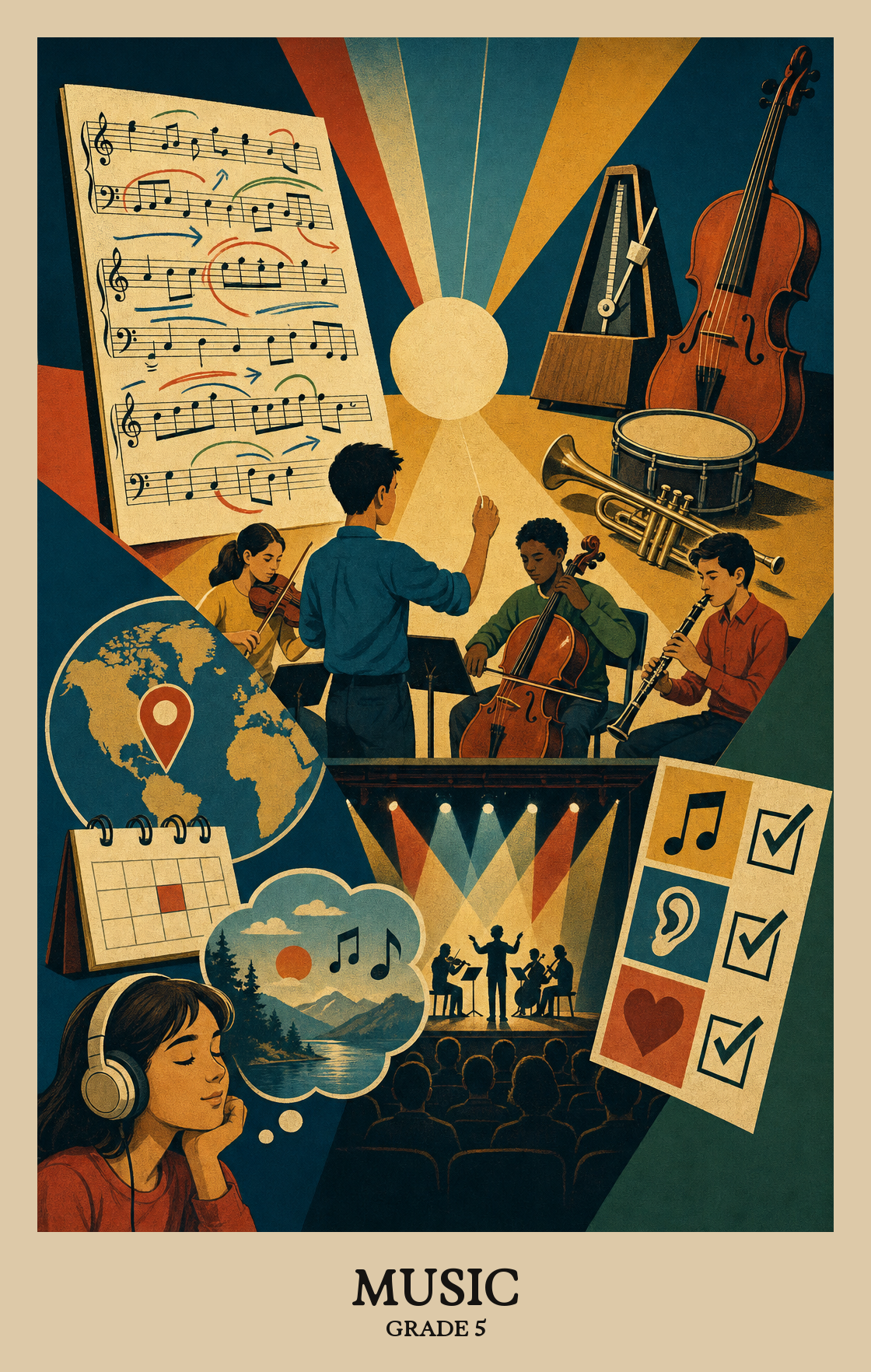
Students start the year by listening closely to songs and pieces of music. They notice things like tempo, mood, and instruments, and they start using music words to describe what they hear.
Students try out their own musical ideas, like a short rhythm, melody, or beat. They tinker with these ideas, get feedback from classmates, and shape them into something they want to share.
Students pick music to perform on voice or an instrument and practice the parts that need work. They learn how to start together, stay in time, and play with the feeling the music calls for.
Students connect songs to where they come from, who wrote them, and why. They link music to their own lives and to history, and they judge performances using clear reasons instead of just liking or disliking them.
Students connect what they've learned in music class to their own life experiences, then use both to shape the choices they make when creating or performing music.
Students connect a piece of music to the time, place, or culture it came from. Knowing that context helps them understand why the music sounds the way it does.
| Standard | Definition | Code |
|---|---|---|
| Synthesize and relate knowledge and personal experiences to make art | Students connect what they've learned in music class to their own life experiences, then use both to shape the choices they make when creating or performing music. | MU:Cn10.5 |
| Relate artistic ideas and works with societal, cultural | Students connect a piece of music to the time, place, or culture it came from. Knowing that context helps them understand why the music sounds the way it does. | MU:Cn11.5 |
Students brainstorm and develop original musical ideas, like inventing a melody, choosing instruments, or deciding how a piece should feel before they start composing.
Students take their musical ideas and shape them into a short piece or pattern, making choices about which sounds to keep, change, or arrange differently.
Students revisit a piece of music they composed, make changes to strengthen it, and decide when the work is ready to share.
| Standard | Definition | Code |
|---|---|---|
| Generate and conceptualize artistic ideas and work | Students brainstorm and develop original musical ideas, like inventing a melody, choosing instruments, or deciding how a piece should feel before they start composing. | MU:Cr1.5 |
| Organize and develop artistic ideas and work | Students take their musical ideas and shape them into a short piece or pattern, making choices about which sounds to keep, change, or arrange differently. | MU:Cr2.5 |
| Refine and complete artistic work | Students revisit a piece of music they composed, make changes to strengthen it, and decide when the work is ready to share. | MU:Cr3.5 |
Students choose a piece of music to perform and explain why it suits their skill level and expressive goals.
Students practice and polish a piece of music before performing it, making adjustments to technique, tempo, or expression until the performance is ready to share.
Students perform a song or piece and make deliberate choices, like tempo and dynamics, to express a specific feeling or idea to the audience.
| Standard | Definition | Code |
|---|---|---|
| Analyze, interpret, and select artistic work for presentation | Students choose a piece of music to perform and explain why it suits their skill level and expressive goals. | MU:Pr4.5 |
| Develop and refine artistic techniques and work for presentation | Students practice and polish a piece of music before performing it, making adjustments to technique, tempo, or expression until the performance is ready to share. | MU:Pr5.5 |
| Convey meaning through the presentation of artistic work | Students perform a song or piece and make deliberate choices, like tempo and dynamics, to express a specific feeling or idea to the audience. | MU:Pr6.5 |
Students listen to a piece of music and describe what they notice: how the melody moves, where the rhythm shifts, or how the mood changes from one section to the next.
Students listen to a piece of music and explain what the composer or performer was trying to express, using specific details from the music to support their thinking.
Students use a checklist or set of criteria to judge a piece of music, then explain in writing or discussion why it meets or falls short of the standard.
| Standard | Definition | Code |
|---|---|---|
| Perceive and analyze artistic work | Students listen to a piece of music and describe what they notice: how the melody moves, where the rhythm shifts, or how the mood changes from one section to the next. | MU:Re7.5 |
| Interpret intent and meaning in artistic work | Students listen to a piece of music and explain what the composer or performer was trying to express, using specific details from the music to support their thinking. | MU:Re8.5 |
| Apply criteria to evaluate artistic work | Students use a checklist or set of criteria to judge a piece of music, then explain in writing or discussion why it meets or falls short of the standard. | MU:Re9.5 |
Students sing, play instruments, and read simple rhythms and notes. They also create short pieces of their own, perform for others, and listen carefully to music to talk about what they hear and why it works.
Listen to a song together and ask what stood out: the beat, the mood, an instrument, a repeated part. Five minutes of real listening and one honest question does more than drills. Singing in the car and clapping rhythms counts too.
Students should read basic rhythms and a simple line of notes on the staff. They are not expected to sight-read fluently. The goal is enough fluency to follow a short song and write down a rhythm they made up.
Start by reviewing steady beat, basic rhythms, and singing in tune. Build into reading pitches on the staff, then short composing tasks, then performance and revision. Save deeper listening and cultural context work for the back half, once students have the vocabulary to discuss it.
Students can perform a short piece with accurate rhythm and pitch, create a brief original piece using a set of rules, and explain choices a composer or performer made using musical terms. They can also revise their own work after feedback.
Steady beat under changing rhythms, the difference between pitch and rhythm notation, and giving specific feedback instead of saying a piece was good or bad. Plan short warm-ups across the year rather than one unit on each.
Musical skill grows with practice, like reading. Praise effort on a specific thing, like keeping the beat or remembering the words, instead of talent. Most fifth graders who keep singing and playing get noticeably better within a few months.
Use a short rubric tied to the task: did the piece follow the rules given, did the student revise after feedback, did the written or spoken response use musical terms and point to something specific in the music. Keep the criteria visible while students work.