Building stories and characters
Students start the year inventing characters and short scenes from their own ideas. They draw on memories, books, and everyday moments to imagine what a character wants and how that character might act.
This is the year theatre shifts from playing pretend to building a scene on purpose. Students come up with their own characters and story ideas, then shape them with a partner or small group before sharing. They start watching plays and classmates' work with a thoughtful eye, noticing what choices an actor made and why. By spring, students can rehearse a short scene, perform it for the class, and explain what the story was trying to say.
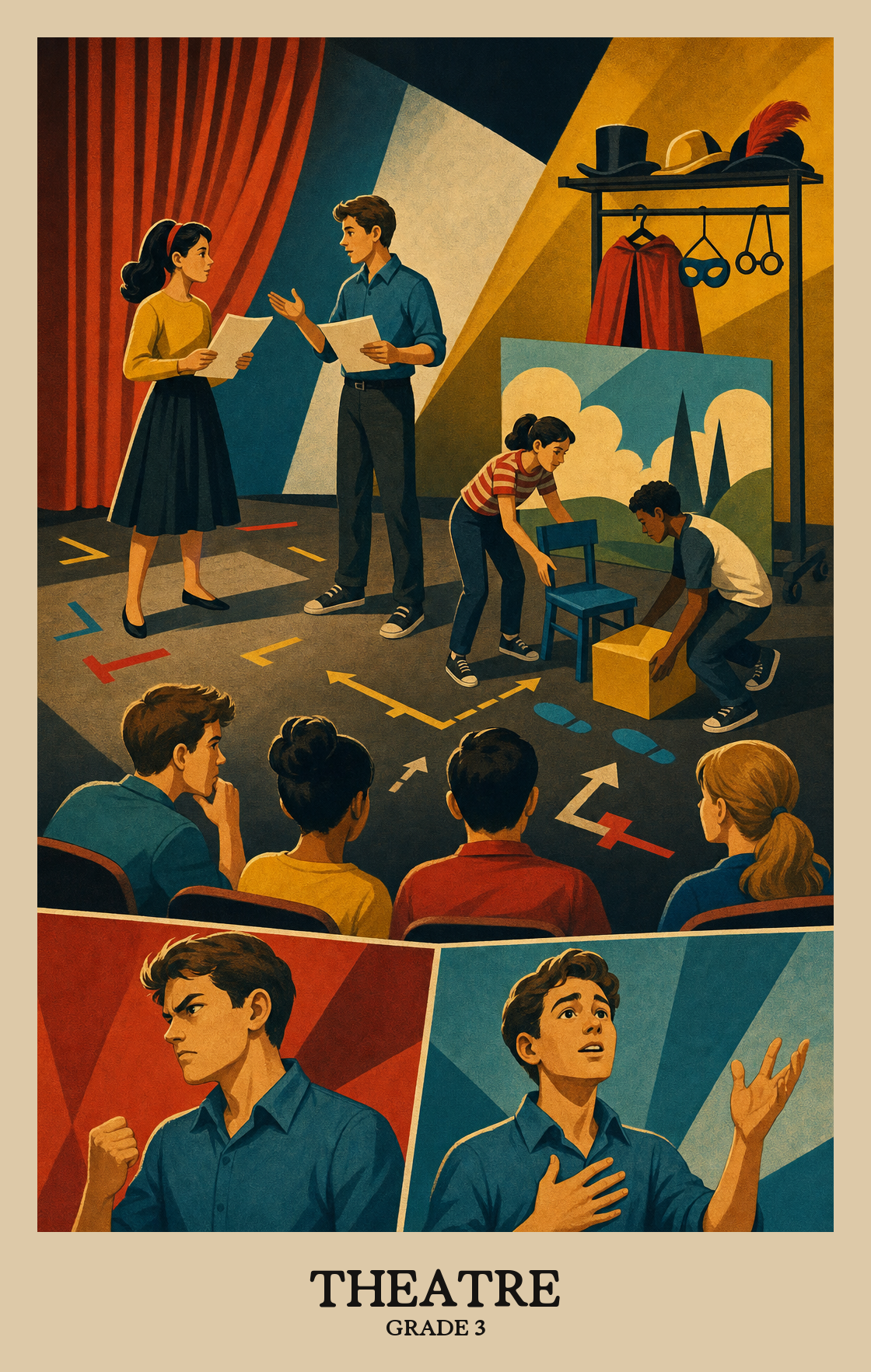
Students start the year inventing characters and short scenes from their own ideas. They draw on memories, books, and everyday moments to imagine what a character wants and how that character might act.
Students work in small groups to organize their ideas into scenes that have a beginning, middle, and end. They try out different choices, listen to each other, and revise the story as it takes shape.
Students rehearse the scenes they have built, focusing on how voice, face, and body show what a character is feeling. They learn that small changes in volume or posture can change what the audience understands.
Students present finished scenes to classmates or families. They think about how to make the meaning clear for an audience and use simple props, costumes, or sound to support the story.
Students watch performances and talk about what they noticed and what the story meant. They begin to connect plays to their own lives and to the places, times, and communities the stories come from.
Students connect something from their own life to a character or story they perform. That personal connection shapes the choices they make on stage.
Students connect a play or performance to the time and place it comes from. Knowing that context helps them understand why characters act the way they do and what the story really means.
| Standard | Definition | Code |
|---|---|---|
| Synthesize and relate knowledge and personal experiences to make art | Students connect something from their own life to a character or story they perform. That personal connection shapes the choices they make on stage. | TH:Cn10.3 |
| Relate artistic ideas and works with societal, cultural | Students connect a play or performance to the time and place it comes from. Knowing that context helps them understand why characters act the way they do and what the story really means. | TH:Cn11.3 |
Students brainstorm original ideas for characters, stories, and scenes they want to act out. This is the starting point where imagination turns into a plan for a play or skit.
Students take a drama idea and shape it into a short scene, deciding what happens, who speaks, and how the story moves from beginning to end.
Students revisit a scene or character they've created, make changes based on feedback, and decide when the work is ready to share.
| Standard | Definition | Code |
|---|---|---|
| Generate and conceptualize artistic ideas and work | Students brainstorm original ideas for characters, stories, and scenes they want to act out. This is the starting point where imagination turns into a plan for a play or skit. | TH:Cr1.3 |
| Organize and develop artistic ideas and work | Students take a drama idea and shape it into a short scene, deciding what happens, who speaks, and how the story moves from beginning to end. | TH:Cr2.3 |
| Refine and complete artistic work | Students revisit a scene or character they've created, make changes based on feedback, and decide when the work is ready to share. | TH:Cr3.3 |
Students choose a scene or character to perform and explain why it fits the story they want to tell. The choice is part of the work.
Students practice and improve a scene or performance before showing it to an audience. That means repeating lines, adjusting movements, and making small changes until the work is ready to share.
Students perform a scene or character in a way that makes the audience feel or understand something specific. The performance itself carries the message.
| Standard | Definition | Code |
|---|---|---|
| Analyze, interpret, and select artistic work for presentation | Students choose a scene or character to perform and explain why it fits the story they want to tell. The choice is part of the work. | TH:Pr4.3 |
| Develop and refine artistic techniques and work for presentation | Students practice and improve a scene or performance before showing it to an audience. That means repeating lines, adjusting movements, and making small changes until the work is ready to share. | TH:Pr5.3 |
| Convey meaning through the presentation of artistic work | Students perform a scene or character in a way that makes the audience feel or understand something specific. The performance itself carries the message. | TH:Pr6.3 |
Students look closely at a short play or performance and explain what they notice, such as how the actors move, speak, or show feelings. They begin to say why those choices make the story work.
Students look at a scene or performance and explain what the actor or playwright was trying to say. They back up their thinking with specific details from the work itself.
Students look at a scene or performance and explain what works and what could be better, using specific reasons. They practice judging theatre the way they would judge a drawing or a story.
| Standard | Definition | Code |
|---|---|---|
| Perceive and analyze artistic work | Students look closely at a short play or performance and explain what they notice, such as how the actors move, speak, or show feelings. They begin to say why those choices make the story work. | TH:Re7.3 |
| Interpret intent and meaning in artistic work | Students look at a scene or performance and explain what the actor or playwright was trying to say. They back up their thinking with specific details from the work itself. | TH:Re8.3 |
| Apply criteria to evaluate artistic work | Students look at a scene or performance and explain what works and what could be better, using specific reasons. They practice judging theatre the way they would judge a drawing or a story. | TH:Re9.3 |
Students make up short scenes, take on characters, and act out stories from books, history, or their own lives. They also watch classmates perform and talk about what worked and why. Most of the work happens through play, not memorized scripts.
Ask students to act out a favorite story or a moment from their day using a different voice or posture for each character. Five minutes of pretend play counts. Watching a short film or show together and asking what the character wanted is also strong practice.
Not really. Most work at this age is improvised or built from a simple outline. If lines come up, they are short and shared by the group, so memorization is not the main goal.
Start with imagination and movement games to build trust. Move into short partner scenes where students invent characters and a problem. End the year with small group pieces that students plan, rehearse, and revise before showing classmates.
Students can build a character with a clear voice and body, work in a small group to plan a short scene, and give a classmate specific feedback about what they saw. Stage fright is normal and does not mean a student is behind.
Start small at home. Read a picture book out loud and give each character a different voice, or act out a scene with stuffed animals. Low-pressure play at home makes the classroom feel less exposed.
Giving useful feedback is the hardest part. Students often say a scene was good or bad without pointing to what they actually saw. Model sentence starters like I noticed or I wondered, and practice them after every showing.
Students act out stories from different times and places, then talk about what life was like for the people in them. A folktale from another country or a scene from a history lesson works well. The goal is to step into someone else's shoes for a few minutes.