Exploring movement ideas
Students start the year by turning everyday ideas, stories, and feelings into movement. They try out shapes, levels, and speeds to see how a body can show an idea without words.
This is the year dance shifts from copying steps to shaping ideas on purpose. Students pull from their own experiences and what they see around them to build short dances with a clear beginning, middle, and end. They practice cleaning up their movement before they show it, and they learn to talk about what a dance means and whether it worked. By spring, students can perform a short dance they helped create and explain the idea behind it.
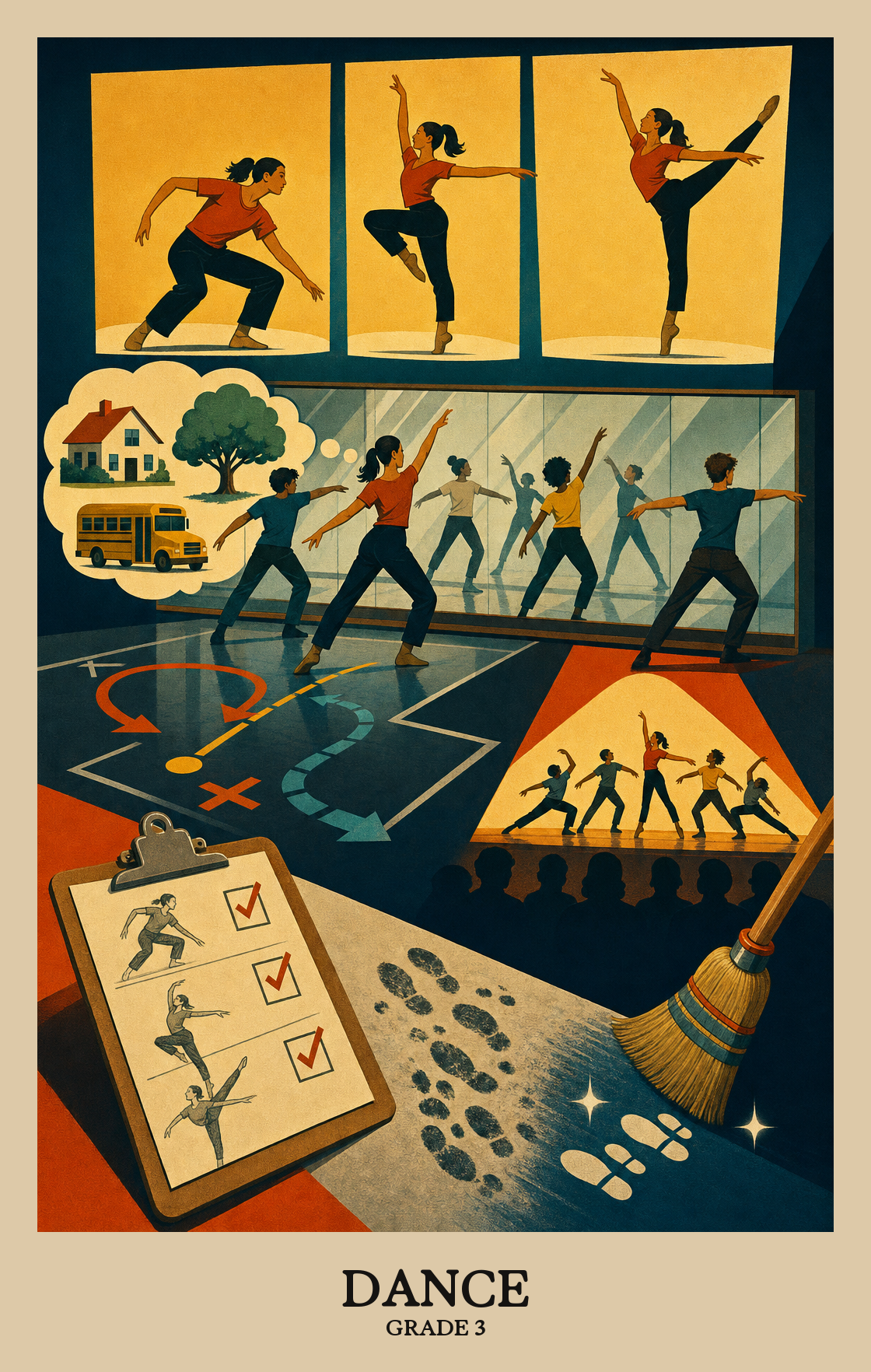
Students start the year by turning everyday ideas, stories, and feelings into movement. They try out shapes, levels, and speeds to see how a body can show an idea without words.
Students put movement pieces together into short dances with a clear beginning, middle, and end. They practice working with a partner or small group and revising parts that do not feel right yet.
Students focus on how dance actually looks and feels when performed. They work on balance, control, and timing with music, and learn what it means to face an audience and commit to each move.
Students watch dances and their classmates' work and talk about what they see. They describe what a dance might mean, compare it to dances from other places and times, and use simple criteria to give feedback.
Students connect something from their own life to a dance they make or perform. A memory, a feeling, or a moment they know becomes part of the movement.
Students look at a dance and ask where it came from. They connect the moves, costumes, or music to the culture or time period that shaped it.
| Standard | Definition | Code |
|---|---|---|
| Synthesize and relate knowledge and personal experiences to make art | Students connect something from their own life to a dance they make or perform. A memory, a feeling, or a moment they know becomes part of the movement. | DA:Cn10.3 |
| Relate artistic ideas and works with societal, cultural | Students look at a dance and ask where it came from. They connect the moves, costumes, or music to the culture or time period that shaped it. | DA:Cn11.3 |
Students brainstorm movement ideas and start shaping them into a short dance. They experiment with how their body can move to express a feeling or tell a story.
Students take their movement ideas and shape them into a short dance, choosing which moves to keep, which to change, and how to put them in order.
Students revisit a dance they have been making, fix what isn't working, and finish it as a complete piece.
| Standard | Definition | Code |
|---|---|---|
| Generate and conceptualize artistic ideas and work | Students brainstorm movement ideas and start shaping them into a short dance. They experiment with how their body can move to express a feeling or tell a story. | DA:Cr1.3 |
| Organize and develop artistic ideas and work | Students take their movement ideas and shape them into a short dance, choosing which moves to keep, which to change, and how to put them in order. | DA:Cr2.3 |
| Refine and complete artistic work | Students revisit a dance they have been making, fix what isn't working, and finish it as a complete piece. | DA:Cr3.3 |
Students choose which dances or movements to perform for an audience and explain why those choices fit the piece they want to share.
Students practice and polish a dance to get it ready to share with an audience. They work on technique, make adjustments, and repeat until the movement looks and feels the way they intend.
Students perform a dance for an audience and make choices, like how fast or slow to move, to express a specific feeling or idea.
| Standard | Definition | Code |
|---|---|---|
| Analyze, interpret, and select artistic work for presentation | Students choose which dances or movements to perform for an audience and explain why those choices fit the piece they want to share. | DA:Pr4.3 |
| Develop and refine artistic techniques and work for presentation | Students practice and polish a dance to get it ready to share with an audience. They work on technique, make adjustments, and repeat until the movement looks and feels the way they intend. | DA:Pr5.3 |
| Convey meaning through the presentation of artistic work | Students perform a dance for an audience and make choices, like how fast or slow to move, to express a specific feeling or idea. | DA:Pr6.3 |
Students watch a dance and describe what they notice: how the dancer moves, where they travel on the stage, and whether the speed or energy changes throughout the piece.
Students explain what a dance is trying to say and why the choreographer made specific choices, like repeating a movement or changing speed.
Students watch a dance and explain what makes it work well or fall short. They use specific reasons, like whether the movements match the music or tell a clear story.
| Standard | Definition | Code |
|---|---|---|
| Perceive and analyze artistic work | Students watch a dance and describe what they notice: how the dancer moves, where they travel on the stage, and whether the speed or energy changes throughout the piece. | DA:Re7.3 |
| Interpret intent and meaning in artistic work | Students explain what a dance is trying to say and why the choreographer made specific choices, like repeating a movement or changing speed. | DA:Re8.3 |
| Apply criteria to evaluate artistic work | Students watch a dance and explain what makes it work well or fall short. They use specific reasons, like whether the movements match the music or tell a clear story. | DA:Re9.3 |
Students make up short dances of their own, learn dances from a teacher, and perform for classmates. They start to talk about what a dance is trying to say and how movement choices change the feeling. By spring, most students can shape a simple dance with a clear beginning, middle, and end.
Put on a song and ask students to show the music with their body. Ask one question after: what part felt strongest, and why? Five minutes of moving and one minute of talking is plenty.
No. School dance at this age is about exploring movement, shaping ideas, and watching others thoughtfully. Studio training is great if students enjoy it, but it is not expected.
Students should be able to invent a short movement idea, repeat it the same way twice, and perform it for a small group. They should also be able to watch a classmate's dance and say one specific thing they noticed about the movement.
Anchor the year in three short cycles: explore, create, and share. Each cycle picks one idea such as shape, speed, or level, builds a small piece around it, and ends with a low-stakes share. That rhythm covers creating, performing, and responding without piling on new content.
Refining and repeating. Students can invent movement quickly, but performing the same sequence twice in a row is hard. Build in short practice loops so students rehearse a piece more than once before sharing it.
Give students a simple frame: name what you saw, then name what it made you think or feel. Model it a few times before asking students to try. Specific observations like "the arms got slower" work better than "good job."
Students can build short dances from a story, a season, or a topic from social studies. The link is real when the movement choices match the idea, such as heavy steps for a heavy moment in a story. Ask students to explain the connection in one sentence.
Look for students who can take a starting idea, shape it into a short dance with a clear order, perform it on cue, and say something specific about a classmate's work. Confidence in front of a small group matters as much as the movement itself.