Starting with ideas
Students come up with ideas for short videos, slideshows, drawings on a tablet, or simple sound recordings. They sketch a plan before they start making anything.
This is the year students start making media projects with a plan instead of just playing around with the tools. Students come up with an idea, sketch it out, then build something like a short video, a slideshow, or a digital story. They learn to look at their own work and a friend's work and say what is working and what needs fixing. By spring, they can plan, make, and share a short media project that gets an idea across to someone watching.
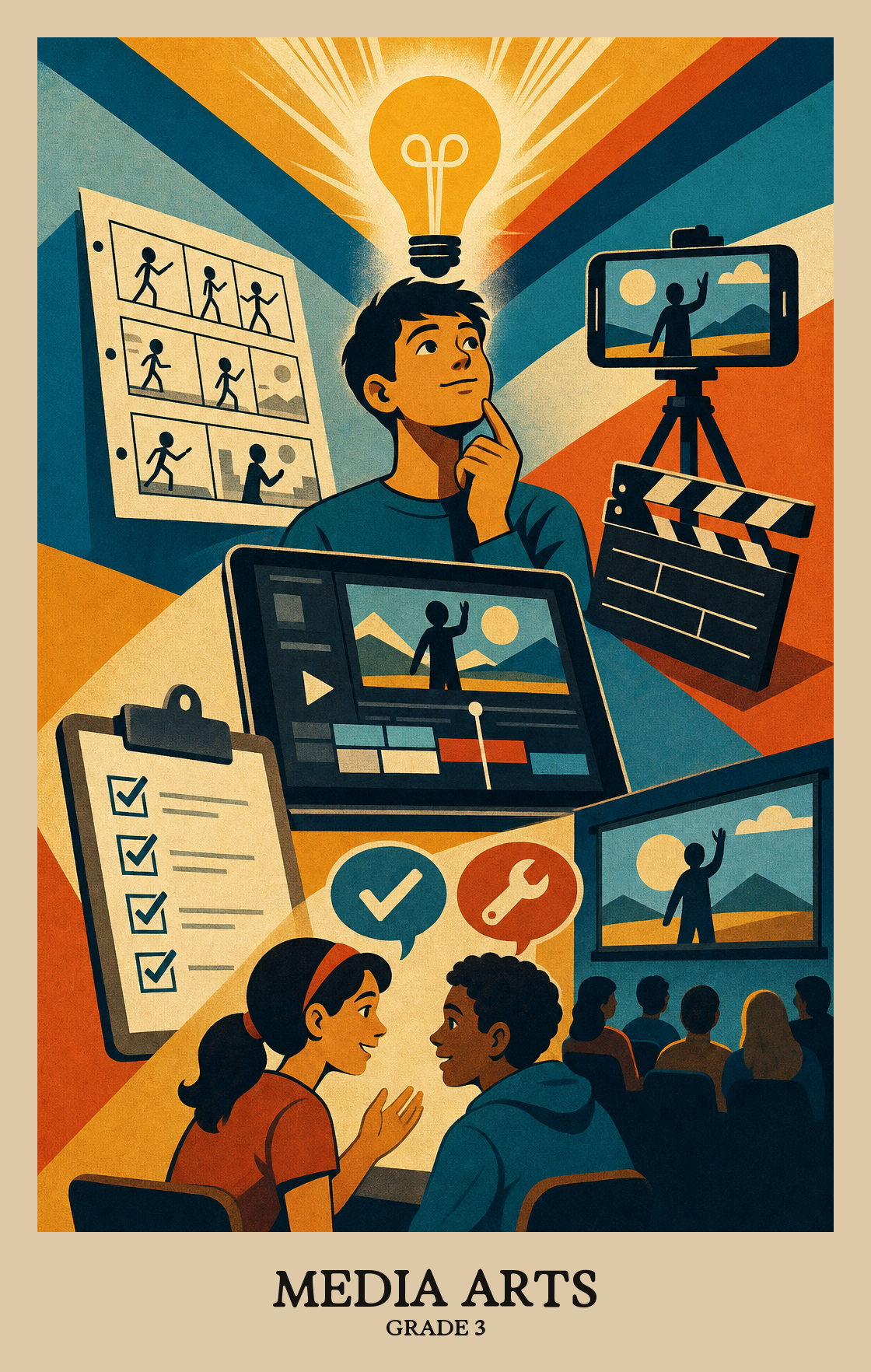
Students come up with ideas for short videos, slideshows, drawings on a tablet, or simple sound recordings. They sketch a plan before they start making anything.
Students put their plans into action using cameras, drawing apps, or recording tools. They learn to organize parts of a project, like choosing pictures, adding sound, or arranging clips in order.
Students watch, listen to, and study work made by others. They notice choices the maker made and talk about what the work seems to be saying.
Students go back into their projects to fix what is not working and add finishing touches. They pick the version they want to share and present it to classmates or family.
Students connect something from their own life to a media arts project, using what they know and what they've lived to shape what they make.
Students look at a piece of media art, such as a photo or short video, and connect it to the time, place, or community it came from. That context helps explain why it was made and what it means.
| Standard | Definition | Code |
|---|---|---|
| Synthesize and relate knowledge and personal experiences to make art | Students connect something from their own life to a media arts project, using what they know and what they've lived to shape what they make. | MA:Cn10.3 |
| Relate artistic ideas and works with societal, cultural | Students look at a piece of media art, such as a photo or short video, and connect it to the time, place, or community it came from. That context helps explain why it was made and what it means. | MA:Cn11.3 |
Students brainstorm and sketch out original ideas for media art projects, like a short animation or digital photo series, before starting to make them.
Students take a media arts idea (like a short video or digital image) and plan it out before making it, deciding what to include and how to arrange the pieces.
Students revisit a media project, make changes based on feedback or their own review, and finish it to a standard they can stand behind.
| Standard | Definition | Code |
|---|---|---|
| Generate and conceptualize artistic ideas and work | Students brainstorm and sketch out original ideas for media art projects, like a short animation or digital photo series, before starting to make them. | MA:Cr1.3 |
| Organize and develop artistic ideas and work | Students take a media arts idea (like a short video or digital image) and plan it out before making it, deciding what to include and how to arrange the pieces. | MA:Cr2.3 |
| Refine and complete artistic work | Students revisit a media project, make changes based on feedback or their own review, and finish it to a standard they can stand behind. | MA:Cr3.3 |
Students look at several pieces of their own media work, compare what makes each one strong, and choose the best one to share with an audience.
Students practice and improve a media project (like a short video or digital image) until it is ready to share with an audience.
Students choose how to share a media project (a short video, a photo series, a digital image) so the idea they had in mind actually comes through to the audience.
| Standard | Definition | Code |
|---|---|---|
| Analyze, interpret, and select artistic work for presentation | Students look at several pieces of their own media work, compare what makes each one strong, and choose the best one to share with an audience. | MA:Pr4.3 |
| Develop and refine artistic techniques and work for presentation | Students practice and improve a media project (like a short video or digital image) until it is ready to share with an audience. | MA:Pr5.3 |
| Convey meaning through the presentation of artistic work | Students choose how to share a media project (a short video, a photo series, a digital image) so the idea they had in mind actually comes through to the audience. | MA:Pr6.3 |
Students look closely at a short video, photo, or digital image and describe what they notice, such as color, sound, or movement. Then they explain what choices the creator made and why those choices matter.
Students look at a piece of media art, such as a photo, animation, or short video, and explain what the creator was trying to say and why specific choices, like color or sound, help communicate that message.
Students look at a piece of media art and judge it using a short checklist or set of questions. They explain what works, what doesn't, and why.
| Standard | Definition | Code |
|---|---|---|
| Perceive and analyze artistic work | Students look closely at a short video, photo, or digital image and describe what they notice, such as color, sound, or movement. Then they explain what choices the creator made and why those choices matter. | MA:Re7.3 |
| Interpret intent and meaning in artistic work | Students look at a piece of media art, such as a photo, animation, or short video, and explain what the creator was trying to say and why specific choices, like color or sound, help communicate that message. | MA:Re8.3 |
| Apply criteria to evaluate artistic work | Students look at a piece of media art and judge it using a short checklist or set of questions. They explain what works, what doesn't, and why. | MA:Re9.3 |
Media arts means making things like short videos, photos, simple animations, audio recordings, slideshows, and digital drawings. Students learn to plan an idea, put it together on a device, and share it with an audience. It blends art with the tools families already use at home.
By spring, students should be able to plan a short media project, put the pieces together, and share it with a class or family audience. That might look like a 30 second video, a photo story, a stop motion clip, or a narrated slideshow with a clear beginning, middle, and end.
Let students record short videos or take photos about something they care about, like a pet, a recipe, or a weekend trip. Ask them what story they want to tell before they hit record, and watch it together afterward. Ten minutes of planning makes a big difference.
No. A phone, tablet, or school laptop is plenty for third grade. The skills that matter most are planning an idea, choosing what to include, and thinking about the audience. Those skills do not depend on the device.
A common path is to start with short, low-stakes projects that build one skill at a time, like framing a photo or recording clean audio. Then move into projects that combine skills, such as a narrated slideshow or a simple stop motion. Save longer projects with revision for the second half of the year.
Planning before recording and revising after a first draft are the two areas that take the longest to stick. Students often want to publish the first take. Building in a quick storyboard step and a peer feedback step pays off across every project.
Media projects pull in writing, reading, social studies, and science. A student might script a short documentary about a local park, illustrate a science observation with photos, or retell a story as an animation. Tying projects to current classroom topics saves planning time.
Ask three questions: who is this for, what do you want them to feel, and what is missing. Most third grade media projects get stuck because the idea is fuzzy, not because the technology is hard. Talking it out for five minutes usually unsticks the work.
Ready students can describe their idea before they start, make choices about what to include and cut, and explain why a project works or does not. They can also give a classmate specific feedback using a simple rubric. Finished products matter less than the thinking behind them.