Sketchbook habits and personal ideas
Students start the year building a sketchbook of drawings, notes, and rough ideas. They pull from their own lives, interests, and memories to come up with subjects worth making art about.
This is the year art shifts from following directions to making choices on purpose. Students plan a piece around an idea that matters to them, then revise it instead of stopping at the first try. They also learn to talk about art with real reasons, looking at how time and place shape what an artist makes. By spring, they can finish a piece, explain the choices behind it, and judge another artist's work using clear reasons.
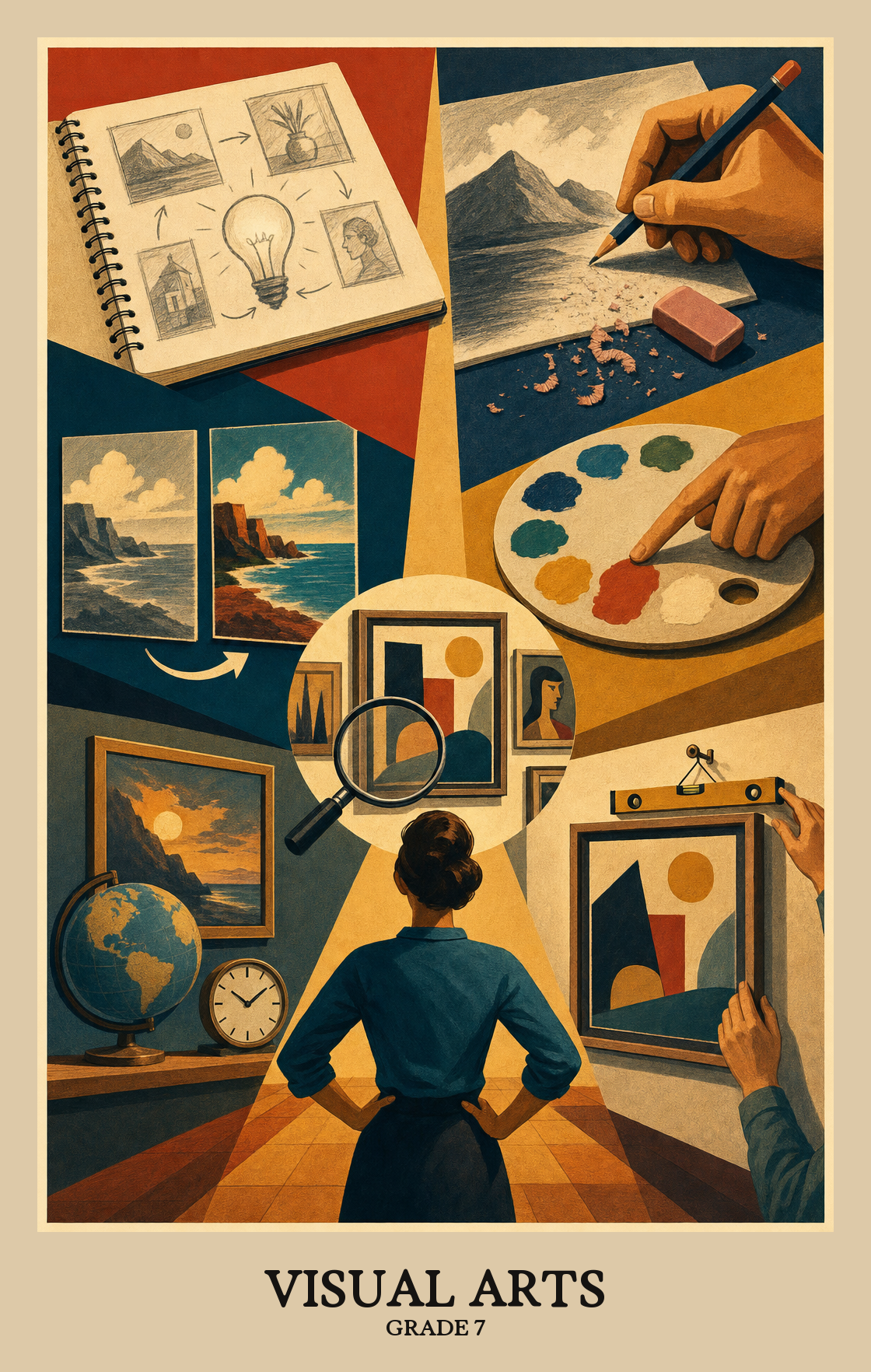
Students start the year building a sketchbook of drawings, notes, and rough ideas. They pull from their own lives, interests, and memories to come up with subjects worth making art about.
Students practice with pencil, paint, clay, collage, or digital tools. The focus is on getting more control over the materials and learning how choices like color, line, and texture change what a piece feels like.
Students study artwork from different cultures, time periods, and communities. They talk about what the artist might have meant and how the time and place an artwork came from shapes the way it looks.
Students take an idea from sketch to finished artwork. They revise as they go, get feedback, and make decisions about what to keep and what to change so the final piece says what they want it to say.
Students choose pieces to display and explain why. They learn to talk about their own work and a classmate's work using clear reasons, not just whether they liked it.
Students connect something from their own life to an idea or question, then let that connection shape what they make in class.
Students look at an artwork and explain what was happening in the world when it was made, connecting the piece to the culture or time period it came from.
| Standard | Definition | Code |
|---|---|---|
| Synthesize and relate knowledge and personal experiences to make art | Students connect something from their own life to an idea or question, then let that connection shape what they make in class. | VA:Cn10.7 |
| Relate artistic ideas and works with societal, cultural | Students look at an artwork and explain what was happening in the world when it was made, connecting the piece to the culture or time period it came from. | VA:Cn11.7 |
Students brainstorm and develop original ideas before starting an art project, thinking through what they want to make and why before picking up a pencil or brush.
Students take a rough idea, sketch or plan it out, and make deliberate choices about how the final piece will look and come together.
Students revisit a piece of art they started, make deliberate changes to improve it, and bring it to a finished state.
| Standard | Definition | Code |
|---|---|---|
| Generate and conceptualize artistic ideas and work | Students brainstorm and develop original ideas before starting an art project, thinking through what they want to make and why before picking up a pencil or brush. | VA:Cr1.7 |
| Organize and develop artistic ideas and work | Students take a rough idea, sketch or plan it out, and make deliberate choices about how the final piece will look and come together. | VA:Cr2.7 |
| Refine and complete artistic work | Students revisit a piece of art they started, make deliberate changes to improve it, and bring it to a finished state. | VA:Cr3.7 |
Students review a collection of their own artwork, think critically about what each piece shows, and choose which works are strong enough to share with an audience.
Students practice and improve their artwork before showing it to others, making deliberate choices about how the finished piece looks and what it communicates.
Students choose how to display or share their artwork so the idea or feeling behind it comes through clearly to the viewer.
| Standard | Definition | Code |
|---|---|---|
| Analyze, interpret, and select artistic work for presentation | Students review a collection of their own artwork, think critically about what each piece shows, and choose which works are strong enough to share with an audience. | VA:Pr4.7 |
| Develop and refine artistic techniques and work for presentation | Students practice and improve their artwork before showing it to others, making deliberate choices about how the finished piece looks and what it communicates. | VA:Pr5.7 |
| Convey meaning through the presentation of artistic work | Students choose how to display or share their artwork so the idea or feeling behind it comes through clearly to the viewer. | VA:Pr6.7 |
Students look closely at a piece of art and describe what they notice, then explain how the artist's choices, like color, shape, or composition, affect what the work communicates.
Students look closely at a piece of artwork and explain what the artist was trying to say. They back up their reading of the work with specific details from what they see.
Students use a set of criteria, like a checklist of what makes a piece successful, to judge whether a work of art is effective. They back up their opinion with specific reasons tied to that criteria.
| Standard | Definition | Code |
|---|---|---|
| Perceive and analyze artistic work | Students look closely at a piece of art and describe what they notice, then explain how the artist's choices, like color, shape, or composition, affect what the work communicates. | VA:Re7.7 |
| Interpret intent and meaning in artistic work | Students look closely at a piece of artwork and explain what the artist was trying to say. They back up their reading of the work with specific details from what they see. | VA:Re8.7 |
| Apply criteria to evaluate artistic work | Students use a set of criteria, like a checklist of what makes a piece successful, to judge whether a work of art is effective. They back up their opinion with specific reasons tied to that criteria. | VA:Re9.7 |
Students move past following directions and start making real choices about their own artwork. They plan ideas in a sketchbook, try different materials, and finish pieces they can talk about. They also look at art from other places and times and explain what it means.
Skip the pep talk and hand them a pencil and a small notebook for five minutes a day. Have them draw something in the room, a shoe, a mug, the dog, without erasing. The point is looking carefully, not making it pretty.
Students can take an idea from a rough sketch to a finished piece and explain the choices they made along the way. They can also look at someone else's artwork and say what it means and why, using specific things they see in the piece.
Sketchbooks work best as thinking space, not graded space. Use them for warm-ups, idea generation, material tests, and written reflection on finished pieces. Check them for evidence of thinking and revision rather than polish.
Start with observation and basic skills in the first quarter so students trust their hands. Move into idea generation and personal meaning in the middle of the year. Save the longest, most independent project for the last quarter when students can plan, revise, and present on their own.
Not at all, as long as they are also stretching. Ask them to draw the same character from a new angle, or to draw a real person sitting across the table. Interest in one style is a starting point, not a ceiling.
Revision is the hardest part. Many students think a piece is done the moment it looks like something. Build in required checkpoints where students get feedback and then change something specific before moving on.
At a museum, a book, or even a poster, ask two questions: what do you see, and what do you think it means. Make them point to the part of the picture that gave them the idea. That is the same move they practice in class.
Look for a student who can start a project without waiting to be told exactly what to do, who keeps working when the first try does not turn out, and who can explain what their finished piece is about. Technical skill matters less than that kind of independence.