Finding movement ideas
Students start the year by turning personal experiences, images, and questions into movement. They explore how a memory or an idea can become a short dance phrase instead of just a story to tell.
This is the year dance becomes a way to say something on purpose. Students take an idea from their own life or from the world around them and shape it into a short piece, choosing movements that fit the meaning. They rehearse, sharpen the rough spots, and watch other dancers with a careful eye for what works and why. By spring, they can perform a short piece they helped create and explain the choices behind it.
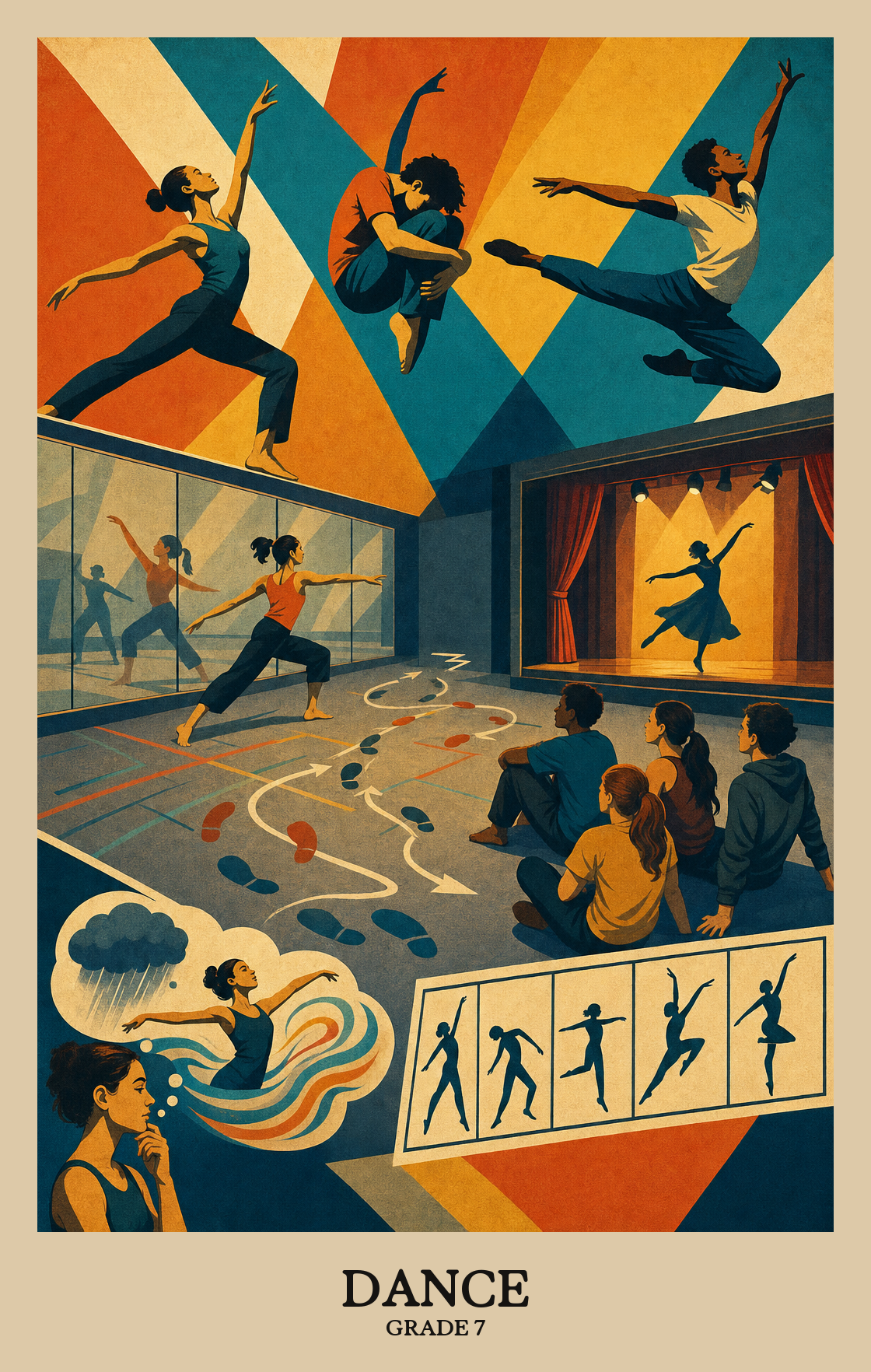
Students start the year by turning personal experiences, images, and questions into movement. They explore how a memory or an idea can become a short dance phrase instead of just a story to tell.
Students take rough movement ideas and build them into something with a clear beginning, middle, and end. They try different orders, work with a partner, and learn that choreography is a series of choices.
Students sharpen the physical skills behind the dancing, including balance, control, timing with music, and clean transitions. Parents may notice more focus on warm-ups and on doing the same step until it looks right.
Students look at dances from different cultures, time periods, and communities. They consider why a dance was made, what it meant to the people who made it, and how that history shows up in the steps.
Students perform their work and watch the work of others with a critical eye. They learn to give feedback based on specific criteria rather than just saying a piece was good or bad.
Students connect their own life experiences to the dances they create or study, using what they know and have lived through to shape their artistic choices.
Students look at a dance piece and explain how it reflects the time, place, or culture it came from. Understanding that context changes how they read the movement itself.
| Standard | Definition | Code |
|---|---|---|
| Synthesize and relate knowledge and personal experiences to make art | Students connect their own life experiences to the dances they create or study, using what they know and have lived through to shape their artistic choices. | DA:Cn10.7 |
| Relate artistic ideas and works with societal, cultural | Students look at a dance piece and explain how it reflects the time, place, or culture it came from. Understanding that context changes how they read the movement itself. | DA:Cn11.7 |
Students brainstorm and develop original ideas for a dance, deciding what movement, mood, or story they want to explore before choreography begins.
Students take a rough dance idea and shape it into something that holds together, choosing movements that fit the mood or story they want to tell.
Students revise a dance they've been building, making deliberate choices about movement, timing, and presentation until the piece feels finished and ready to share.
| Standard | Definition | Code |
|---|---|---|
| Generate and conceptualize artistic ideas and work | Students brainstorm and develop original ideas for a dance, deciding what movement, mood, or story they want to explore before choreography begins. | DA:Cr1.7 |
| Organize and develop artistic ideas and work | Students take a rough dance idea and shape it into something that holds together, choosing movements that fit the mood or story they want to tell. | DA:Cr2.7 |
| Refine and complete artistic work | Students revise a dance they've been building, making deliberate choices about movement, timing, and presentation until the piece feels finished and ready to share. | DA:Cr3.7 |
Students choose a dance piece to perform and explain why it suits their strengths and the audience. They look at the work closely before deciding what to present.
Students rehearse and improve a dance piece until it's ready to share with an audience. That means cleaning up movements, fixing transitions, and making intentional choices about how the work looks and feels as a whole.
Students perform a dance with a clear purpose in mind, making deliberate choices about movement so the audience understands what the piece is meant to express.
| Standard | Definition | Code |
|---|---|---|
| Analyze, interpret, and select artistic work for presentation | Students choose a dance piece to perform and explain why it suits their strengths and the audience. They look at the work closely before deciding what to present. | DA:Pr4.7 |
| Develop and refine artistic techniques and work for presentation | Students rehearse and improve a dance piece until it's ready to share with an audience. That means cleaning up movements, fixing transitions, and making intentional choices about how the work looks and feels as a whole. | DA:Pr5.7 |
| Convey meaning through the presentation of artistic work | Students perform a dance with a clear purpose in mind, making deliberate choices about movement so the audience understands what the piece is meant to express. | DA:Pr6.7 |
Students watch a dance performance and break down what they see: how the choreographer uses movement, spacing, and timing to create meaning. The goal is to look closely, not just react.
Students explain what a dance piece is expressing and why the choreographer may have made specific choices, using details from the movement itself to back up their reading.
Students use a set of criteria, like structure, expression, or technique, to judge a piece of dance and explain what makes it work or fall short.
| Standard | Definition | Code |
|---|---|---|
| Perceive and analyze artistic work | Students watch a dance performance and break down what they see: how the choreographer uses movement, spacing, and timing to create meaning. The goal is to look closely, not just react. | DA:Re7.7 |
| Interpret intent and meaning in artistic work | Students explain what a dance piece is expressing and why the choreographer may have made specific choices, using details from the movement itself to back up their reading. | DA:Re8.7 |
| Apply criteria to evaluate artistic work | Students use a set of criteria, like structure, expression, or technique, to judge a piece of dance and explain what makes it work or fall short. | DA:Re9.7 |
Students move through four big areas: making dances of their own, performing, watching and analyzing dance, and connecting dance to history and culture. The year builds from short movement ideas into longer pieces students shape, refine, and share with an audience.
Give space to move and time to practice. Ask students to show a short piece they are working on and explain the idea behind it. Talking through the meaning is just as important as the steps.
No. The focus is on building movement skills, working with ideas, and growing as a thoughtful performer. Students with no formal training can grow quickly when they show up ready to try and willing to revise their work.
Start with short movement studies that build vocabulary and class trust. Move into longer creative work where students draft, get feedback, and revise. End with performance pieces that pull together technique, meaning, and audience awareness.
Refining and revising work is the hardest shift at this age. Students often want a piece to be done after the first draft. Plan repeated cycles of feedback so revision becomes a normal part of the process, not a punishment.
Start small at home. Ask for a ten-second movement that shows a feeling, then watch without commenting on technique. Confidence grows when students see that an audience can be curious and kind, not just judging.
Students can generate an original movement idea, shape it into a short piece with a clear intent, and perform it with control. They can also watch another dance and talk about what it means and how it was made, using specific evidence from what they saw.
Students draw on personal experience, history, and culture to make and interpret dances. A piece might grow out of a poem, a news story, or a family tradition, which makes dance a natural partner for reading, social studies, and writing.