Working with rational numbers
Students start the year sharpening how they add, subtract, multiply, and divide with positive and negative numbers, fractions, and decimals. Expect homework that mixes signed numbers into everyday math.
This is the year math stretches into negative numbers and real algebra. Students add, subtract, multiply, and divide with negatives, and they work with percents in everyday situations like tips, discounts, and interest. Equations grow up too, with letters standing in for unknowns that students solve for step by step. By spring, students can solve a two-step equation like 3x + 5 = 20 and figure out a 15 percent tip in their head.
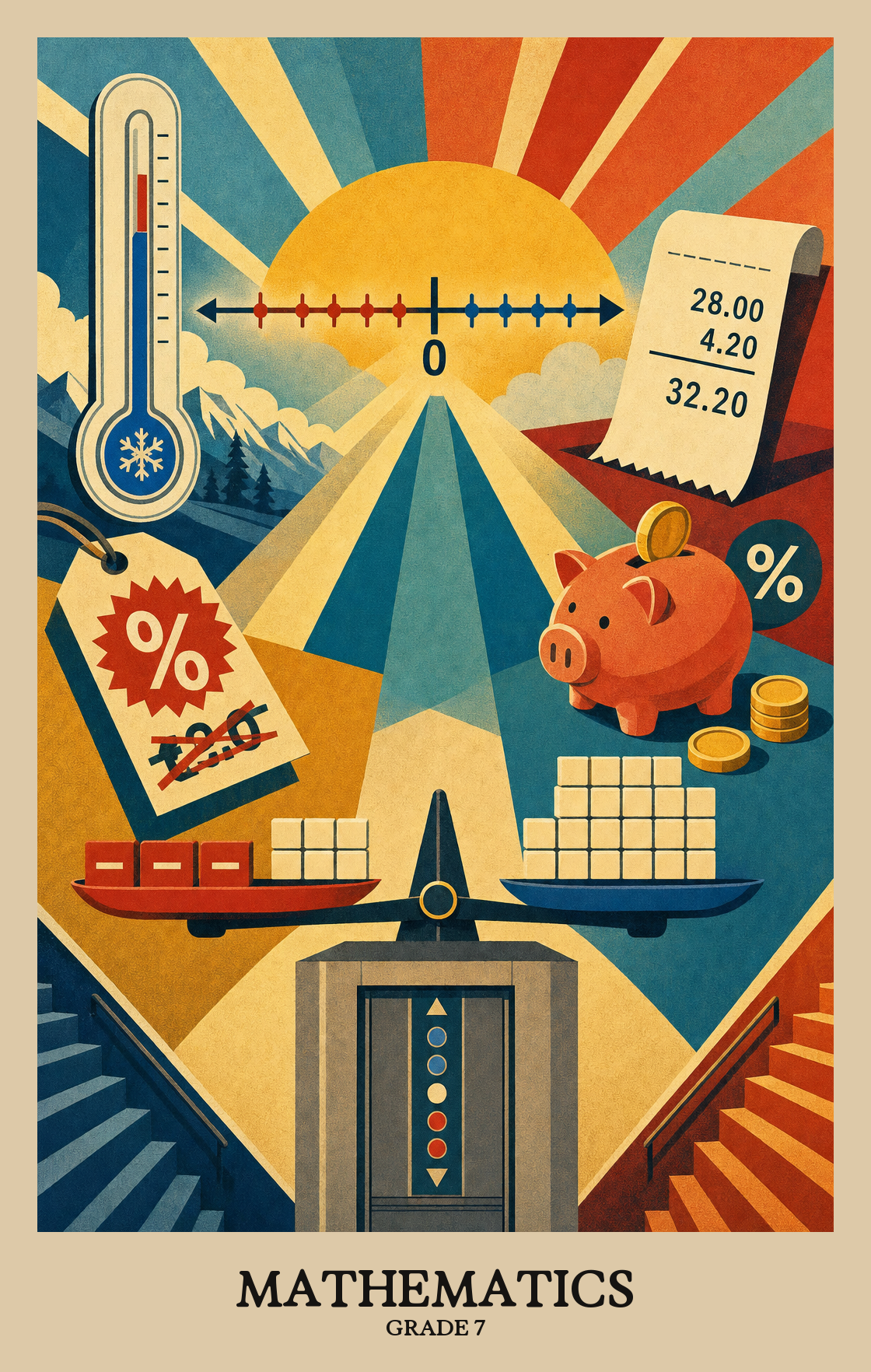
Students start the year sharpening how they add, subtract, multiply, and divide with positive and negative numbers, fractions, and decimals. Expect homework that mixes signed numbers into everyday math.
Students use ratios and rates to compare quantities and solve percent problems like tips, discounts, tax, and simple interest. Word problems start looking a lot like real shopping and travel math.
Students move into algebra by writing, simplifying, and solving expressions and equations with variables. They learn to translate a written situation into an equation and solve for the unknown.
Students work with angles, circles, and the surface area and volume of solid shapes. They also use scale drawings, which connects to maps, blueprints, and models.
Students organize data, compare groups using measures like mean and median, and figure out the chance of simple events. They start asking whether a sample really represents the whole group.
Students apply their math to personal finance topics like saving, spending, and how credit works. The goal is making sense of real decisions about money before high school.
When a math problem gets hard, students keep going. They try a different approach if the first one fails, and they work through the problem instead of giving up.
Students take a real-life situation, like splitting a bill or measuring a yard, and translate it into a math equation or diagram that makes the problem easier to solve.
Students pick the fastest, most practical method to solve a problem and carry it through without stalling. Speed matters here, but so does choosing an approach that actually makes sense for the numbers involved.
Students talk through math problems with classmates, asking questions when something is unclear and explaining their own thinking out loud. The goal is to sharpen understanding on both sides of the conversation.
Students look for patterns or repeated structure to figure out what a math problem is really asking, then use that pattern to find a solution. Recognizing how pieces of a problem connect helps students solve new problems faster and with fewer mistakes.
Students check whether an answer makes sense for the situation, not just whether the math is correct. That means asking if a rounded number, an estimate, or a unit like miles or dollars fits the real-world context of the problem.
Students use math to work through problems they'd actually encounter outside of school, like budgeting money, reading a map, or interpreting a graph. The goal is making math useful, not just practiced.
| Standard | Definition | Code |
|---|---|---|
| Mathematical Thinking | When a math problem gets hard, students keep going. They try a different approach if the first one fails, and they work through the problem instead of giving up. | FL-MATH.MTR.7.1 |
| Modeling Real-World Situations | Students take a real-life situation, like splitting a bill or measuring a yard, and translate it into a math equation or diagram that makes the problem easier to solve. | FL-MATH.MTR.7.2 |
| Complete Tasks with Fluency | Students pick the fastest, most practical method to solve a problem and carry it through without stalling. Speed matters here, but so does choosing an approach that actually makes sense for the numbers involved. | FL-MATH.MTR.7.3 |
| Engage in Discourse | Students talk through math problems with classmates, asking questions when something is unclear and explaining their own thinking out loud. The goal is to sharpen understanding on both sides of the conversation. | FL-MATH.MTR.7.4 |
| Use Patterns and Structure | Students look for patterns or repeated structure to figure out what a math problem is really asking, then use that pattern to find a solution. Recognizing how pieces of a problem connect helps students solve new problems faster and with fewer mistakes. | FL-MATH.MTR.7.5 |
| Assess Reasonableness | Students check whether an answer makes sense for the situation, not just whether the math is correct. That means asking if a rounded number, an estimate, or a unit like miles or dollars fits the real-world context of the problem. | FL-MATH.MTR.7.6 |
| Apply Mathematics in Real-World Contexts | Students use math to work through problems they'd actually encounter outside of school, like budgeting money, reading a map, or interpreting a graph. The goal is making math useful, not just practiced. | FL-MATH.MTR.7.7 |
Grade 7 math covers the full range of numbers students have learned so far: whole numbers, fractions, decimals, and negatives. Students add, subtract, multiply, and divide across all of them.
Students look for patterns in numbers and shapes, write expressions to describe what they find, and solve equations to figure out unknown values. This is the foundation of algebra.
Students use measurements like distance, weight, time, and money to solve real problems at a 7th-grade level. That means working with decimals, fractions, and unit conversions, not just reading a ruler.
Students sort, describe, and measure flat shapes like triangles and rectangles alongside solid shapes like cubes and cylinders. They use what they know about angles, sides, and faces to explain how shapes are alike or different.
Students gather real data, sort it into graphs or tables, and calculate measures like mean and median to spot patterns and draw conclusions.
Students practice making real money decisions: how much to save, what to spend, and what it means to borrow money and pay it back with interest.
| Standard | Definition | Code |
|---|---|---|
| Number Sense and Operations | Grade 7 math covers the full range of numbers students have learned so far: whole numbers, fractions, decimals, and negatives. Students add, subtract, multiply, and divide across all of them. | FL-MATH.K8.7.1 |
| Algebraic Reasoning | Students look for patterns in numbers and shapes, write expressions to describe what they find, and solve equations to figure out unknown values. This is the foundation of algebra. | FL-MATH.K8.7.2 |
| Measurement | Students use measurements like distance, weight, time, and money to solve real problems at a 7th-grade level. That means working with decimals, fractions, and unit conversions, not just reading a ruler. | FL-MATH.K8.7.3 |
| Geometric Reasoning | Students sort, describe, and measure flat shapes like triangles and rectangles alongside solid shapes like cubes and cylinders. They use what they know about angles, sides, and faces to explain how shapes are alike or different. | FL-MATH.K8.7.4 |
| Data Analysis and Probability | Students gather real data, sort it into graphs or tables, and calculate measures like mean and median to spot patterns and draw conclusions. | FL-MATH.K8.7.5 |
| Financial Literacy | Students practice making real money decisions: how much to save, what to spend, and what it means to borrow money and pay it back with interest. | FL-MATH.K8.7.6 |
FAST Mathematics for grades 6 through 8, given three times per year.
Students should work confidently with positive and negative numbers, fractions, decimals, and percents. They should solve multi-step problems with ratios, set up and solve basic equations, find area and surface area of shapes, and read graphs and data to draw conclusions.
Ask them to read the problem out loud and tell you what it is asking in their own words. Then ask what numbers matter and what they could try first. The goal is to slow down and make a plan, not to hand them the answer.
Cooking, shopping, and travel all help. Ask students to double a recipe, figure out a sale price, calculate a tip, compare unit prices at the store, or work out how long a trip will take at a given speed. Five minutes of real math beats a worksheet.
Treat mistakes as part of the work, not proof of failure. Sit with them while they try a hard problem and praise the effort and the strategy, not just the right answer. Most seventh graders get unstuck once they stop panicking and start sketching the problem.
Yes. Seventh grade math leans hard on quick recall of times tables and comfort with fractions and decimals. A few minutes of practice a couple of times a week, in a card game or a quick drill, keeps those skills warm.
Start with rational number operations so students are fluent with signed numbers and fractions before anything else. Move into ratios, proportions, and percents, then equations and inequalities. Save geometry and statistics for later units when students can lean on that algebraic reasoning.
Operations with negative numbers, dividing fractions, and setting up proportions trip up the most students. Plan extra practice and short spiral reviews across the year rather than hoping one unit will stick.
A student who has mastered seventh grade math can solve a multi-step problem with rational numbers, write and solve an equation from a word problem, and explain their reasoning to a peer. They should also be able to check whether an answer is reasonable before moving on.
They should be able to work with positive and negative numbers without a calculator, solve a two-step equation, and explain what a percent or a ratio means in a real situation. If those feel shaky, a short summer review of fractions and equations goes a long way.