Ancient and classical civilizations
Students start the year far back in time, looking at early civilizations and what they gave the world. They study how rulers governed, how people traded, and how ideas about law and religion spread.
This is the year social studies clicks into a bigger frame. Students step back from single stories and start tracing how the United States was founded, how ancient civilizations grew and traded, and how a citizen actually fits into government today. They also pick up real money skills like budgeting and using credit wisely. By spring, students can explain what the Constitution does, find major regions on a map, and describe how a bill becomes a law.
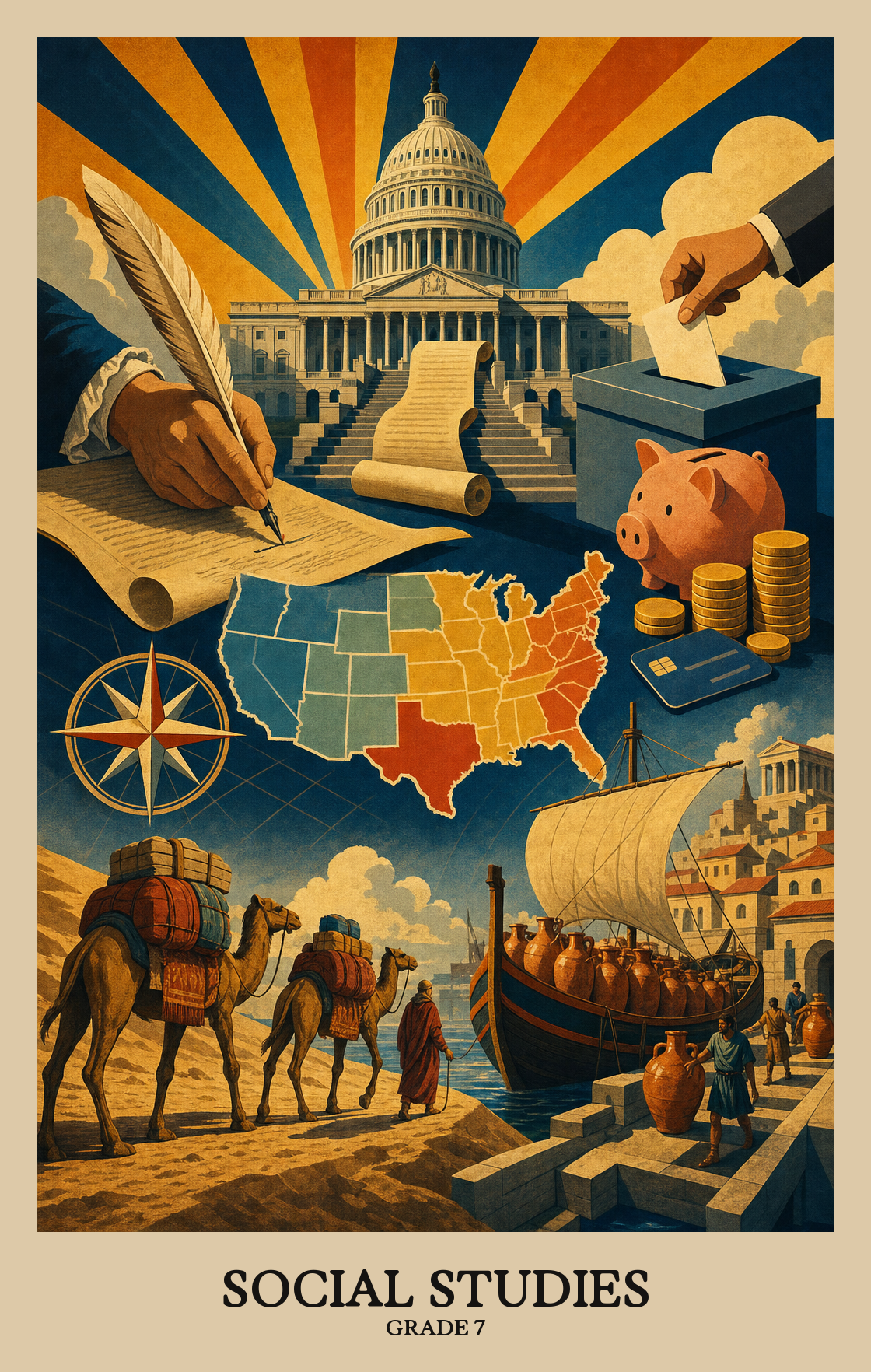
Students start the year far back in time, looking at early civilizations and what they gave the world. They study how rulers governed, how people traded, and how ideas about law and religion spread.
Students follow the story forward through the Middle Ages, the Renaissance, and the age of exploration. They look at how ships, money, and new ideas pulled distant parts of the world together for the first time.
Students turn to the founding of the country and read pieces of the Declaration of Independence and the Constitution. They learn the basic principles behind American government and why the founders set it up the way they did.
Students walk through major chapters of American history and look at how the country and its people changed. They pay attention to the individuals and groups who pushed those changes forward.
Students use maps and globes to place events and describe regions. They look at how land, climate, and movement of people shape the way a place feels and how it changes over the years.
Students close the year with how money and government work in daily life. They practice budgeting, saving, and thinking about credit, and they study how federal, state, and local government connect and how citizens take part.
Students read the founding documents, such as the Constitution and Declaration of Independence, and learn what ideas shaped the new government. They study how those principles still define how American government is supposed to work.
Students learn the major turning points in American history and practice explaining why those events mattered, not just when they happened.
Students look at how American society has stayed the same and how it has changed over time, focusing on real people and groups who pushed things forward or held them in place.
| Standard | Definition | Code |
|---|---|---|
| American Founding | Students read the founding documents, such as the Constitution and Declaration of Independence, and learn what ideas shaped the new government. They study how those principles still define how American government is supposed to work. | FL-SS.AH.7.1 |
| American Eras | Students learn the major turning points in American history and practice explaining why those events mattered, not just when they happened. | FL-SS.AH.7.2 |
| Continuity and Change | Students look at how American society has stayed the same and how it has changed over time, focusing on real people and groups who pushed things forward or held them in place. | FL-SS.AH.7.3 |
Students learn how early civilizations like ancient Greece, Rome, Egypt, and China built governments, traded goods, and created art and ideas that still shape the modern world.
Students learn to place major turning points in world history in order, from the Middle Ages and Renaissance through the age of exploration and into the modern era.
Trade routes, wars, and the movement of people connected civilizations across the ancient world. Students study how those contacts spread religions, technologies, and goods from one society to another.
| Standard | Definition | Code |
|---|---|---|
| Ancient and Classical Civilizations | Students learn how early civilizations like ancient Greece, Rome, Egypt, and China built governments, traded goods, and created art and ideas that still shape the modern world. | FL-SS.WH.7.1 |
| World Eras | Students learn to place major turning points in world history in order, from the Middle Ages and Renaissance through the age of exploration and into the modern era. | FL-SS.WH.7.2 |
| Global Interactions | Trade routes, wars, and the movement of people connected civilizations across the ancient world. Students study how those contacts spread religions, technologies, and goods from one society to another. | FL-SS.WH.7.3 |
Students read maps and globes to pinpoint where places are and compare how large different regions are relative to each other.
Places have physical traits like landforms and climate, and human traits like language and landmarks. Students examine how both types of characteristics shift as populations, economies, and environments change.
Students study why people move, where they settle, and how those choices reshape the land, language, and traditions of a place over time.
| Standard | Definition | Code |
|---|---|---|
| The World in Spatial Terms | Students read maps and globes to pinpoint where places are and compare how large different regions are relative to each other. | FL-SS.GEO.7.1 |
| Places and Regions | Places have physical traits like landforms and climate, and human traits like language and landmarks. Students examine how both types of characteristics shift as populations, economies, and environments change. | FL-SS.GEO.7.2 |
| Human Systems | Students study why people move, where they settle, and how those choices reshape the land, language, and traditions of a place over time. | FL-SS.GEO.7.3 |
Scarcity means there is never enough of everything, so people have to choose. Students learn how individuals, families, and businesses decide what to buy, save, or produce when money and resources run short.
Markets are where buyers and sellers agree on prices. Students learn how competition between sellers shapes what gets made, what it costs, and who ends up with it.
Students practice making money decisions: how much to save, how much to spend, and what it means to borrow money and pay it back. The focus is on building habits that hold up in real life, not just on paper.
| Standard | Definition | Code |
|---|---|---|
| Economic Decision Making | Scarcity means there is never enough of everything, so people have to choose. Students learn how individuals, families, and businesses decide what to buy, save, or produce when money and resources run short. | FL-SS.ECON.7.1 |
| Markets and the Economy | Markets are where buyers and sellers agree on prices. Students learn how competition between sellers shapes what gets made, what it costs, and who ends up with it. | FL-SS.ECON.7.2 |
| Personal Financial Literacy | Students practice making money decisions: how much to save, how much to spend, and what it means to borrow money and pay it back. The focus is on building habits that hold up in real life, not just on paper. | FL-SS.ECON.7.3 |
Students read the founding documents (like the Constitution and Declaration of Independence) and learn the core ideas behind how American government is structured and limited. The focus is on why those rules exist, not just what they say.
Citizens have both rights (protections like free speech) and responsibilities (like voting or following laws). Students learn what it means to participate in their community and government.
Students learn how the three levels of American government work: what the federal government handles, what falls to states, and what local officials manage in their own communities. They also learn how these layers work together and sometimes overlap.
Students learn how ordinary people shape government decisions by voting, contacting elected officials, or volunteering in their community. The focus is on real actions citizens take to influence public life, not just how government is organized on paper.
| Standard | Definition | Code |
|---|---|---|
| Foundations of Government | Students read the founding documents (like the Constitution and Declaration of Independence) and learn the core ideas behind how American government is structured and limited. The focus is on why those rules exist, not just what they say. | FL-SS.CIV.7.1 |
| Roles, Rights, and Responsibilities | Citizens have both rights (protections like free speech) and responsibilities (like voting or following laws). Students learn what it means to participate in their community and government. | FL-SS.CIV.7.2 |
| Government Structures | Students learn how the three levels of American government work: what the federal government handles, what falls to states, and what local officials manage in their own communities. They also learn how these layers work together and sometimes overlap. | FL-SS.CIV.7.3 |
| Civic Engagement | Students learn how ordinary people shape government decisions by voting, contacting elected officials, or volunteering in their community. The focus is on real actions citizens take to influence public life, not just how government is organized on paper. | FL-SS.CIV.7.4 |
End-of-course exam in Civics, typically grade 7.
Students study a lot of ground this year. They look at how the United States was founded and how the government works, walk through world history from ancient civilizations up through modern times, read maps, and learn how money and trade work in everyday life.
Watch the news together for ten minutes and ask what students think and why. Pull up a map when a place comes up in conversation. Talk about money decisions out loud, like why one option costs more or whether something is worth saving for.
Most teachers split the year into a long American history block, a long world history block, and shorter units on geography, economics, and civics woven in. Geography skills work well at the start so students can place every later unit on a map. Civics often anchors the spring.
Some names and dates matter, but the bigger goal is understanding why events happened and how they connect. Students who can explain causes and effects in their own words are in better shape than students who only memorize a list.
The structure of the three branches of government, the difference between federal and state powers, and basic economics ideas like scarcity and trade-offs tend to need a second pass. Reading primary sources also takes practice, since the language can be hard.
Read short passages out loud together and stop to put each sentence into plain words. Looking up two or three hard words is enough. The goal is for students to say what the writer is arguing and why it mattered at the time.
Students should be able to build a simple budget, explain the difference between needs and wants, and describe how saving, spending, and credit work. Letting students help plan a grocery trip or a small purchase gives them real practice.
By spring, students should be able to explain how the United States government is set up, place major world eras in order, read a map with confidence, and reason through a basic money decision. Short writing tasks that ask for evidence are a good check.
Talk about local elections, school board meetings, and city decisions when they come up. Show students a ballot or a news story about a new law and ask who decided it and who it affects. Small conversations add up over the year.