First words and greetings
Students start with the basics of a new language. They learn to greet people, introduce themselves, and pick out familiar words when someone speaks slowly or in a short text.
This is the year a new language starts to click as a tool, not a list of vocabulary words. Students hold short conversations, read simple texts, and write basic messages about familiar topics like family, school, and food. They also learn how people in other countries actually live, and notice what is similar to or different from life at home. By the end of the year, they can introduce themselves, ask and answer everyday questions, and share a few facts about another culture.
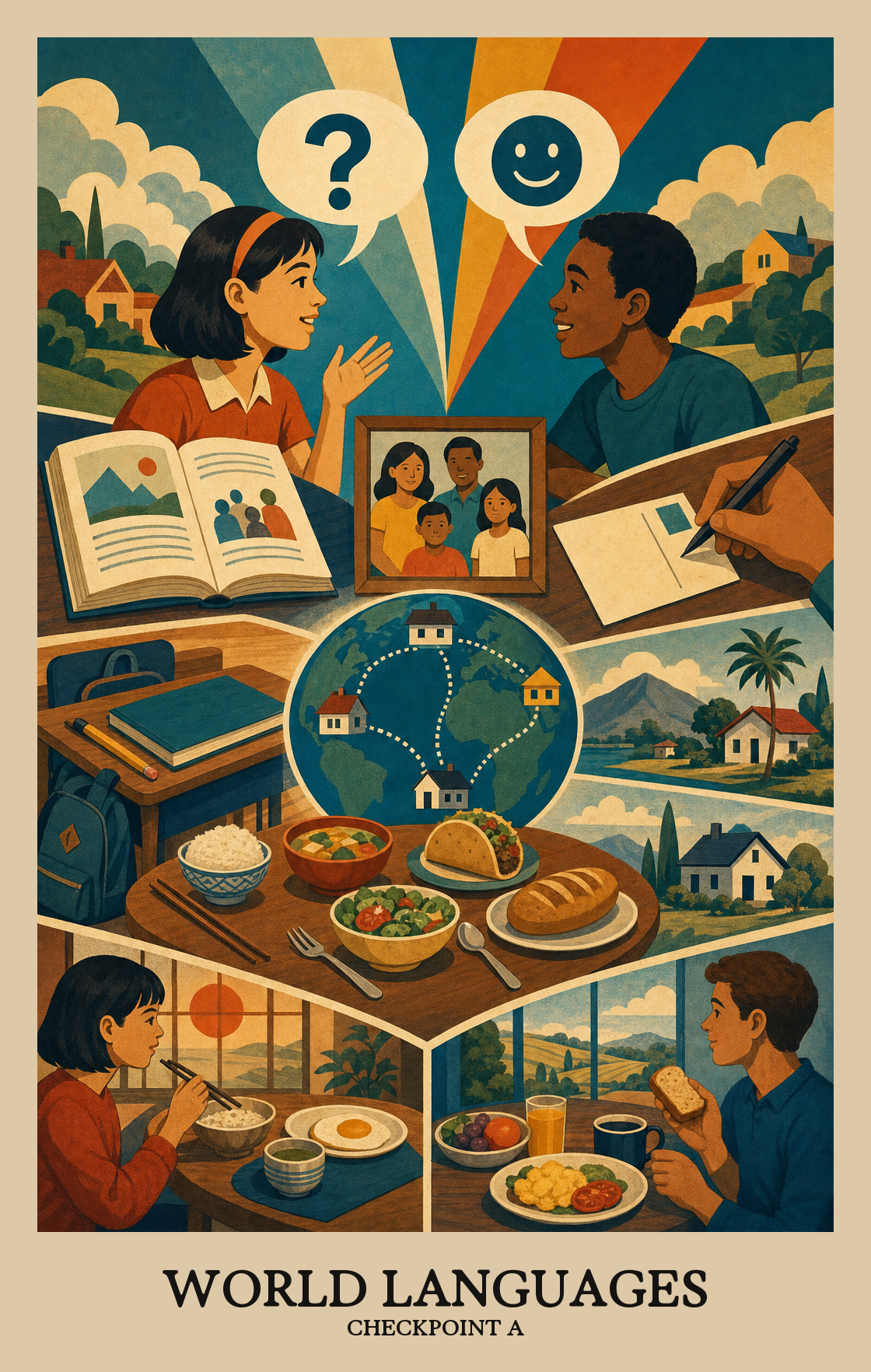
Students start with the basics of a new language. They learn to greet people, introduce themselves, and pick out familiar words when someone speaks slowly or in a short text.
Students practice short back-and-forth exchanges about family, school, food, and free time. They share simple opinions and ask questions to keep a conversation going.
Students look at how people live in places where the language is spoken, from holidays to meals to school routines. They compare those habits with their own and notice what feels similar and what feels different.
Students put longer pieces together. They write short notes, give a small presentation about themselves or a topic they care about, and read short stories or articles to find the main idea.
Students use the language beyond the classroom, whether through a video, a song, a pen pal, or a community event. They set personal goals and notice how much they can already do.
Students listen to, read, or watch material in the new language and show they understood the main idea and key details. Topics range from everyday situations to broader subjects.
Students hold short back-and-forth conversations in the language they are learning, sharing opinions and reactions while working out what the other person means.
Students share information or tell a story in a new language, choosing words and details that fit who is listening or reading.
| Standard | Definition | Code |
|---|---|---|
| Learners understand, interpret Checkpoint A | Students listen to, read, or watch material in the new language and show they understood the main idea and key details. Topics range from everyday situations to broader subjects. | FL-WL.1.1.wl-checkpoint-a |
| Learners interact and negotiate meaning in spoken, signed Checkpoint A | Students hold short back-and-forth conversations in the language they are learning, sharing opinions and reactions while working out what the other person means. | FL-WL.1.2.wl-checkpoint-a |
| Learners present information, concepts Checkpoint A | Students share information or tell a story in a new language, choosing words and details that fit who is listening or reading. | FL-WL.1.3.wl-checkpoint-a |
Students look at everyday habits and traditions in another culture, like how people greet each other or celebrate together, and explain what those customs reveal about what that culture values.
Students look at everyday objects, art, food, or traditions from another culture and explain what those things reveal about how people in that culture think and what they value.
| Standard | Definition | Code |
|---|---|---|
| Learners use the language to investigate, explain Checkpoint A | Students look at everyday habits and traditions in another culture, like how people greet each other or celebrate together, and explain what those customs reveal about what that culture values. | FL-WL.2.1.wl-checkpoint-a |
| Learners use the language to investigate, explain Checkpoint A | Students look at everyday objects, art, food, or traditions from another culture and explain what those things reveal about how people in that culture think and what they value. | FL-WL.2.2.wl-checkpoint-a |
Learning a new language doubles as a lesson in other subjects. Students use the language they're studying to explore ideas from science, history, or math, building thinking skills along the way.
Students read, listen to, or watch real content in the language they are learning, then think about what the perspective or information reveals. They practice finding and weighing ideas that come from a different culture.
| Standard | Definition | Code |
|---|---|---|
| Learners build, reinforce Checkpoint A | Learning a new language doubles as a lesson in other subjects. Students use the language they're studying to explore ideas from science, history, or math, building thinking skills along the way. | FL-WL.3.1.wl-checkpoint-a |
| Learners access and evaluate information and diverse perspectives that are… Checkpoint A | Students read, listen to, or watch real content in the language they are learning, then think about what the perspective or information reveals. They practice finding and weighing ideas that come from a different culture. | FL-WL.3.2.wl-checkpoint-a |
Students notice how the new language works differently from their own. They compare things like word order, verb forms, or greetings to understand both languages better.
Students look at everyday life in another culture (food, celebrations, school, family) and compare it to their own. They use the new language to describe what's similar and what's different.
| Standard | Definition | Code |
|---|---|---|
| Learners use the language to investigate, explain Checkpoint A | Students notice how the new language works differently from their own. They compare things like word order, verb forms, or greetings to understand both languages better. | FL-WL.4.1.wl-checkpoint-a |
| Learners use the language to investigate, explain Checkpoint A | Students look at everyday life in another culture (food, celebrations, school, family) and compare it to their own. They use the new language to describe what's similar and what's different. | FL-WL.4.2.wl-checkpoint-a |
Students practice the language outside class too, not just during lessons. They use it to talk, work with others, and connect with people in their school and in the wider world.
Students decide what they want to get better at in a new language, then look back at how far they've come. The focus is on using the language in real life, not just for class.
| Standard | Definition | Code |
|---|---|---|
| Learners use the language both within and beyond the classroom to interact and… Checkpoint A | Students practice the language outside class too, not just during lessons. They use it to talk, work with others, and connect with people in their school and in the wider world. | FL-WL.5.1.wl-checkpoint-a |
| Learners set goals and reflect on their progress in using languages for… Checkpoint A | Students decide what they want to get better at in a new language, then look back at how far they've come. The focus is on using the language in real life, not just for class. | FL-WL.5.2.wl-checkpoint-a |
Checkpoint A is the first stage of language learning. Students learn to understand and use short, familiar phrases about everyday topics like family, food, school, and weather. Expect memorized words and simple sentences, not paragraphs or long conversations.
Ask students to teach one new word or phrase at dinner each night. Watch a short video clip together in the language, even if only a few words are clear. Five quiet minutes of practice a day beats one long session on the weekend.
Students should introduce themselves, ask and answer basic questions, and describe people, places, and things using short sentences. They can read simple signs, menus, and short notes, and write a few sentences about familiar topics.
Start with greetings, names, numbers, and classroom language so students can function in the room. Then build outward to family, school, food, and free time. Save culture comparisons and short presentations for later in the year, once vocabulary is steady.
Some memorization is useful, but words stick better when students use them in short conversations or labels around the room. At home, point to common objects and ask for the word in the new language. Repetition with meaning works better than flashcards alone.
Pronunciation, question forms, and gender or verb endings tend to need repeated practice. Plan short warm-ups that loop these back every week instead of teaching them once and moving on. Students forget fast at Checkpoint A and need spaced review.
Culture shows up through small, concrete things: how people greet each other, what they eat, holidays, school routines, and music. Students compare these to their own daily life. The goal is curiosity and noticing, not deep analysis.
Look for students who can hold a short back-and-forth conversation on a familiar topic without freezing, read a simple paragraph and get the main idea, and write four or five connected sentences. Confidence and willingness to try matter as much as accuracy.
Follow a short podcast, watch a cartoon with subtitles, label items at home, or message a relative or pen pal in the language. Ten minutes a day of real contact with the language builds more than an hour of worksheets.