Rational numbers and real numbers
Students stretch the number line to include numbers like the square root of 2 and pi. They learn that some numbers go on forever without repeating, and they practice estimating where those numbers fall.
This is the year math shifts from arithmetic to algebra. Students work with rational and irrational numbers, solve equations with variables on both sides, and graph lines to see how one quantity changes with another. They also study angles, triangles, and the Pythagorean theorem to find missing lengths. By spring, students can graph a line from an equation and use it to predict a value.
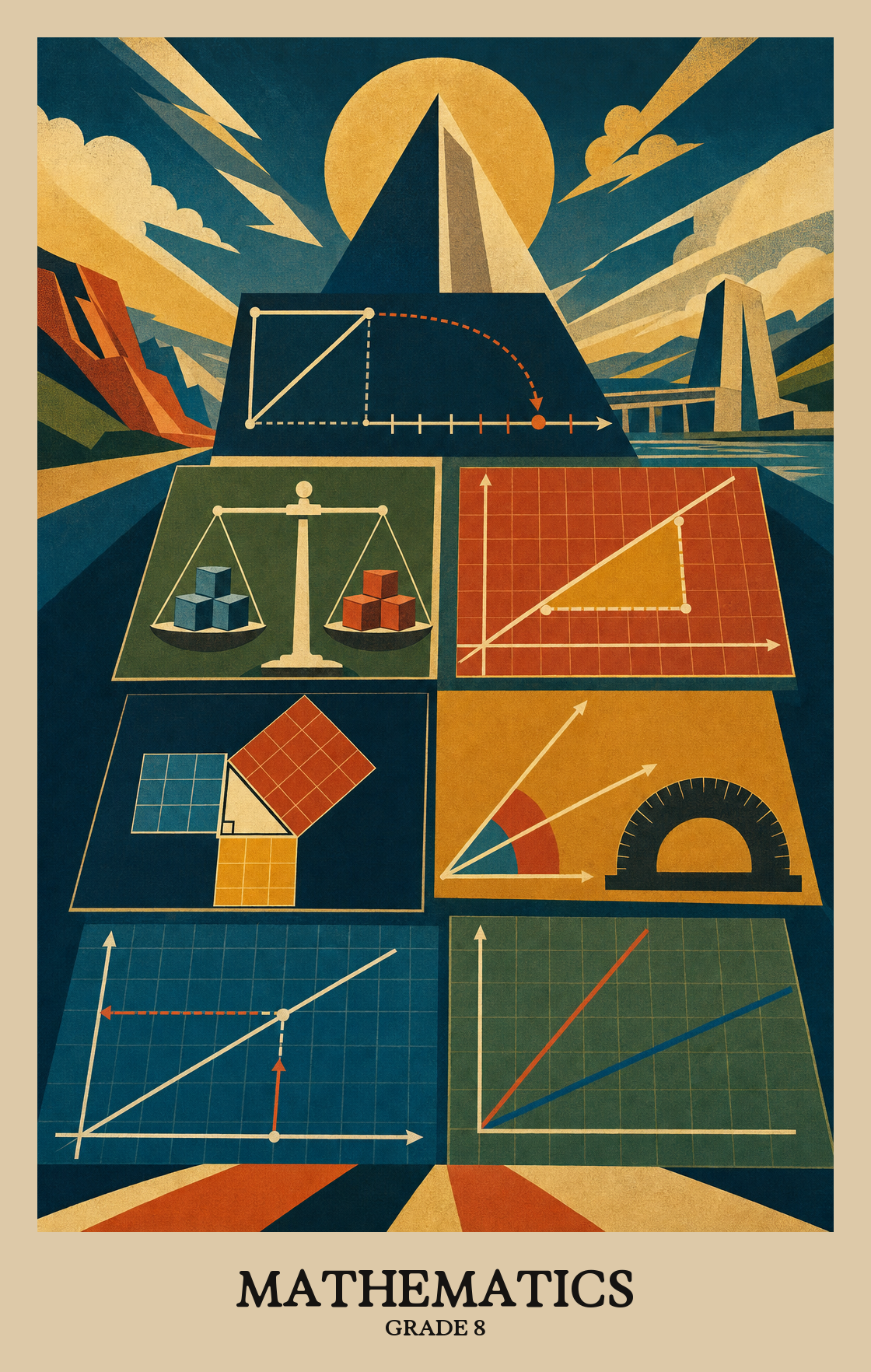
Students stretch the number line to include numbers like the square root of 2 and pi. They learn that some numbers go on forever without repeating, and they practice estimating where those numbers fall.
Students work with powers and scientific notation, the shorthand scientists use for very large and very small numbers. They simplify expressions and learn the rules that make exponents behave.
Students solve equations with a variable on both sides and graph straight lines. They start to see a function as a rule that turns one number into another, and they read slope as a rate of change.
Students solve two equations at once to find a point that works for both, like figuring out when two phone plans cost the same. They connect tables, graphs, and equations to the same story.
Students use the Pythagorean theorem to find missing side lengths in right triangles and distances between points. They also study angles formed by parallel lines and the rules for similar shapes.
Students plot two-variable data on scatter plots and describe the trend they see. They also weigh real choices about saving, spending, and using credit, and check whether their answers make sense.
When a math problem gets hard, students stick with it and try more than one way to find a solution. They treat wrong turns as part of the process, not a reason to stop.
Students take a real situation (like a sale price or a growing plant) and turn it into a number sentence, equation, or graph that captures what's happening.
Students solve problems using methods that are both accurate and efficient. They choose approaches that get to the right answer without unnecessary steps.
Students ask and answer questions during math discussions to sharpen their own thinking and help classmates understand the work more clearly.
Students look for patterns and shortcuts that make a hard problem easier to solve. Spotting structure in numbers, shapes, or equations helps students work smarter instead of starting from scratch each time.
Students check whether their answer actually makes sense for the situation. That means asking if the number is in the right ballpark, using the right units, and whether rounding changed the answer enough to matter.
Students use math to work through real problems, like splitting a bill, reading a graph, or figuring out a discount. The point is to see how classroom math connects to decisions outside school.
| Standard | Definition | Code |
|---|---|---|
| Mathematical Thinking | When a math problem gets hard, students stick with it and try more than one way to find a solution. They treat wrong turns as part of the process, not a reason to stop. | FL-MATH.MTR.8.1 |
| Modeling Real-World Situations | Students take a real situation (like a sale price or a growing plant) and turn it into a number sentence, equation, or graph that captures what's happening. | FL-MATH.MTR.8.2 |
| Complete Tasks with Fluency | Students solve problems using methods that are both accurate and efficient. They choose approaches that get to the right answer without unnecessary steps. | FL-MATH.MTR.8.3 |
| Engage in Discourse | Students ask and answer questions during math discussions to sharpen their own thinking and help classmates understand the work more clearly. | FL-MATH.MTR.8.4 |
| Use Patterns and Structure | Students look for patterns and shortcuts that make a hard problem easier to solve. Spotting structure in numbers, shapes, or equations helps students work smarter instead of starting from scratch each time. | FL-MATH.MTR.8.5 |
| Assess Reasonableness | Students check whether their answer actually makes sense for the situation. That means asking if the number is in the right ballpark, using the right units, and whether rounding changed the answer enough to matter. | FL-MATH.MTR.8.6 |
| Apply Mathematics in Real-World Contexts | Students use math to work through real problems, like splitting a bill, reading a graph, or figuring out a discount. The point is to see how classroom math connects to decisions outside school. | FL-MATH.MTR.8.7 |
Grade 8 students work with whole numbers, fractions, decimals, and negative numbers to solve real problems. They choose the right operation and know when an answer makes sense.
Students spot patterns in numbers and shapes, write expressions to describe them, and solve equations to find unknowns. This is the algebra foundation that connects arithmetic to high school math.
Students use rulers, scales, clocks, and coins to solve real measurement problems. At this grade level, that means working with length, weight, time, and money in ways that go beyond basic calculation.
Students sort, name, and measure flat shapes like triangles and circles, and solid shapes like cubes and cylinders. They use geometric rules to explain how shapes are related and why they look the way they do.
Students gather data, organize it into graphs or tables, and calculate statistics like mean or median to draw conclusions from what they find.
Students practice the math behind real money choices: how much to save from a paycheck, what a loan actually costs, and when spending now means less later.
| Standard | Definition | Code |
|---|---|---|
| Number Sense and Operations | Grade 8 students work with whole numbers, fractions, decimals, and negative numbers to solve real problems. They choose the right operation and know when an answer makes sense. | FL-MATH.K8.8.1 |
| Algebraic Reasoning | Students spot patterns in numbers and shapes, write expressions to describe them, and solve equations to find unknowns. This is the algebra foundation that connects arithmetic to high school math. | FL-MATH.K8.8.2 |
| Measurement | Students use rulers, scales, clocks, and coins to solve real measurement problems. At this grade level, that means working with length, weight, time, and money in ways that go beyond basic calculation. | FL-MATH.K8.8.3 |
| Geometric Reasoning | Students sort, name, and measure flat shapes like triangles and circles, and solid shapes like cubes and cylinders. They use geometric rules to explain how shapes are related and why they look the way they do. | FL-MATH.K8.8.4 |
| Data Analysis and Probability | Students gather data, organize it into graphs or tables, and calculate statistics like mean or median to draw conclusions from what they find. | FL-MATH.K8.8.5 |
| Financial Literacy | Students practice the math behind real money choices: how much to save from a paycheck, what a loan actually costs, and when spending now means less later. | FL-MATH.K8.8.6 |
FAST Mathematics for grades 6 through 8, given three times per year.
End-of-course exam taken at the completion of Algebra I, typically grade 8 or 9. Students must pass this EOC to graduate.
Federally administered sample-based assessment in reading, mathematics, science, and writing. NAEP results inform state-by-state comparisons rather than individual student or school accountability.
Students should work confidently with positive and negative numbers, solve equations with a variable on both sides, and graph straight lines from a rule. They should also understand square roots, basic right-triangle reasoning, and how to read scatter plots.
Ask students to explain one homework problem out loud, step by step, like teaching a younger sibling. Talking through the reasoning catches small mistakes and builds the habit of checking whether an answer makes sense.
That gap will slow down almost everything else this year. Practice converting between fractions, decimals, and percents using real prices, tips, and discounts at the store. Ten minutes a few times a week makes a real difference.
A common path starts with rational numbers and exponents, moves into linear equations and functions, then systems of equations, and finishes with geometry, the Pythagorean relationship, and data. Front-loading number sense pays off when equations and graphs arrive.
Negative numbers in multi-step problems, slope as a rate of change, and solving equations with variables on both sides tend to need a second pass. Plan a short review week before functions and again before the geometry unit.
Ask students to show what each step does and why, not just the answer. If a step does not make sense to a non-math adult, it probably needs another look. Confusion at home is useful information.
Students can move between a table, a graph, an equation, and a word problem for the same linear relationship. They can solve a multi-step equation, justify each step, and decide whether the final answer is reasonable in context.
Ready students can solve a two-step equation without hesitation, graph a line from a rule, and estimate whether an answer is reasonable before reaching for a calculator. If any of those feel slow in spring, spend the summer practicing them.
Calculators help with messy arithmetic, but students should still estimate first and check whether the screen answer makes sense. Mental math with percents, fractions, and signed numbers needs to stay sharp.