Founding a new country
Students study how the United States began and read parts of the Declaration of Independence and the Constitution. They learn why the founders set up three branches of government and a system of checks on power.
This is the year social studies pulls back to look at the whole American story, from the founding documents to the people and events that shaped the country. Students read the Constitution closely and trace how the government was built to work. They also step further out to study ancient civilizations, world eras like the Renaissance, and how trade and migration moved ideas across continents. By spring, students can explain what the Constitution does, place major events on a timeline, and talk through a basic budget with saving and spending.
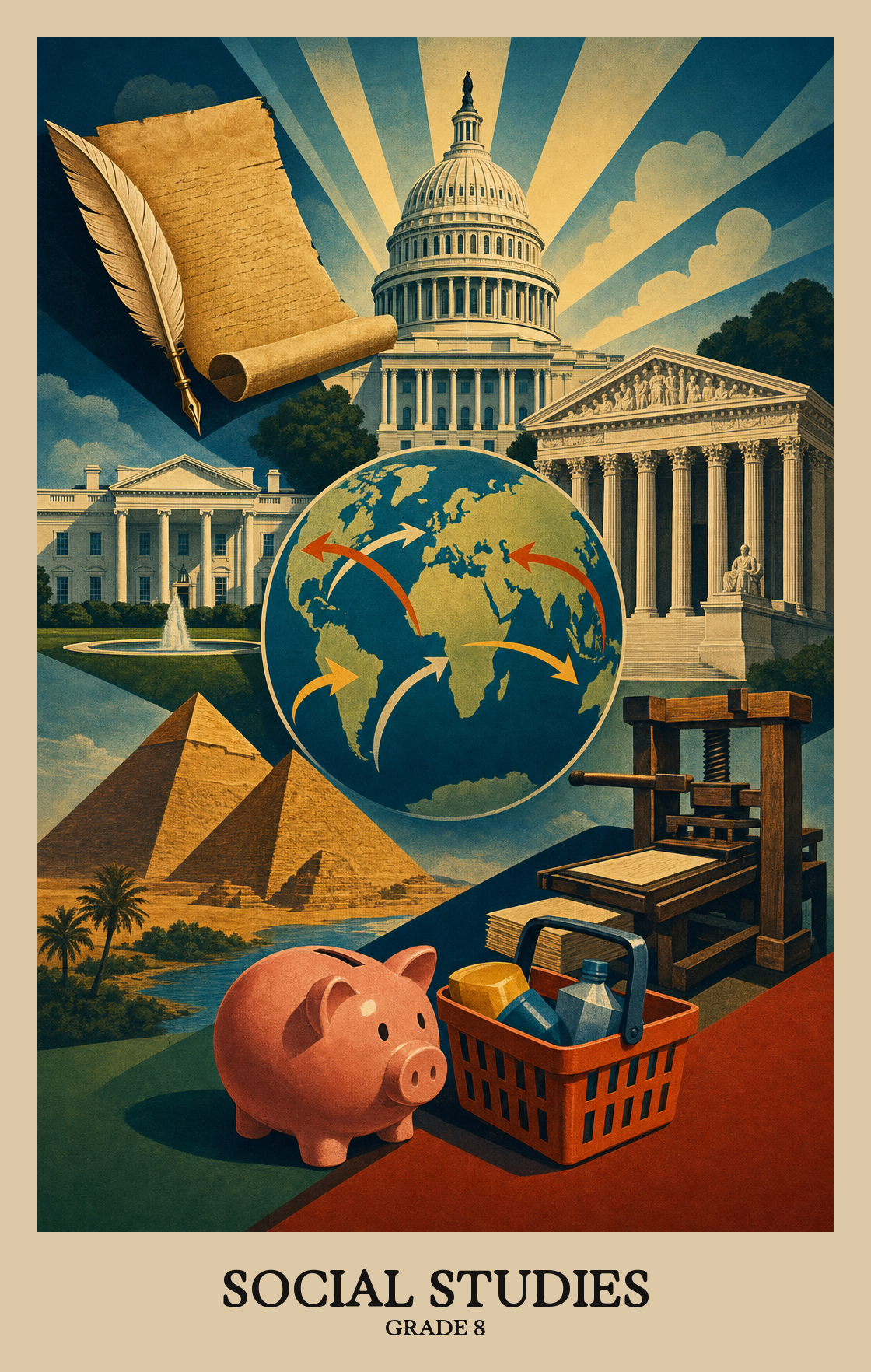
Students study how the United States began and read parts of the Declaration of Independence and the Constitution. They learn why the founders set up three branches of government and a system of checks on power.
Students walk through the major chapters of early American history, from westward expansion through the Civil War and Reconstruction. They look at the people and groups who pushed the country to change.
Students step back to see the bigger picture, from ancient civilizations through the Middle Ages, Renaissance, and age of exploration. They trace how trade routes, wars, and migration moved ideas and goods between regions.
Students use maps and globes to locate countries and regions and describe what makes each place different. They look at how mountains, rivers, climate, and human choices shape where people live and how communities grow.
Students learn how prices, competition, and scarcity drive everyday decisions for families and businesses. They practice the basics of saving, budgeting, and using credit, with examples a teenager can actually picture.
Students study how federal, state, and local governments share power and what each one handles. They learn the rights and duties of citizens and the ways people take part, from voting to speaking up in their community.
Students read the founding documents (the Constitution, the Declaration of Independence, the Bill of Rights) and explain the core ideas behind how American government is set up and why it works the way it does.
Students place major events in American history in order and explain why those events mattered. This standard covers the full sweep of American history at the eighth-grade level.
History rarely changes all at once. Students study how American society shifted over time, looking at which ideas and customs stayed the same and which ones changed, and at the specific people and groups who pushed those changes forward or held them back.
| Standard | Definition | Code |
|---|---|---|
| American Founding | Students read the founding documents (the Constitution, the Declaration of Independence, the Bill of Rights) and explain the core ideas behind how American government is set up and why it works the way it does. | FL-SS.AH.8.1 |
| American Eras | Students place major events in American history in order and explain why those events mattered. This standard covers the full sweep of American history at the eighth-grade level. | FL-SS.AH.8.2 |
| Continuity and Change | History rarely changes all at once. Students study how American society shifted over time, looking at which ideas and customs stayed the same and which ones changed, and at the specific people and groups who pushed those changes forward or held them back. | FL-SS.AH.8.3 |
Students study how early civilizations like ancient Egypt, Greece, and Rome built governments, traded goods, and created art and ideas that still shape the modern world.
Students learn to place major turning points in world history in order, from the Middle Ages and Renaissance through the age of exploration into the modern world.
Trade routes, wars, and the movement of people changed how civilizations developed. Students examine how societies influenced each other through commerce, conflict, and the spread of religions, technologies, and ideas across regions.
| Standard | Definition | Code |
|---|---|---|
| Ancient and Classical Civilizations | Students study how early civilizations like ancient Egypt, Greece, and Rome built governments, traded goods, and created art and ideas that still shape the modern world. | FL-SS.WH.8.1 |
| World Eras | Students learn to place major turning points in world history in order, from the Middle Ages and Renaissance through the age of exploration into the modern world. | FL-SS.WH.8.2 |
| Global Interactions | Trade routes, wars, and the movement of people changed how civilizations developed. Students examine how societies influenced each other through commerce, conflict, and the spread of religions, technologies, and ideas across regions. | FL-SS.WH.8.3 |
Students read maps and globes to pinpoint where places are and compare how large one region is next to another.
Students learn how a place's landscape, climate, and population shape what it looks and feels like, and how those features shift as people, economies, and environments change.
Students study why people move, where they settle, and how those choices change a place over time. This includes how farming, cities, trade routes, and cultural traditions leave a lasting mark on the land and communities around them.
| Standard | Definition | Code |
|---|---|---|
| The World in Spatial Terms | Students read maps and globes to pinpoint where places are and compare how large one region is next to another. | FL-SS.GEO.8.1 |
| Places and Regions | Students learn how a place's landscape, climate, and population shape what it looks and feels like, and how those features shift as people, economies, and environments change. | FL-SS.GEO.8.2 |
| Human Systems | Students study why people move, where they settle, and how those choices change a place over time. This includes how farming, cities, trade routes, and cultural traditions leave a lasting mark on the land and communities around them. | FL-SS.GEO.8.3 |
Scarcity means there is never enough of everything, so people have to choose. Students learn how individuals, families, and businesses weigh options and give something up to get what matters most.
Markets match buyers and sellers, and prices signal where resources go. Students learn how competition between businesses shapes what gets made, what things cost, and who ends up with what.
Students practice making real money decisions: how much to save, how much to spend, when to borrow, and how to build a simple budget that keeps those choices in balance.
| Standard | Definition | Code |
|---|---|---|
| Economic Decision Making | Scarcity means there is never enough of everything, so people have to choose. Students learn how individuals, families, and businesses weigh options and give something up to get what matters most. | FL-SS.ECON.8.1 |
| Markets and the Economy | Markets match buyers and sellers, and prices signal where resources go. Students learn how competition between businesses shapes what gets made, what things cost, and who ends up with what. | FL-SS.ECON.8.2 |
| Personal Financial Literacy | Students practice making real money decisions: how much to save, how much to spend, when to borrow, and how to build a simple budget that keeps those choices in balance. | FL-SS.ECON.8.3 |
Students read the founding documents (like the Constitution and Declaration of Independence) and explain the core ideas behind how American government is structured and why it works the way it does.
Citizens have both rights (protections the government must respect) and responsibilities (duties they owe back, like voting or jury service). Students learn what those are and how people actually use them in public life.
Students learn how the federal, state, and local governments are set up, what each level is responsible for, and how they work together or divide power across different areas of life.
Citizens shape government in more ways than voting. Students learn how people influence laws and leaders through elections, speaking up for causes, and volunteering in their communities.
| Standard | Definition | Code |
|---|---|---|
| Foundations of Government | Students read the founding documents (like the Constitution and Declaration of Independence) and explain the core ideas behind how American government is structured and why it works the way it does. | FL-SS.CIV.8.1 |
| Roles, Rights, and Responsibilities | Citizens have both rights (protections the government must respect) and responsibilities (duties they owe back, like voting or jury service). Students learn what those are and how people actually use them in public life. | FL-SS.CIV.8.2 |
| Government Structures | Students learn how the federal, state, and local governments are set up, what each level is responsible for, and how they work together or divide power across different areas of life. | FL-SS.CIV.8.3 |
| Civic Engagement | Citizens shape government in more ways than voting. Students learn how people influence laws and leaders through elections, speaking up for causes, and volunteering in their communities. | FL-SS.CIV.8.4 |
Federally administered sample-based assessment in reading, mathematics, science, and writing. NAEP results inform state-by-state comparisons rather than individual student or school accountability.
Students study the founding of the United States, ancient and modern world history, geography, basic economics, and how government works. American history gets the biggest share of time, with a close look at the Constitution and the early republic. The other topics fill in the world around that story.
Ask students to explain who someone was and why they mattered, not just the date. A five-minute conversation at dinner about a person or event from class builds memory better than rereading the textbook. Visiting a historical site or watching a short documentary together also helps.
Most teachers move chronologically from the colonial period through Reconstruction, anchoring each unit in the founding documents and constitutional principles. Building a timeline students add to every unit keeps the eras connected. Save room in the spring for review of the Constitution and major turning points.
A small number of anchor dates help, but the goal is understanding cause and effect. Students should be able to explain what led to an event and what changed because of it. Knowing the order of major events matters more than memorizing every date.
The Constitution, the branches of government, and the difference between federal, state, and local power tend to need a second pass. Economics vocabulary like scarcity, supply, and credit also takes time to stick. Plan short review cycles rather than one big unit.
Let students help plan a small budget, like groceries for the week or a birthday gift. Talk about saving, spending choices, and how credit cards work. Real money decisions teach more than worksheets ever will.
Students use maps to locate places, compare regions, and explain how land and climate shape how people live. Keep a world map or globe visible at home and look up places that come up in the news or in class. It builds the mental map students need for history too.
Civics works best when students see how government touches their daily lives. Mock elections, debates on local issues, and short visits from a city official or judge make the structure of government concrete. Tie each lesson back to a right or responsibility students actually have.
By spring, students should be able to read a primary source, explain its main idea, and tie it to a bigger event. They should also describe how the three branches of government work and use basic economic terms in a sentence. Writing a short, organized paragraph with evidence is the clearest sign of readiness.