Thinking like a scientist
Students start the year by asking questions they can actually test, planning experiments, and using evidence to back up what they claim. Expect dinner-table debates about what counts as proof.
This is the year science gets serious about evidence. Students stop just learning facts and start running real investigations, asking testable questions and weighing what the data actually shows. They dig into how cells build living things, how genes pass traits from parent to child, and how matter, energy, and forces shape everything from weather to motion. By spring, students can plan an experiment, collect results, and explain what those results mean.
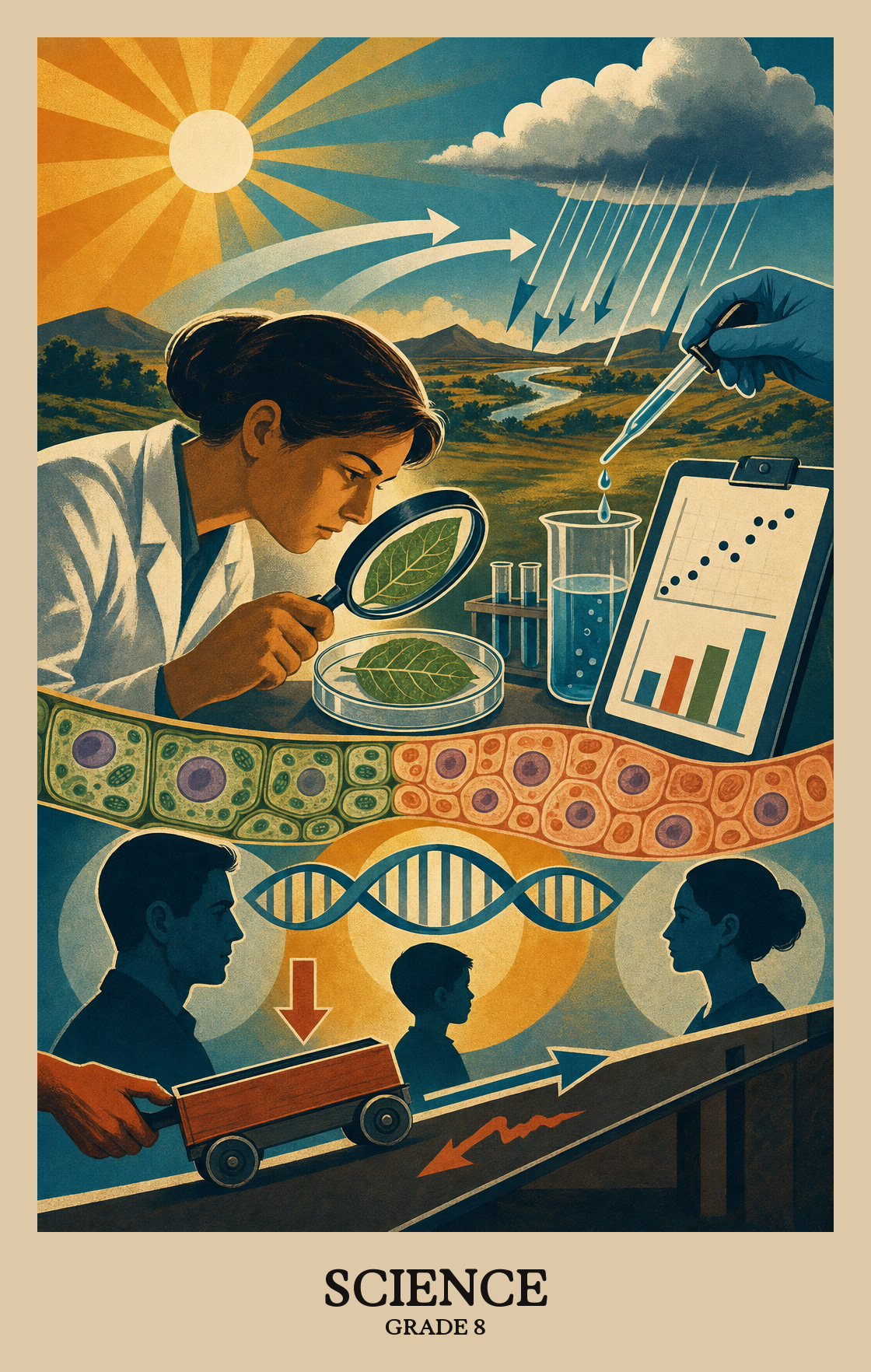
Students start the year by asking questions they can actually test, planning experiments, and using evidence to back up what they claim. Expect dinner-table debates about what counts as proof.
Students dig into what stuff is made of and how it changes when heated, mixed, or pushed. They track energy as it moves and study how forces speed things up, slow them down, or change direction.
Students zoom out to look at rocks, oceans, air, and the planet's place in the solar system. They learn why seasons happen and what drives the weather a parent checks each morning.
Students move from single cells up to whole ecosystems. They study how traits get passed from parents to kids, how species change over long stretches of time, and how living things depend on each other for food and energy.
Students ask a question that can be tested, plan an experiment to answer it, collect data, and use the results to explain what they found.
Scientific knowledge isn't fixed. Students learn how scientists test ideas, challenge each other's findings, and revise conclusions when new evidence shows the old explanation was incomplete.
Theories explain why things happen, laws describe what reliably happens, hypotheses are testable guesses, and models are simplified pictures of complex ideas. Students learn to tell these apart and use each one to make sense of how the natural world works.
| Standard | Definition | Code |
|---|---|---|
| The Practice of Science | Students ask a question that can be tested, plan an experiment to answer it, collect data, and use the results to explain what they found. | FL-SCI.NATURE.8.1 |
| The Characteristics of Scientific Knowledge | Scientific knowledge isn't fixed. Students learn how scientists test ideas, challenge each other's findings, and revise conclusions when new evidence shows the old explanation was incomplete. | FL-SCI.NATURE.8.2 |
| The Role of Theories, Laws, and Models | Theories explain why things happen, laws describe what reliably happens, hypotheses are testable guesses, and models are simplified pictures of complex ideas. Students learn to tell these apart and use each one to make sense of how the natural world works. | FL-SCI.NATURE.8.3 |
Students learn why we have day, night, and seasons by studying how Earth moves around the sun and spins on its tilted axis. It connects those patterns to Earth's place in the wider universe.
Students learn how Earth's rocky ground, oceans, and air each work and how they affect one another. Think of it as understanding why continents shift, why weather changes, and why rivers run where they do.
Reading weather patterns helps students explain why some places are hot and dry while others are rainy or cold. They look at how sunlight, ocean currents, and wind shape the climate of a region over time.
| Standard | Definition | Code |
|---|---|---|
| Earth in Space and Time | Students learn why we have day, night, and seasons by studying how Earth moves around the sun and spins on its tilted axis. It connects those patterns to Earth's place in the wider universe. | FL-SCI.ESS.8.1 |
| Earth's Structures | Students learn how Earth's rocky ground, oceans, and air each work and how they affect one another. Think of it as understanding why continents shift, why weather changes, and why rivers run where they do. | FL-SCI.ESS.8.2 |
| Weather and Climate | Reading weather patterns helps students explain why some places are hot and dry while others are rainy or cold. They look at how sunlight, ocean currents, and wind shape the climate of a region over time. | FL-SCI.ESS.8.3 |
Living things are built from tiny cells that group together to form tissues, organs, and body systems. Students learn how that layered organization lets a single cell grow into a complete organism.
Students learn how living things pass traits to offspring through reproduction. This covers how a single cell grows into a full organism and how DNA carries the instructions that shape what each offspring looks like and how it functions.
Students compare living things across species and trace how those species have shifted, split, or died out over millions of years. The focus is on why life looks so different today from life in the fossil record.
Living things in an ecosystem depend on each other and on their environment to survive. Matter like water and carbon moves in cycles, and energy flows from the sun through plants, animals, and eventually back to the environment.
| Standard | Definition | Code |
|---|---|---|
| Organization and Development | Living things are built from tiny cells that group together to form tissues, organs, and body systems. Students learn how that layered organization lets a single cell grow into a complete organism. | FL-SCI.LS.8.1 |
| Heredity and Reproduction | Students learn how living things pass traits to offspring through reproduction. This covers how a single cell grows into a full organism and how DNA carries the instructions that shape what each offspring looks like and how it functions. | FL-SCI.LS.8.2 |
| Diversity and Evolution | Students compare living things across species and trace how those species have shifted, split, or died out over millions of years. The focus is on why life looks so different today from life in the fossil record. | FL-SCI.LS.8.3 |
| Interdependence | Living things in an ecosystem depend on each other and on their environment to survive. Matter like water and carbon moves in cycles, and energy flows from the sun through plants, animals, and eventually back to the environment. | FL-SCI.LS.8.4 |
Students learn what matter is made of at the atomic level and how physical and chemical changes alter its properties. Think melting ice, dissolving salt, or rust forming on metal.
Students learn that energy comes in different forms (light, heat, motion, electricity) and can change from one form to another, but the total amount never disappears. They trace how energy moves through everyday objects and systems.
Students learn why objects speed up, slow down, or change direction, and how forces like friction and gravity cause those changes. They also practice reading graphs and data that show how motion works in the real world.
| Standard | Definition | Code |
|---|---|---|
| Properties of Matter | Students learn what matter is made of at the atomic level and how physical and chemical changes alter its properties. Think melting ice, dissolving salt, or rust forming on metal. | FL-SCI.PS.8.1 |
| Forms of Energy | Students learn that energy comes in different forms (light, heat, motion, electricity) and can change from one form to another, but the total amount never disappears. They trace how energy moves through everyday objects and systems. | FL-SCI.PS.8.2 |
| Forces and Motion | Students learn why objects speed up, slow down, or change direction, and how forces like friction and gravity cause those changes. They also practice reading graphs and data that show how motion works in the real world. | FL-SCI.PS.8.3 |
Florida Statewide Science Assessment given annually in grade 8 covering NGSSS Science.
Federally administered sample-based assessment in reading, mathematics, science, and writing. NAEP results inform state-by-state comparisons rather than individual student or school accountability.
Students study four big areas: how scientists work, Earth and space, living things, and matter and energy. They ask testable questions, run investigations, and use evidence to explain what they observe. The year pulls together a lot of the science students have met since elementary school.
Pick one thing they wonder about and chase it for ten minutes. Watch the moon for a week, track the weather, cook something and talk about why it changes, or look up how a muscle works. Real questions about real stuff beat any worksheet.
By spring, students should be able to design a simple investigation, collect data, and explain results using evidence. They should also be comfortable talking about cells, forces, energy, and Earth systems without memorising a script. If they can defend an answer with a reason, they are in good shape.
Most teachers open with nature of science so students have habits to use all year. From there, physical science gives students the vocabulary of matter, energy, and forces that life and Earth science lean on later. Saving ecosystems or climate for the end lets students pull every strand together.
Genetics, energy transfer, and the difference between a theory and a hypothesis are common sticking points. Students often confuse weather with climate and mix up cell parts with body systems. Plan extra practice and a second pass on these before moving on.
Not the whole table, and not every organelle. Students should know what atoms and elements are, how to read the table, and the main jobs of a few key cell parts. Understanding how things work matters more than reciting names.
Aim for hands-on work most weeks, even if it is short and low-cost. Students need practice asking a question, measuring something, and writing what they found. A messy ten-minute investigation often teaches more than a polished demo.
Read the question together and ask students to explain it back in their own words. Then ask what evidence or example would answer it. Looking things up together is fine and shows that adults also use sources to figure things out.