Moving and exploring space
Students start the year learning how their bodies move. They try big and small movements, fast and slow, and practice using the space around them without bumping into classmates.
This is the year students learn that their bodies can tell a story. Students try out simple movements like skipping, swaying, and freezing in a shape, then put a few of them together into a short dance. They watch classmates dance and talk about what they noticed. By spring, students can make up a short movement based on an idea like a storm or a sleeping cat and show it to the class.
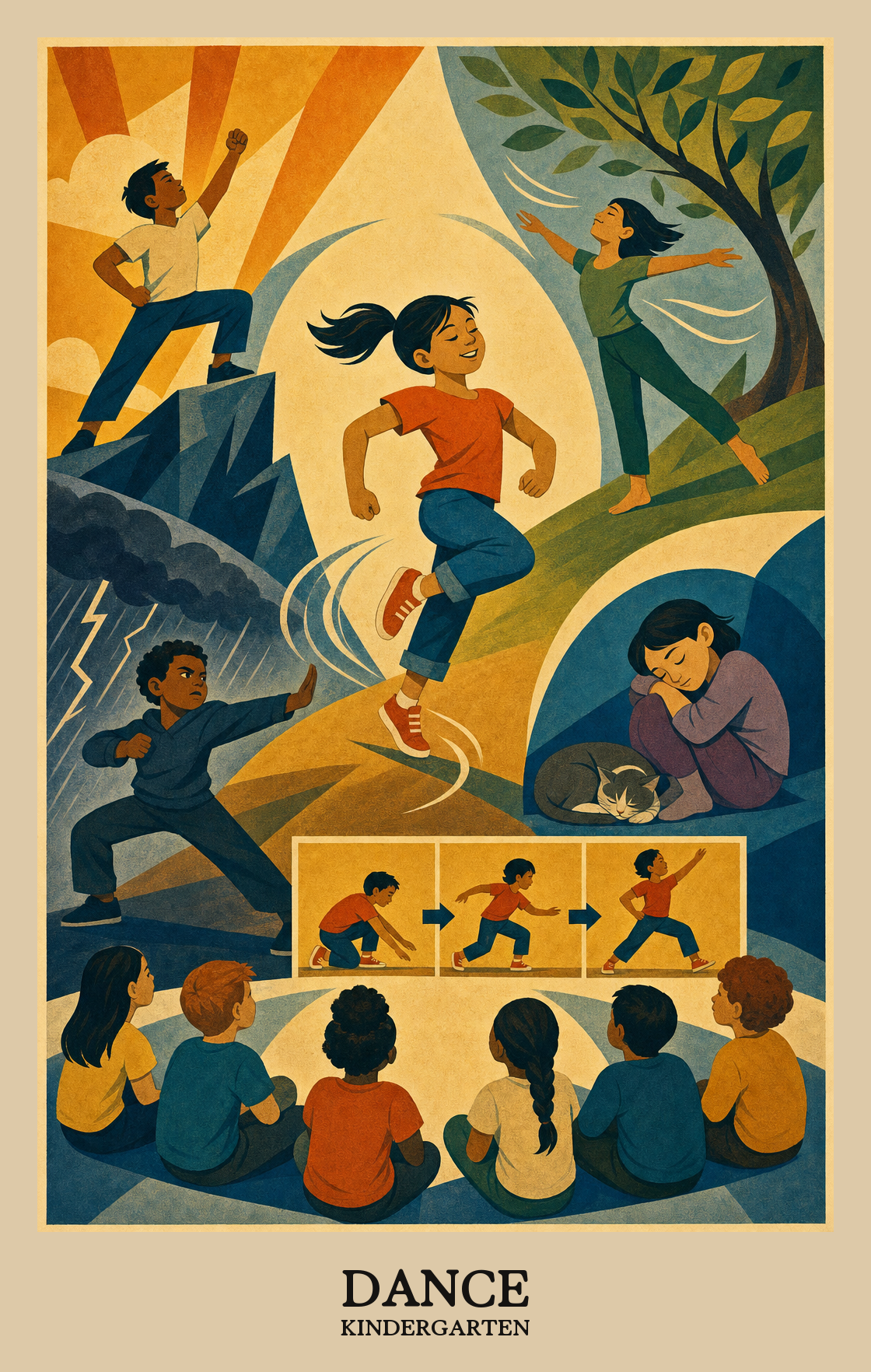
Students start the year learning how their bodies move. They try big and small movements, fast and slow, and practice using the space around them without bumping into classmates.
Students begin inventing their own movements. They pick ideas from things they know, like animals or weather, and string a few movements together into a short dance.
Students practice a dance and show it to classmates. They learn what it feels like to perform, how to start and stop, and how to use movement to share an idea or feeling.
Students watch each other dance and watch dances from different places and times. They describe what they notice and say what they liked, using simple words about movement.
Students connect something from their own life to what they're learning in dance class, then use that connection to create movement.
Dance tells stories that belong to real places and times. Students begin to notice how the dances people do connect to where they live and who they are.
| Standard | Definition | Code |
|---|---|---|
| Synthesize and relate knowledge and personal experiences to make art | Students connect something from their own life to what they're learning in dance class, then use that connection to create movement. | DA:Cn10.k |
| Relate artistic ideas and works with societal, cultural | Dance tells stories that belong to real places and times. Students begin to notice how the dances people do connect to where they live and who they are. | DA:Cn11.k |
Students make up their own movements and start to turn those ideas into a short dance. This is the first step in learning how to create something original with their bodies.
Students arrange movements they have made up into a short sequence and begin to shape it into a simple dance.
Students practice a dance movement, make small changes to improve it, and decide when it feels ready to share.
| Standard | Definition | Code |
|---|---|---|
| Generate and conceptualize artistic ideas and work | Students make up their own movements and start to turn those ideas into a short dance. This is the first step in learning how to create something original with their bodies. | DA:Cr1.k |
| Organize and develop artistic ideas and work | Students arrange movements they have made up into a short sequence and begin to shape it into a simple dance. | DA:Cr2.k |
| Refine and complete artistic work | Students practice a dance movement, make small changes to improve it, and decide when it feels ready to share. | DA:Cr3.k |
Students choose which movements or short dances to show an audience. They pick work they feel ready to perform and can explain why they chose it.
Students practice a dance movement until they can do it the way they want to show it. They learn that rehearsing helps a performance look and feel better.
Students perform a dance for others and show what the movement means to them.
| Standard | Definition | Code |
|---|---|---|
| Analyze, interpret, and select artistic work for presentation | Students choose which movements or short dances to show an audience. They pick work they feel ready to perform and can explain why they chose it. | DA:Pr4.k |
| Develop and refine artistic techniques and work for presentation | Students practice a dance movement until they can do it the way they want to show it. They learn that rehearsing helps a performance look and feel better. | DA:Pr5.k |
| Convey meaning through the presentation of artistic work | Students perform a dance for others and show what the movement means to them. | DA:Pr6.k |
Students watch a dance and talk about what they notice, such as how the dancer moves fast or slow, high or low.
Students look at a dance and share what they think it means or how it makes them feel. There is no single right answer.
Students watch a dance and say what they liked and why. They start to notice what makes movement interesting or clear.
| Standard | Definition | Code |
|---|---|---|
| Perceive and analyze artistic work | Students watch a dance and talk about what they notice, such as how the dancer moves fast or slow, high or low. | DA:Re7.k |
| Interpret intent and meaning in artistic work | Students look at a dance and share what they think it means or how it makes them feel. There is no single right answer. | DA:Re8.k |
| Apply criteria to evaluate artistic work | Students watch a dance and say what they liked and why. They start to notice what makes movement interesting or clear. | DA:Re9.k |
Students explore how their bodies can move through space. They make up short movement ideas, copy simple steps, and watch each other dance. Most of the work happens on their feet, not at a desk.
Put on music and let students invent a few moves to go with it. Ask what the dance is about, like a storm or a sleepy cat. Five minutes of free movement before dinner is plenty.
No. The focus is on exploring movement, not performing set choreography. Students learn to start, stop, change direction, and connect movement to an idea or feeling.
Start with body awareness and basic locomotor moves like walking, hopping, and tiptoeing. Then add space, speed, and shape. Save short sharing moments and simple peer feedback for the second half of the year, once students are comfortable moving in front of each other.
Students can invent a short movement based on a prompt, repeat it, and say what it was about. They can watch a classmate dance and describe one thing they noticed. That is the bar.
Stopping on cue and using personal space without bumping into classmates. Both take repeated practice with clear signals. Build short freeze games into every class until it sticks.
Students act out stories from read-alouds, show shapes with their bodies, and move to patterns and counts. Dance gives them another way to express what they already know.