Building characters and ideas
Students start the year imagining characters and story ideas, often pulling from their own lives. They try out voices, gestures, and quick scenes to see what feels true on stage.
This is the year theatre work gets intentional. Students stop just playing pretend and start making real choices about characters, scenes, and stories they want an audience to understand. They draw on their own lives and on history to shape what a play is really saying, then rehearse and revise to make it land. By spring, students can plan a short scene, perform it for classmates, and explain what they wanted the audience to feel.
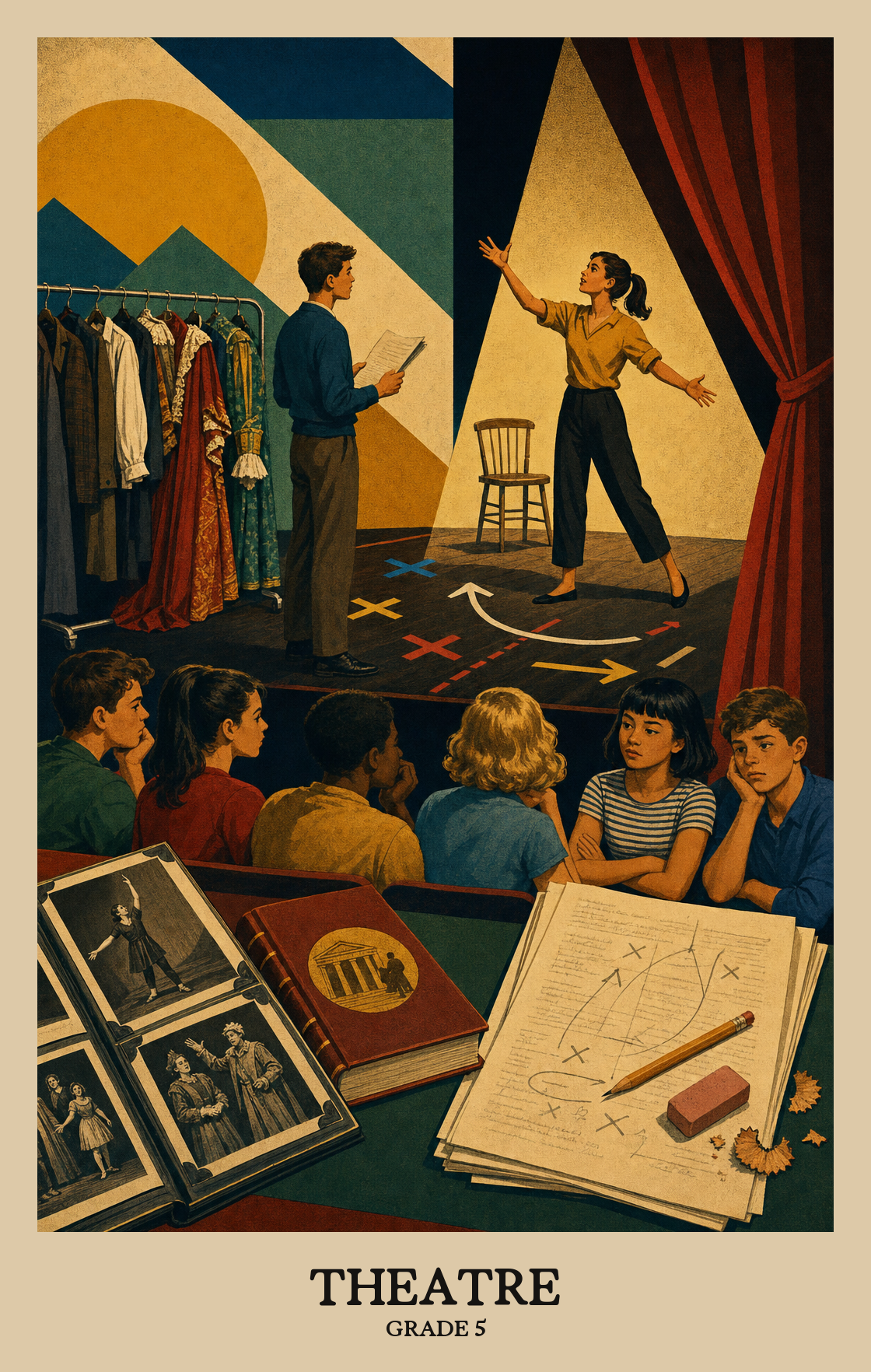
Students start the year imagining characters and story ideas, often pulling from their own lives. They try out voices, gestures, and quick scenes to see what feels true on stage.
Students work in small groups to organize ideas into scenes with a clear beginning, middle, and end. They give and take suggestions from classmates as the work takes shape.
Students pick which pieces to share and practice the acting choices that bring them to life. They sharpen voice, movement, and timing so the meaning lands for an audience.
Students perform their scenes and present their work with intention. They think about how costumes, props, or simple staging help tell the story.
Students watch performances and talk about what the artist was trying to say. They use simple criteria to explain what worked and connect the story to history, culture, or their own experience.
Students connect something from their own life to a character or scene they're creating. That personal link shapes the choices they make in the performance.
Students look at a play or performance and ask where it came from. They connect what happens on stage to the time period, culture, or community that shaped it.
| Standard | Definition | Code |
|---|---|---|
| Synthesize and relate knowledge and personal experiences to make art | Students connect something from their own life to a character or scene they're creating. That personal link shapes the choices they make in the performance. | TH:Cn10.5 |
| Relate artistic ideas and works with societal, cultural | Students look at a play or performance and ask where it came from. They connect what happens on stage to the time period, culture, or community that shaped it. | TH:Cn11.5 |
Students brainstorm characters, settings, and conflicts to build the foundation of an original scene or story. They explore "what if" questions to push those ideas further before choosing a direction for their work.
Students take a rough theatre idea and shape it into something ready to perform, making choices about characters, dialogue, and how the story unfolds.
Students revise a scene or script based on feedback, then bring the finished piece to a performance or presentation. The focus is on improving the work, not just finishing it.
| Standard | Definition | Code |
|---|---|---|
| Generate and conceptualize artistic ideas and work | Students brainstorm characters, settings, and conflicts to build the foundation of an original scene or story. They explore "what if" questions to push those ideas further before choosing a direction for their work. | TH:Cr1.5 |
| Organize and develop artistic ideas and work | Students take a rough theatre idea and shape it into something ready to perform, making choices about characters, dialogue, and how the story unfolds. | TH:Cr2.5 |
| Refine and complete artistic work | Students revise a scene or script based on feedback, then bring the finished piece to a performance or presentation. The focus is on improving the work, not just finishing it. | TH:Cr3.5 |
Students choose a scene or character to perform and explain why it fits the story and their skills as a performer.
Students practice and improve their acting, movement, and voice skills to get a performance ready to share with an audience.
Students rehearse and perform a scene, making choices about voice, movement, and character so the audience understands the story's meaning.
| Standard | Definition | Code |
|---|---|---|
| Analyze, interpret, and select artistic work for presentation | Students choose a scene or character to perform and explain why it fits the story and their skills as a performer. | TH:Pr4.5 |
| Develop and refine artistic techniques and work for presentation | Students practice and improve their acting, movement, and voice skills to get a performance ready to share with an audience. | TH:Pr5.5 |
| Convey meaning through the presentation of artistic work | Students rehearse and perform a scene, making choices about voice, movement, and character so the audience understands the story's meaning. | TH:Pr6.5 |
Students watch a scene or performance and explain what choices the actor or designer made and why those choices matter to the story.
Students explain what they think a scene or performance is really about, looking past what happens on stage to describe the choices an actor or playwright made and why those choices matter.
Students look at a scene or performance and judge how well it works, using specific reasons tied to what makes good theatre.
| Standard | Definition | Code |
|---|---|---|
| Perceive and analyze artistic work | Students watch a scene or performance and explain what choices the actor or designer made and why those choices matter to the story. | TH:Re7.5 |
| Interpret intent and meaning in artistic work | Students explain what they think a scene or performance is really about, looking past what happens on stage to describe the choices an actor or playwright made and why those choices matter. | TH:Re8.5 |
| Apply criteria to evaluate artistic work | Students look at a scene or performance and judge how well it works, using specific reasons tied to what makes good theatre. | TH:Re9.5 |
Students move beyond simple pretend play into building characters, shaping short scenes, and performing for an audience. They learn to plan a scene, rehearse it, perform it, and then talk about what worked. By spring, most can take a story idea and turn it into a short performance.
Start small and private. Read a picture book aloud together using different voices for each character, or act out a favorite scene from a movie in the living room. Confidence grows from low-pressure practice with someone who already likes them, not from being pushed onto a stage.
Begin with ensemble and improv games to build trust and listening. Move into character work and short scene writing in the middle of the year. Save staged performances and peer feedback for the back half, once students have the vocabulary to give and take notes without it stinging.
Some memorization helps, but it is not the main point at this age. The goal is to make choices about a character: how they walk, how they speak, what they want. A student who understands the scene can hold a script and still give a strong performance.
Giving useful feedback is the hardest one. Students default to saying a scene was good or bad. Spend time modeling specific language, such as naming a moment that was clear or a line that needed more volume, and revisit it every time the class watches each other perform.
Students look at where a story comes from and what life was like for the people in it. A scene set during the Civil Rights era, for example, asks students to think about the time period, not just the lines. This pulls in reading, history, and social studies in a natural way.
A ready student can take a short script, make choices about their character, rehearse with a small group, and perform without freezing. They can also watch a classmate and say something specific about the work. That mix of doing and responding is what middle school will build on.
Pick a short scene from a book or show and act it out two different ways. Try it once as written, then change one thing, such as the setting or the mood of a character. Talk about which version felt stronger and why. That small habit builds the same thinking used in class.