Exploring ideas through movement
Students start the year by turning their own experiences, stories, and observations into short movement ideas. Parents may hear about dances inspired by a memory, a picture, or a feeling.
This is the year dance becomes thoughtful, not just active. Students start shaping their own short pieces, pulling ideas from books they've read, places they've been, or moments that matter to them. They learn to revise a dance the way a writer revises a paragraph, sharpening the parts that work and cutting what doesn't. By spring, students can perform a short piece they helped create and explain what it means.
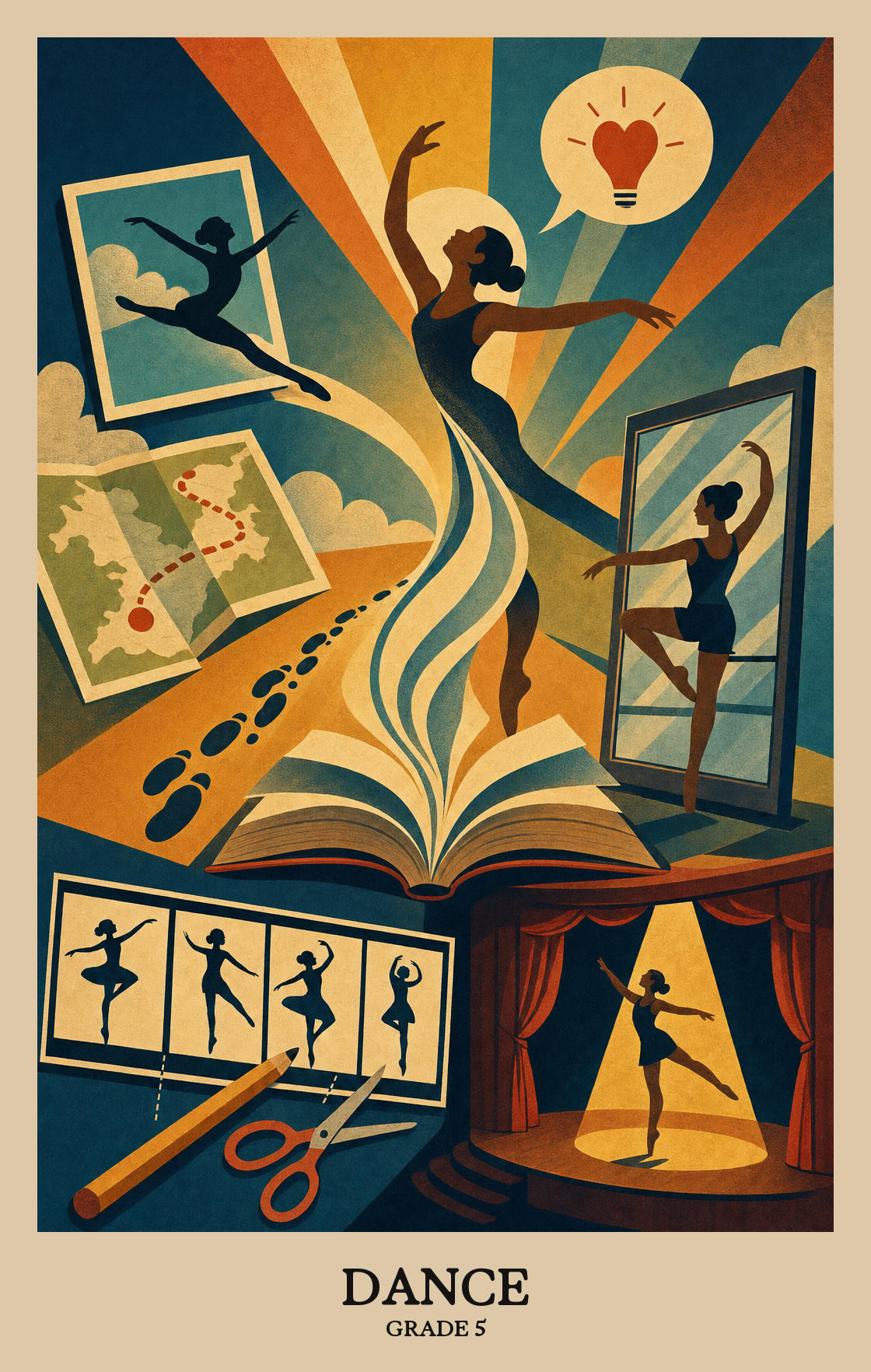
Students start the year by turning their own experiences, stories, and observations into short movement ideas. Parents may hear about dances inspired by a memory, a picture, or a feeling.
Students take their early ideas and grow them into longer pieces with a clear beginning, middle, and end. They try different choices, get feedback, and revise the parts that are not working yet.
Students focus on how they move, not just what they move. They practice balance, control, timing, and clarity so the dance reads to an audience and carries the meaning they want.
Students look at dances from different cultures, places, and time periods and notice what each one is saying. They compare those works to their own and talk about what the choreographer might have meant.
Students prepare a piece to share with an audience and use clear criteria to judge dances, including their own. They explain what worked, what did not, and what they would change next time.
Students connect their own memories and life experiences to the dances they create or study, explaining how personal moments shape the choices they make in movement.
Students look at a dance and ask where it came from: what culture made it, when, and why. That context changes how the dance looks and what it means.
| Standard | Definition | Code |
|---|---|---|
| Synthesize and relate knowledge and personal experiences to make art | Students connect their own memories and life experiences to the dances they create or study, explaining how personal moments shape the choices they make in movement. | DA:Cn10.5 |
| Relate artistic ideas and works with societal, cultural | Students look at a dance and ask where it came from: what culture made it, when, and why. That context changes how the dance looks and what it means. | DA:Cn11.5 |
Students brainstorm and develop original ideas for a dance, experimenting with movement choices before settling on a direction for their piece.
Students take a rough movement idea and shape it into a finished dance phrase, making choices about timing, spacing, and how the piece flows from start to finish.
Students revisit a dance they've been building, make specific changes to improve it, and bring it to a finished state ready to share or perform.
| Standard | Definition | Code |
|---|---|---|
| Generate and conceptualize artistic ideas and work | Students brainstorm and develop original ideas for a dance, experimenting with movement choices before settling on a direction for their piece. | DA:Cr1.5 |
| Organize and develop artistic ideas and work | Students take a rough movement idea and shape it into a finished dance phrase, making choices about timing, spacing, and how the piece flows from start to finish. | DA:Cr2.5 |
| Refine and complete artistic work | Students revisit a dance they've been building, make specific changes to improve it, and bring it to a finished state ready to share or perform. | DA:Cr3.5 |
Students choose a dance to perform and explain why it suits the audience or occasion. They think through what the movement communicates before they step on the stage.
Students practice and improve a dance piece until it is ready to share with an audience. They work on technique, timing, and how the piece looks and feels as a whole.
Students perform a dance with a clear purpose in mind, making deliberate choices about movement so the audience understands what the piece is meant to express.
| Standard | Definition | Code |
|---|---|---|
| Analyze, interpret, and select artistic work for presentation | Students choose a dance to perform and explain why it suits the audience or occasion. They think through what the movement communicates before they step on the stage. | DA:Pr4.5 |
| Develop and refine artistic techniques and work for presentation | Students practice and improve a dance piece until it is ready to share with an audience. They work on technique, timing, and how the piece looks and feels as a whole. | DA:Pr5.5 |
| Convey meaning through the presentation of artistic work | Students perform a dance with a clear purpose in mind, making deliberate choices about movement so the audience understands what the piece is meant to express. | DA:Pr6.5 |
Students watch a dance and describe what they notice: how the dancer moves, where they travel, and how the rhythm shapes the whole piece.
Students explain what a dance is trying to express, using specific movements and choices in the choreography as evidence for their interpretation.
Students use a set of criteria, like technique, expression, or use of space, to judge a dance performance and explain what makes it effective or where it falls short.
| Standard | Definition | Code |
|---|---|---|
| Perceive and analyze artistic work | Students watch a dance and describe what they notice: how the dancer moves, where they travel, and how the rhythm shapes the whole piece. | DA:Re7.5 |
| Interpret intent and meaning in artistic work | Students explain what a dance is trying to express, using specific movements and choices in the choreography as evidence for their interpretation. | DA:Re8.5 |
| Apply criteria to evaluate artistic work | Students use a set of criteria, like technique, expression, or use of space, to judge a dance performance and explain what makes it effective or where it falls short. | DA:Re9.5 |
Students move beyond copying steps and start making their own short dances. They build movement from ideas, stories, or pictures, practice with a partner or small group, and perform pieces they have shaped themselves. Watching dance and talking about what it means is just as important as performing.
Clear a small space and let students show a movement they have been working on. Ask what the dance is about and where the idea came from. Watching short dance clips together, from ballet to hip hop to folk dance, also counts and gives students new ideas to pull from.
Start with exploring movement and generating ideas, then move into shaping and refining short pieces, and end with sharing finished work. Responding skills, like watching a dance and describing what it shows, can run alongside all year. Save formal performance work for later in the year when students have material worth presenting.
No. The year focuses on making movement choices, sharing ideas, and revising work, not on natural talent. Students who think carefully about what their dance means and who keep refining it tend to grow the most.
Refining work is the hardest part. Students often want to stop once a piece is finished and resist going back to clean up shapes, timing, or transitions. Giving specific feedback and modeling small revisions helps more than asking for a full redo.
Students look at where dances come from and what they meant to the people who made them. A short unit on a cultural or historical dance form gives them a richer pool of ideas to draw on when making their own work. Plain conversations about context matter more than memorizing facts.
That reaction is normal at this age. Watch a short performance together instead of asking for one, and talk about what the dancers were trying to show. Low pressure viewing builds confidence and gives students language to describe their own work later.
Ready students can come up with a movement idea, shape it into a short piece with a clear beginning and end, perform it with focus, and talk about another dancer's work using specific words. Strength and flexibility matter less than being able to plan, revise, and explain choices.