Asking questions and weighing sources
Students start the year learning how historians and citizens work. They ask sharp questions about the past and the news, then test whether a source is trustworthy before believing it.
This is the year social studies turns into real argument. Students stop just naming events and start using evidence from old letters, speeches, maps, and news sources to back up what they think happened and why. They look closely at how our government works, how money and trade shape daily choices, and how people and places have changed over time. By spring, students can write a short argument about a historical or civic question, point to the sources they used, and explain a different point of view.
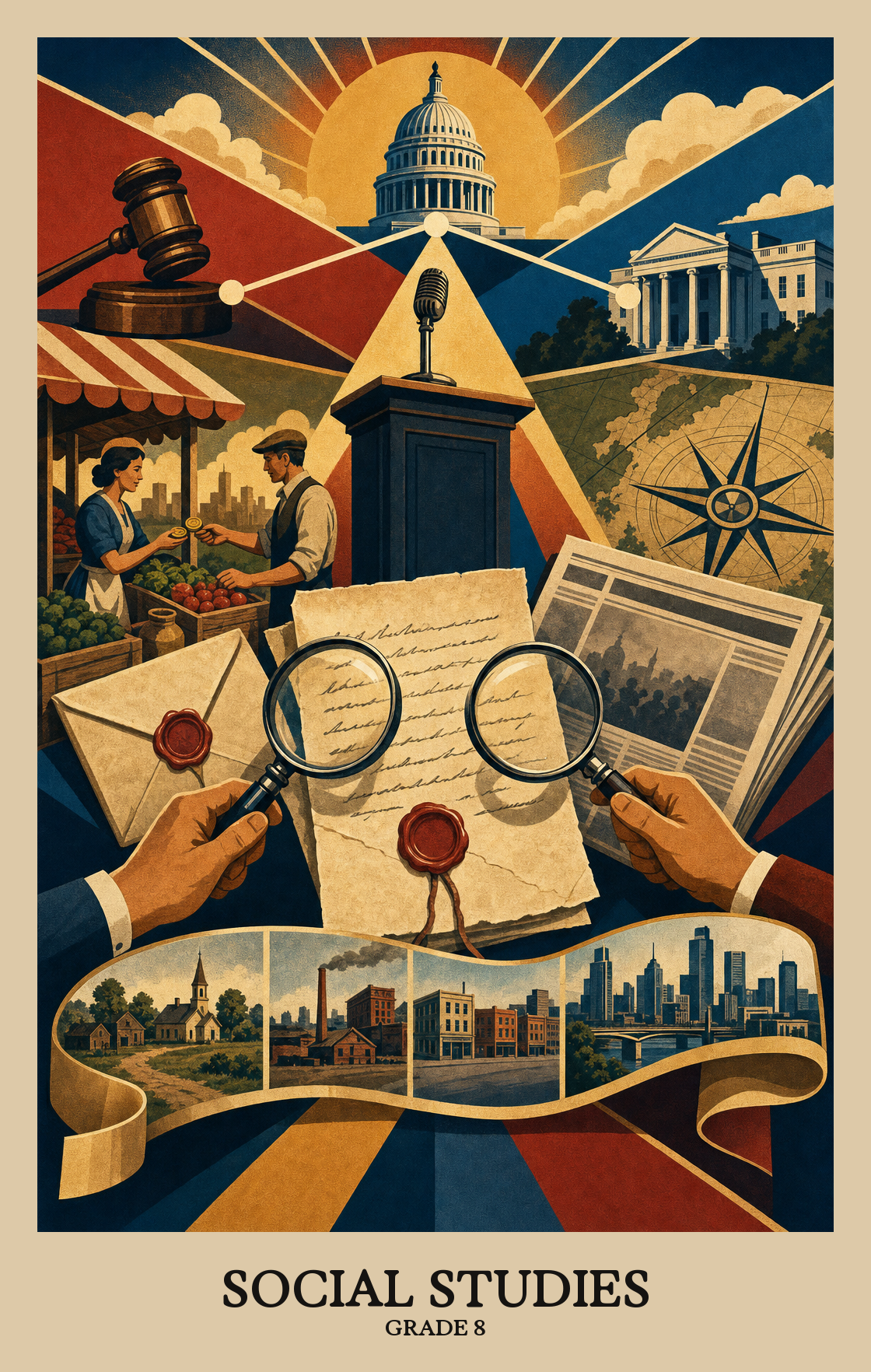
Students start the year learning how historians and citizens work. They ask sharp questions about the past and the news, then test whether a source is trustworthy before believing it.
Students dig into how DC, state, and federal government are set up and who has power to do what. They connect ideas like rule of law and civil rights to real issues in the news.
Students look at how people and countries decide what to buy, save, and trade when they cannot have everything. They also practice personal money skills like saving, credit, and budgeting.
Students read maps and photos to see how land, climate, and people shape each other. They follow how families and goods have moved between regions and what changes when cultures meet.
Students trace the country's story from colonial times to today, with a close look at the District's role. They notice what has changed, what has stayed the same, and whose voices were heard.
Students compare turning points from world history and tie them to issues today. They finish the year writing arguments backed by evidence and taking informed action in school or the community.
Students come up with a big, arguable question about a real historical or civic issue, then build smaller questions underneath it that help answer the larger one.
Students pick up real tools from civics, economics, geography, and history to answer questions about how the world works. That might mean reading a map, tracing a cause, or weighing a policy decision.
Students decide whether a source is trustworthy, then use it to back up a claim. That means checking who wrote a document, when, and why before citing it as proof.
Students share what they learned from their research, in writing, a speech, or another format, then use those conclusions to do something real: vote in a school election, speak at a meeting, or push for a change in their community.
| Standard | Definition | Code |
|---|---|---|
| Develop Questions | Students come up with a big, arguable question about a real historical or civic issue, then build smaller questions underneath it that help answer the larger one. | DC-SS.INQ.8.1 |
| Apply Disciplinary Tools | Students pick up real tools from civics, economics, geography, and history to answer questions about how the world works. That might mean reading a map, tracing a cause, or weighing a policy decision. | DC-SS.INQ.8.2 |
| Evaluate Sources and Use Evidence | Students decide whether a source is trustworthy, then use it to back up a claim. That means checking who wrote a document, when, and why before citing it as proof. | DC-SS.INQ.8.3 |
| Communicate and Take Action | Students share what they learned from their research, in writing, a speech, or another format, then use those conclusions to do something real: vote in a school election, speak at a meeting, or push for a change in their community. | DC-SS.INQ.8.4 |
Students learn how local, state, and federal government bodies are set up and what each one actually does, including how DC's government fits into that picture.
Students take core ideas behind how the U.S. government works, like divided power and equal rights under the law, and use them to explain real events from the past and present.
Students learn what rights they hold as citizens and what responsibilities come with them, then practice the skills needed to take part in democratic life, like voting, debating public issues, and engaging with government.
| Standard | Definition | Code |
|---|---|---|
| Government Institutions | Students learn how local, state, and federal government bodies are set up and what each one actually does, including how DC's government fits into that picture. | DC-SS.CIV.8.1 |
| Foundational Principles | Students take core ideas behind how the U.S. government works, like divided power and equal rights under the law, and use them to explain real events from the past and present. | DC-SS.CIV.8.2 |
| Citizenship and Participation | Students learn what rights they hold as citizens and what responsibilities come with them, then practice the skills needed to take part in democratic life, like voting, debating public issues, and engaging with government. | DC-SS.CIV.8.3 |
Scarcity means there is never enough of everything, so people make tradeoffs. Students study how those tradeoffs, and the rewards or consequences that push people toward certain choices, shape decisions at home, in businesses, and in government policy.
Markets match buyers and sellers, and prices signal where resources go. Students explain how competition shapes those prices across local and global economies.
Students learn how money decisions work in real life: when to save, when to spend, how credit and debt affect their finances, and what it means to invest money for the future.
| Standard | Definition | Code |
|---|---|---|
| Economic Decision Making | Scarcity means there is never enough of everything, so people make tradeoffs. Students study how those tradeoffs, and the rewards or consequences that push people toward certain choices, shape decisions at home, in businesses, and in government policy. | DC-SS.ECON.8.1 |
| Markets and Exchange | Markets match buyers and sellers, and prices signal where resources go. Students explain how competition shapes those prices across local and global economies. | DC-SS.ECON.8.2 |
| Personal Finance | Students learn how money decisions work in real life: when to save, when to spend, how credit and debt affect their finances, and what it means to invest money for the future. | DC-SS.ECON.8.3 |
Students read maps, photos, and location data to understand what a place looks like, how it's organized, and how people there shape and respond to their surroundings.
Students examine how things like rivers, mountains, and climate push people to build, farm, and settle in certain ways, and how those human choices then change the land itself.
Students study why people moved from one region to another, where they settled, and what they traded or shared along the way. The focus is on patterns: what made those movements happen and what changed as a result.
| Standard | Definition | Code |
|---|---|---|
| Geographic Representations | Students read maps, photos, and location data to understand what a place looks like, how it's organized, and how people there shape and respond to their surroundings. | DC-SS.GEO.8.1 |
| Human-Environment Interaction | Students examine how things like rivers, mountains, and climate push people to build, farm, and settle in certain ways, and how those human choices then change the land itself. | DC-SS.GEO.8.2 |
| Movement and Connections | Students study why people moved from one region to another, where they settled, and what they traded or shared along the way. The focus is on patterns: what made those movements happen and what changed as a result. | DC-SS.GEO.8.3 |
Students trace the major events and figures that shaped Washington, D.C., from its founding to today, and explain how the city's story connects to U.S. history as a whole.
Students map out how the United States changed and stayed the same from the colonial period to today, connecting major turning points across American history into one coherent story.
Students compare major civilizations and turning points across world history, such as empires, revolutions, and migrations, then trace how those events still shape politics, culture, and daily life today.
Students build a written argument about a historical event by pulling evidence from original documents and outside accounts, then weighing more than one point of view before reaching a conclusion.
| Standard | Definition | Code |
|---|---|---|
| District of Columbia History | Students trace the major events and figures that shaped Washington, D.C., from its founding to today, and explain how the city's story connects to U.S. history as a whole. | DC-SS.HIST.8.1 |
| United States History | Students map out how the United States changed and stayed the same from the colonial period to today, connecting major turning points across American history into one coherent story. | DC-SS.HIST.8.2 |
| World History | Students compare major civilizations and turning points across world history, such as empires, revolutions, and migrations, then trace how those events still shape politics, culture, and daily life today. | DC-SS.HIST.8.3 |
| Historical Reasoning | Students build a written argument about a historical event by pulling evidence from original documents and outside accounts, then weighing more than one point of view before reaching a conclusion. | DC-SS.HIST.8.4 |
Federally administered sample-based assessment in reading, mathematics, science, and writing. NAEP results inform state-by-state comparisons rather than individual student or school accountability.
Students study four big areas: how government works, how the economy works, how places and people shape each other, and key events in American and world history. They also learn how to ask good questions, weigh sources, and back up claims with evidence.
Tie history to something they care about. Talk about a news story at dinner and ask what led up to it, or watch a documentary clip together and ask who is telling the story and who is left out. Ten minutes of real conversation beats an hour of flashcards.
Most teachers anchor the year in United States history from colonial times to the present and weave civics, economics, and geography into each era. Inquiry skills like sourcing and argument writing should be taught early and revisited in every unit, not saved for a research project at the end.
Students can read a primary source, judge how trustworthy it is, and use it to support a written claim. They can also explain how the branches of government check each other and connect a past event to something happening now.
Some dates and names matter as anchors, but the real work is explaining why events happened and how they connect. If students can tell the story of an era in their own words and point to evidence, the dates tend to stick.
Source evaluation and evidence-based writing. Students often summarize a source instead of analyzing it, or make a claim without pointing to specific lines. Short, frequent practice with one source at a time works better than long research papers.
Bring students into real money decisions. Show a paycheck stub and talk about taxes, compare two prices at the store and explain why one is cheaper, or set a savings goal together for something they want. These small moments make saving, credit, and budgeting feel concrete.
A ready student can read a short article or speech, summarize the main argument, and say whether the evidence holds up. They can also write a short paragraph that makes a claim and backs it with two or three specific details from a source.
Use the city as a case study inside national units. When teaching the early republic, look at how the capital was planned and who built it. When teaching civil rights, look at local schools, neighborhoods, and protests. Students learn the national story better when they can walk past it.