Finding ideas to move
Students start the year by pulling movement ideas from their own lives, music they like, and things they have seen or read. They learn that a dance can begin with a feeling, a memory, or a question.
This is the year dance becomes a way to say something on purpose. Students draw on their own lives and the world around them to shape pieces with real meaning, not just steps. They sharpen their technique, rehearse with intent, and learn to give honest feedback on what works and what doesn't. By spring, students can perform a short dance they helped create and explain the idea behind it.
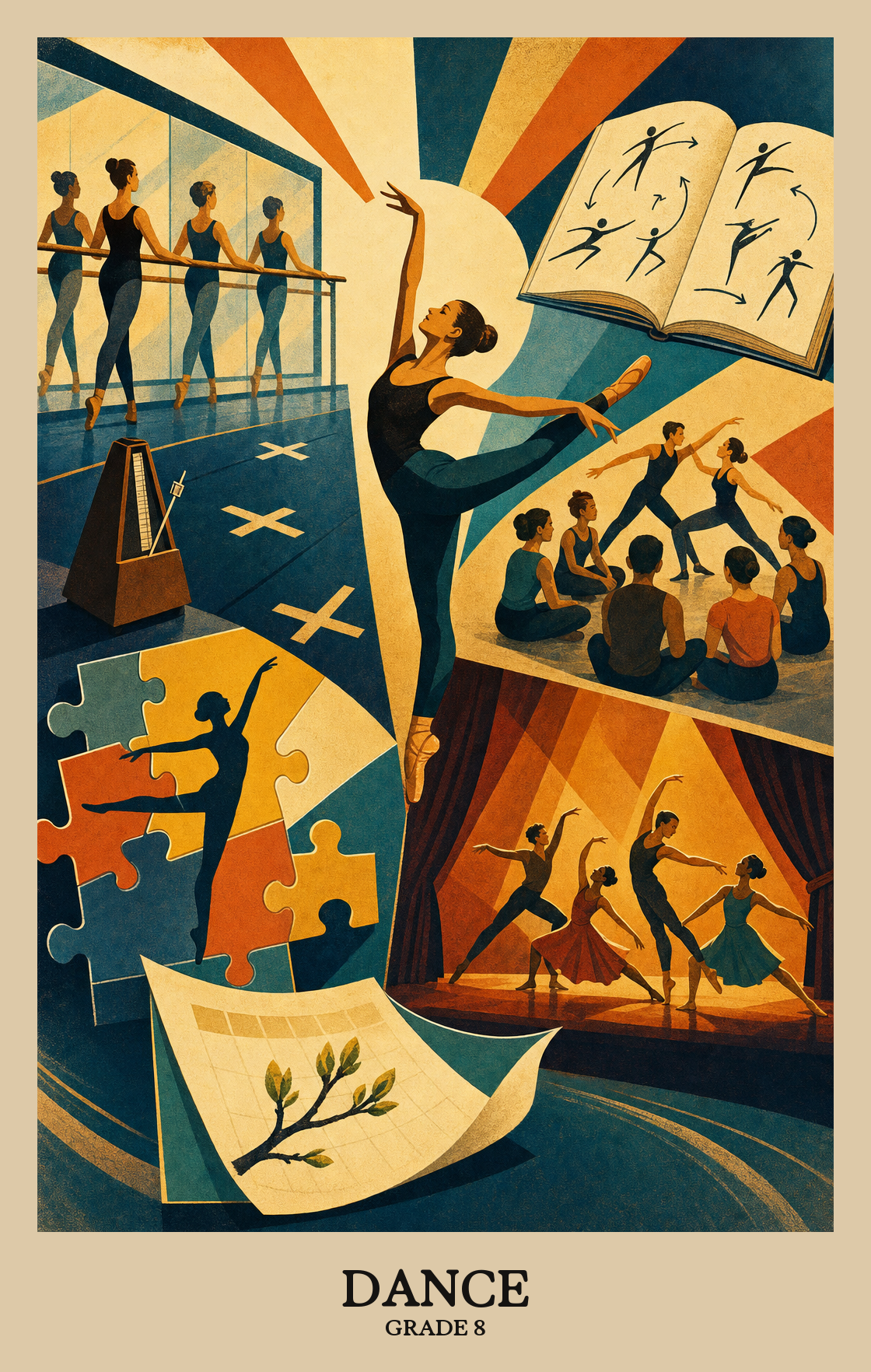
Students start the year by pulling movement ideas from their own lives, music they like, and things they have seen or read. They learn that a dance can begin with a feeling, a memory, or a question.
Students take a rough idea and shape it into a real piece. They try different orders, repeat what works, cut what does not, and use feedback from classmates to make the dance clearer.
Students work on how their bodies move, not just what they do. Balance, timing, control, and stamina all get attention so that the dance looks the way it did in their head.
Students watch dances from different cultures and time periods and talk about what the choreographer might be saying. They learn to back up their opinions with what they actually saw on stage.
Students pick a piece, get it ready for an audience, and perform it. They think about lighting, costume, and space, and they reflect on what worked and what they would change next time.
Students connect what they already know and what they've lived through to the dances they create. Personal experience becomes the raw material for artistic choices in choreography and performance.
Students look at a dance piece and ask where it came from: what culture made it, when, and why. That context changes how the dance reads and what it means.
| Standard | Definition | Code |
|---|---|---|
| Synthesize and relate knowledge and personal experiences to make art | Students connect what they already know and what they've lived through to the dances they create. Personal experience becomes the raw material for artistic choices in choreography and performance. | DA:Cn10.8 |
| Relate artistic ideas and works with societal, cultural | Students look at a dance piece and ask where it came from: what culture made it, when, and why. That context changes how the dance reads and what it means. | DA:Cn11.8 |
Students brainstorm movement ideas and shape them into a dance concept worth developing. The focus is on where creative choices come from, not just what the final piece looks like.
Students take their movement ideas and shape them into a structured dance phrase, making deliberate choices about how sections connect and build on each other.
Students revisit a dance they've been building, make specific changes based on feedback or their own judgment, and bring it to a finished, presentable state.
| Standard | Definition | Code |
|---|---|---|
| Generate and conceptualize artistic ideas and work | Students brainstorm movement ideas and shape them into a dance concept worth developing. The focus is on where creative choices come from, not just what the final piece looks like. | DA:Cr1.8 |
| Organize and develop artistic ideas and work | Students take their movement ideas and shape them into a structured dance phrase, making deliberate choices about how sections connect and build on each other. | DA:Cr2.8 |
| Refine and complete artistic work | Students revisit a dance they've been building, make specific changes based on feedback or their own judgment, and bring it to a finished, presentable state. | DA:Cr3.8 |
Students review a piece of choreography, decide what it expresses, and choose whether it is ready to perform for an audience.
Students practice and polish a dance piece until it's ready to perform in front of others, focusing on technique, timing, and the details that make the work feel finished.
Students perform a dance piece with a clear intent, making choices about movement, timing, and staging so the audience understands what the piece is about.
| Standard | Definition | Code |
|---|---|---|
| Analyze, interpret, and select artistic work for presentation | Students review a piece of choreography, decide what it expresses, and choose whether it is ready to perform for an audience. | DA:Pr4.8 |
| Develop and refine artistic techniques and work for presentation | Students practice and polish a dance piece until it's ready to perform in front of others, focusing on technique, timing, and the details that make the work feel finished. | DA:Pr5.8 |
| Convey meaning through the presentation of artistic work | Students perform a dance piece with a clear intent, making choices about movement, timing, and staging so the audience understands what the piece is about. | DA:Pr6.8 |
Students watch a dance performance and break down how the choreographer used movement, timing, and space to build meaning. They explain what choices stand out and why those choices work.
Students analyze a dance performance and explain what the choreographer was trying to communicate, using specific movements or patterns as evidence.
Students use a set of criteria, like a rubric or a checklist, to judge a dance and explain in specific terms why it works or where it falls short.
| Standard | Definition | Code |
|---|---|---|
| Perceive and analyze artistic work | Students watch a dance performance and break down how the choreographer used movement, timing, and space to build meaning. They explain what choices stand out and why those choices work. | DA:Re7.8 |
| Interpret intent and meaning in artistic work | Students analyze a dance performance and explain what the choreographer was trying to communicate, using specific movements or patterns as evidence. | DA:Re8.8 |
| Apply criteria to evaluate artistic work | Students use a set of criteria, like a rubric or a checklist, to judge a dance and explain in specific terms why it works or where it falls short. | DA:Re9.8 |
Students build their own short dances from an idea, a feeling, or a story they care about. They also learn to perform with control, watch other dancers carefully, and explain what a piece is trying to say. The work feels closer to art class than gym class.
Make space for movement and curiosity. Watch short dance clips together and ask what the dancer might be feeling or showing. If a student is choreographing something, be an audience for a one-minute draft and ask one honest question about it.
Students can take an idea and shape it into a short dance with a clear beginning, middle, and end. They can perform it with intention, talk about why they made the choices they made, and give specific feedback on someone else's piece using shared criteria.
Start with short improvisation tasks that generate movement material, then move into shaping and refining those ideas into longer pieces. Layer in feedback cycles and revision earlier than feels comfortable. By spring, students should be drafting, rehearsing, and revising work that has a clear point of view.
It is common at this age and not a red flag. Most of the year is rehearsal, peer sharing, and small-group work, not big stage moments. Encouraging a student to share a short piece with one trusted person at home builds confidence faster than pushing for a full performance.
Refining and revising. Students often want to finish a piece after the first draft and resist going back to fix transitions, timing, or intent. Plan to model revision explicitly and protect class time for second and third passes on the same work.
They use shared criteria to describe what they see and what it might mean, then back it up with specifics from the performance. Watching short clips together and asking what choices the choreographer made helps a lot. The goal is honest, specific responses, not polite ones.
Pair a short movement study with the context that shaped it, then ask students to respond through their own choreography. A five-minute clip and a guiding question often does more than a slide deck. Let students pull in dance forms from their own communities too.
A ready student can generate movement ideas without waiting to be told what to do, shape those ideas into a short piece, and revise based on feedback. They can also watch a performance and say something specific about intent and craft, not just whether they liked it.