Sketching ideas from life
Students start the year by turning their own memories and everyday moments into drawings. They learn to gather ideas in a sketchbook before picking one to develop into a finished piece.
This is the year art becomes intentional. Students start with a plan, choose materials on purpose, and revise their work instead of calling the first try done. They also learn to talk about art, explaining what a piece might mean and why an artist made certain choices. By spring, students can finish a piece they planned, prepare it for display, and say a few clear sentences about what it shows.
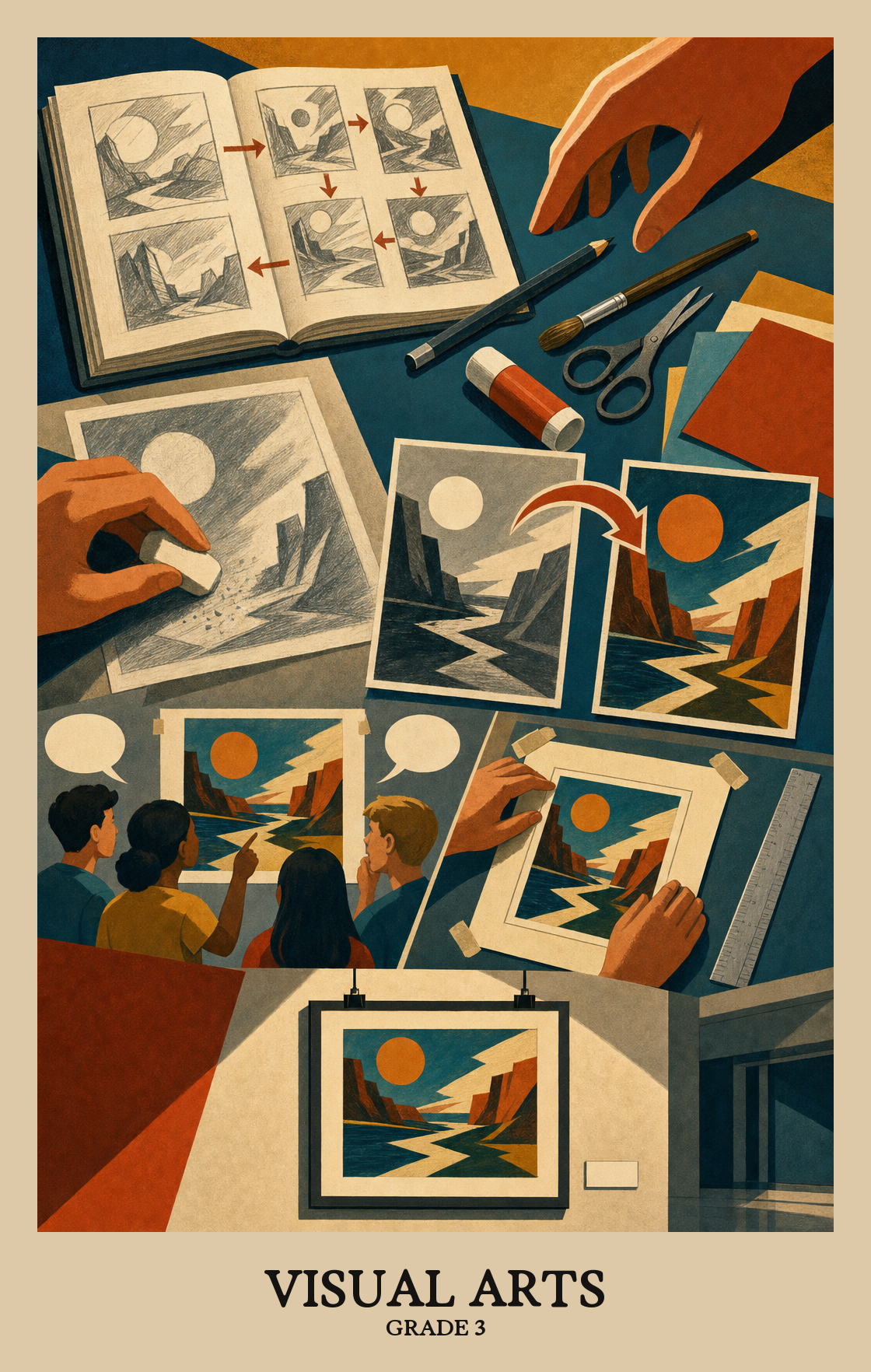
Students start the year by turning their own memories and everyday moments into drawings. They learn to gather ideas in a sketchbook before picking one to develop into a finished piece.
Students practice with pencils, paint, clay, and collage. They learn how each tool works and how to plan a piece so the materials match the idea they want to show.
Students study artwork from different cultures and time periods. They notice why the artist made certain choices and use those ideas to shape their own projects.
Students learn that a first try is rarely the final piece. They look at their work with fresh eyes, decide what to fix, and polish a project until it says what they meant.
Students choose which work to display and think about how to present it so a viewer understands the message. They also practice talking about what other artists' pieces might mean.
Students draw on things they already know and moments from their own life to make choices about what to create and how.
Students look at a painting, sculpture, or craft and think about when and where it was made, who made it, and why. That context helps explain what the artwork means.
| Standard | Definition | Code |
|---|---|---|
| Synthesize and relate knowledge and personal experiences to make art | Students draw on things they already know and moments from their own life to make choices about what to create and how. | VA:Cn10.3 |
| Relate artistic ideas and works with societal, cultural | Students look at a painting, sculpture, or craft and think about when and where it was made, who made it, and why. That context helps explain what the artwork means. | VA:Cn11.3 |
Students brainstorm ideas for their own artwork, then choose a direction and start making something. The focus is on where creative ideas come from and how students develop them into a plan.
Students plan and refine a piece of art before calling it finished, making choices about color, shape, and composition along the way.
Students review their own artwork, make changes to improve it, and decide when a piece is finished.
| Standard | Definition | Code |
|---|---|---|
| Generate and conceptualize artistic ideas and work | Students brainstorm ideas for their own artwork, then choose a direction and start making something. The focus is on where creative ideas come from and how students develop them into a plan. | VA:Cr1.3 |
| Organize and develop artistic ideas and work | Students plan and refine a piece of art before calling it finished, making choices about color, shape, and composition along the way. | VA:Cr2.3 |
| Refine and complete artistic work | Students review their own artwork, make changes to improve it, and decide when a piece is finished. | VA:Cr3.3 |
Students look at several pieces of their own artwork, talk about what each one shows, and choose the piece that best represents their work to share with others.
Students practice and improve a piece of artwork before sharing it with others. They learn to look at their own work carefully and make changes that strengthen it.
Students choose how to display their artwork and explain what they want it to say to someone looking at it.
| Standard | Definition | Code |
|---|---|---|
| Analyze, interpret, and select artistic work for presentation | Students look at several pieces of their own artwork, talk about what each one shows, and choose the piece that best represents their work to share with others. | VA:Pr4.3 |
| Develop and refine artistic techniques and work for presentation | Students practice and improve a piece of artwork before sharing it with others. They learn to look at their own work carefully and make changes that strengthen it. | VA:Pr5.3 |
| Convey meaning through the presentation of artistic work | Students choose how to display their artwork and explain what they want it to say to someone looking at it. | VA:Pr6.3 |
Students look closely at a piece of art and describe what they notice, from colors and shapes to the mood the artist created.
Students look closely at a drawing, painting, or sculpture and explain what they think the artist was trying to say or show.
Students look at their own artwork or a classmate's and use a set of questions or rules to explain what works well and what could be stronger.
| Standard | Definition | Code |
|---|---|---|
| Perceive and analyze artistic work | Students look closely at a piece of art and describe what they notice, from colors and shapes to the mood the artist created. | VA:Re7.3 |
| Interpret intent and meaning in artistic work | Students look closely at a drawing, painting, or sculpture and explain what they think the artist was trying to say or show. | VA:Re8.3 |
| Apply criteria to evaluate artistic work | Students look at their own artwork or a classmate's and use a set of questions or rules to explain what works well and what could be stronger. | VA:Re9.3 |
Students make art on purpose this year, not just for fun. They plan an idea, pick materials that fit it, and finish a piece they can talk about. They also start looking closely at other people's art and saying what they notice and what it might mean.
Keep a small sketchbook or a stack of scrap paper around and let students draw from real life. Ask what they noticed today, then suggest they draw it. Ideas come easier when students have something specific to look at, like a pet, a meal, or a window view.
Praise the choices, not the talent. Point out a color they picked, a line that looks careful, or a part they spent time on. Students this age are learning that art takes drafts and fixes, so it helps when adults treat a messy first try as normal.
No. Pencils, crayons, markers, glue, scissors, and paper cover almost everything. Cereal boxes, junk mail, and old magazines work well for cutting and collage. The point is practice and choices, not nice materials.
Build each unit around one making project and one looking task tied to the same idea, such as portraits, neighborhoods, or weather. Front-load idea generation and planning early in the year, then push refinement and artist statements as students get more comfortable finishing work.
Planning before making is the big one. Students want to jump straight to the final paper, so sketching options and picking the best one needs steady practice. Talking about meaning in someone else's art also takes modeling, since students often stop at what they like or do not like.
Ask one slow question: what part are you proud of, and what part do you want to fix? Then give them five more minutes to change one thing. Small revisions teach more than starting over.
Pair each making project with one or two real artworks from different times or places, and ask students what they notice before sharing context. Keep background short and tied to choices the artist made. Students remember the art when they have already looked hard at it.
By spring, students should be able to plan an idea, pick materials with a reason, finish a piece, and say what it means. They should also be able to look at another artist's work and point to specific parts that carry the meaning.